CreditMarket noteWednesday 14 October 2026, 06:58
Bank of America fine: $1.2bn for failing to report $5bn of suspicious payments
The Bank of America fine is the third-largest in Treasury history. The bank admits it relied on police and other banks to spot money laundering for it.
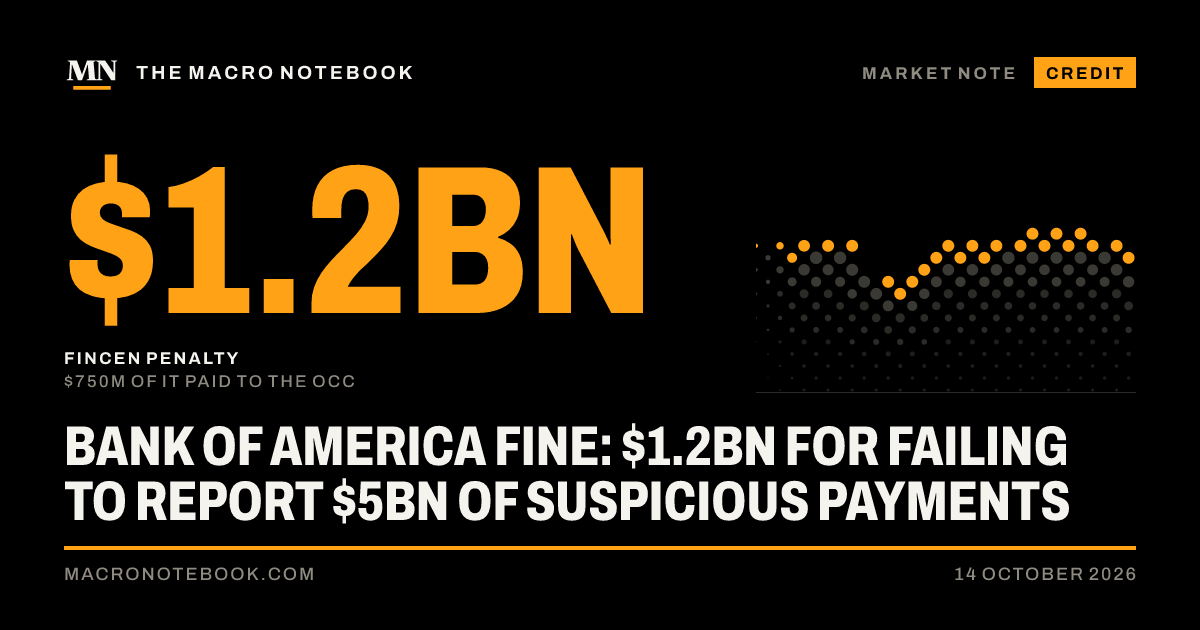
The US Treasury fined Bank of America $1.2bn on Tuesday for failing to stop money laundering, the third-largest penalty in the Treasury’s history. The Bank of America fine comes from the Financial Crimes Enforcement Network (FinCEN), which says the bank failed to report in time more than $5bn of suspicious transactions, over $1bn of them linked to national-security risks such as Chinese money-laundering networks and illicit finance along the south-west border, the Treasury said. The Office of the Comptroller of the Currency (OCC), which supervises national banks, added a $750m penalty, the largest in its history.
The two penalties overlap. FinCEN credits the $750m paid to the OCC against its own, so Bank of America pays $450m to the Treasury on top, FinCEN’s consent order says. A separate $11.6m settlement with the Office of Foreign Assets Control covers sanctions breaches. In all, the Treasury puts the penalties at more than $1.21bn.
What Bank of America admits
The bank admits that it wilfully broke the Bank Secrecy Act, the main US law against money laundering, between at least January 2018 and July 2025. It failed to run an adequate anti-money-laundering programme, to check the foreign banks that held accounts with it, and to file suspicious activity reports, the notices that banks must send to FinCEN within 30 days of spotting a suspect payment.
The order’s sharpest finding is about how the bank found suspicious activity at all. It leaned on enquiries from law enforcement and requests from other banks rather than on its own automated controls, and so “effectively outsourced to third parties” much of its duty to detect and report, the Treasury says. Suspicious activity piled up for long periods without investigation, and the reports that were filed came too late to be of much use. As these problems arose, the bank “prioritized its revenues and minimized the impact on its required compliance resources”.
Its own tests showed the gap. The bank lowered the score at which its monitoring system flags activity for investigation. In 2024 a one-off review of past activity under the new settings led it to file over 8,000 reports covering about $3.96bn of suspicious activity that it had not reported before, the order says. The bank expected the change to add 16,000 investigations a month in the US, double the previous volume.
Why the Bank of America fine is so large
Size is part of it. Bank of America is the second-largest bank in the United States, with about $2.7tn of assets, FinCEN notes, and its monitoring system failed to watch “trillions of dollars in transactions” properly, the OCC found. The other part is the record after the regulators had already acted. The OCC ordered the bank to fix its anti-money-laundering programme in December 2024. More than a year later, the Treasury says, the bank still failed to send suspicious activity to its investigators, and it processed possible trade-based money laundering because of a gap in its monitoring.
The fine is smaller than the $1.3bn FinCEN imposed on TD Bank in October 2024, which FinCEN called the largest penalty against a deposit-taking bank in Treasury and FinCEN history. TD Bank also had to accept a four-year independent monitor. Bank of America is the second large US lender punished for money-laundering failures this month, after American Express, as we reported on 9 October. Bank of America instead must hire a third party to look back for missed suspicious transactions and report them, and submit to independent reviews of its monitoring, its customer checks and its data.
Sanctions breaches too
The OFAC settlement covers 475 apparent breaches of US sanctions on Russia, Belarus, Iran, Burma, Somalia, drug traffickers and terrorist groups. The bank routed payments through blocked banks, let people on the sanctions list make payments and withdraw cash because its alerts were poorly set, and was slow to update its watchlists after new designations. OFAC judged the breaches non-egregious but said the bank had largely not disclosed them itself, and it gave no reduction for cooperation or for the fixes the bank had made.
What to watch
For a bank of Bank of America’s size the money is manageable. The larger cost is the work the order demands: the lookback, the reviews and a monitoring system that finds suspicious payments without being told. The Treasury framed the case as a warning to other large banks, saying “even the biggest financial institutions are not above the law”. The next reviews of the bank’s programme will show whether the December 2024 order is finally met.
Disclosure
This is analysis and opinion, not investment advice.
WeeklyThe Notebook by email
The week, in one email
Once a week: the stories we published, and the releases and decisions due in the week ahead. Free. One click stops it.
We email you a link to confirm. By signing up, you agree to the Terms and the Privacy policy.
Check your email. We sent a link to . Open it within 15 minutes to confirm.
You are signed in as . You can change this on your Saved page.
You get the weekly email. To stop it, use the link at the end of any of them, or your Saved page.