GeopoliticsMarket noteTuesday 13 October 2026, 06:09
Energy ceasefire: the US threatens Ukraine's weapons supply over refinery strikes
Trump declared an energy ceasefire as US officials threatened to cut Ukraine's arms and intelligence unless it stops striking Russian refineries, the FT says.
The United States has threatened to cut off the system that supplies Ukraine with American weapons unless Kyiv stops striking Russian oil refineries, the Financial Times reported on Sunday, citing officials in Europe, on the day Donald Trump declared an energy ceasefire. The message included threats to end intelligence sharing and the Prioritised Ukraine Requirements List, or Purl, the mechanism through which Ukraine’s allies buy US weapons for it, according to Reuters. US officials were lobbying European capitals as well as Kyiv. “They are calling everyone,” one official told the newspaper. Reuters could not verify the report, and the White House did not comment.
Neither side had confirmed the truce. “Effective immediately, there is an ENERGY CEASEFIRE in the War between Russia and Ukraine. Both parties have agreed. Do not break it!” Trump wrote on Truth Social. Volodymyr Zelensky told Axios that the ceasefire “was news for me”, CBS News reported. The Kremlin said only that “contacts are ongoing”, and Ukrainian officials said Russia struck an energy site near Kharkiv in the hours after the post, according to NBC News.
Diesel is behind the pressure
The White House wants the refinery strikes stopped because of fuel prices, three weeks before the midterm elections. Trump has blamed Kyiv for high diesel prices in the US, and on Saturday he said Ukraine should get “a new leader who can make a deal”.
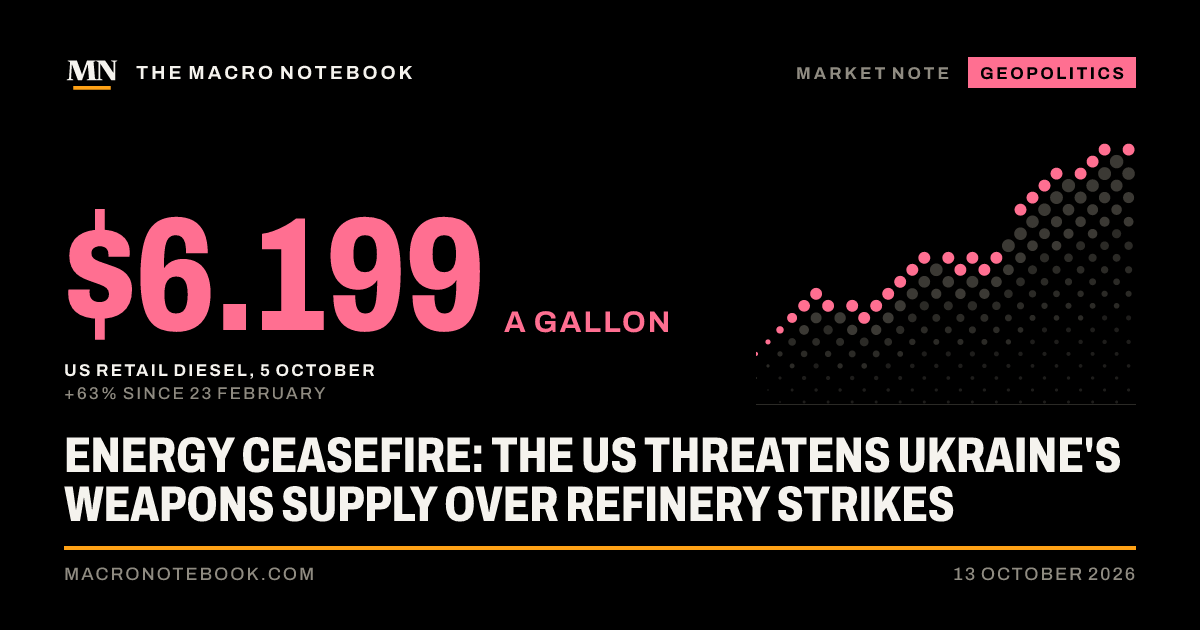
The prices are real. The average US retail price of diesel was $6.199 a gallon on 5 October, the Energy Information Administration’s weekly survey shows. That is 63% above the $3.809 of 23 February, the month the US went to war with Iran. It peaked at a record $6.529 on 21 September and has fallen 33 cents since. The next figures are due on 14 October.
Zelensky put the blame elsewhere. It is easy to link prices with Ukraine, he told ABC News, “when everybody in the world understands” that the war in the Middle East is pushing them up. On Friday the US licensed imports of Russian diesel, which Trump says will start with 300,000 tonnes, followed by 500,000 tonnes in November and more later. As we reported on 12 October, the first cargo covers about 14 hours of US use.
Why Kyiv keeps striking despite the energy ceasefire
The strikes are part of a war that has moved into the air. The two armies are largely deadlocked on the front line, more than four and a half years after the full-scale invasion, and Russia and Ukraine now fight a long-range war of drones and missiles, CBS noted. Shortly before Trump’s post, Zelensky had vowed to keep striking Russian refineries.
The campaign is not limited to oil. On Sunday a Ukrainian drone attack shut a data centre run by Yandex in the city of Vladimir, east of Moscow, the third strike on the company’s sites in four days, CBS reported. Outages spread to taxi and banking services in dozens of Russian cities.
Zelensky has offered a trade. “We are ready for energy ceasefire, not to attack energy — both sides,” he told ABC. In other words, Ukraine would stop hitting Russian refineries if Russia stopped hitting Ukraine’s power plants. Trump made a similar announcement a month ago, NBC noted, and both sides kept attacking.
Europe is caught in between
Europe’s governments are being asked to choose between Washington and Kyiv. Andy Burnham, the British prime minister, backed a mutual halt. “Ukraine is ready if Russia stops its attacks,” he wrote. “This is the best route to get energy and fuel back into world markets.” Mark Carney, Canada’s prime minister, also supported an energy ceasefire but denounced the US deal on Russian diesel, saying it undermined efforts to end the war.
Opposition is growing in Washington too. Six US senators, four Republicans and two Democrats, called on the administration to “immediately reverse course” on buying Russian diesel. They said it had not consulted Congress or explained its decision, as the law requires.
The threat reaches Europe because Purl is the channel through which allies’ money buys American weapons for Ukraine. Closing it would hit the governments that pay as well as the army that receives.
What to watch
Moscow has not confirmed the ceasefire, and Ukraine says Russian strikes on its energy sites have not stopped. The next Ukrainian strike on a Russian refinery will show whether Kyiv has accepted the American terms. The International Energy Agency’s governing board meets on 15 October to discuss releasing more diesel from emergency stocks, which we cover in a separate item today. The EIA’s weekly survey on 14 October will show whether US diesel prices are still falling.
Disclosure
This is analysis and opinion, not investment advice.
WeeklyThe Notebook by email
The week, in one email
Once a week: the stories we published, and the releases and decisions due in the week ahead. Free. One click stops it.
We email you a link to confirm. By signing up, you agree to the Terms and the Privacy policy.
Check your email. We sent a link to . Open it within 15 minutes to confirm.
You are signed in as . You can change this on your Saved page.
You get the weekly email. To stop it, use the link at the end of any of them, or your Saved page.