GeopoliticsMarket noteTuesday 13 October 2026, 06:15
EU-China hybrid deal: imports capped at 350,000 a year, less than half this year's
China will hold hybrid car exports to the EU to 350,000 a year from December, against about 800,000 this year. The EU's deficit with China was €372bn in 2025.
China has agreed to cut its exports of hybrid and plug-in hybrid cars to the European Union by more than half, Maroš Šefčovič, the EU’s trade commissioner, said in Beijing on Friday after the second round of EU-China trade talks. “By this step we are actually preventing several millions of car exports from China to the European Union,” he said, The Next Web reported.
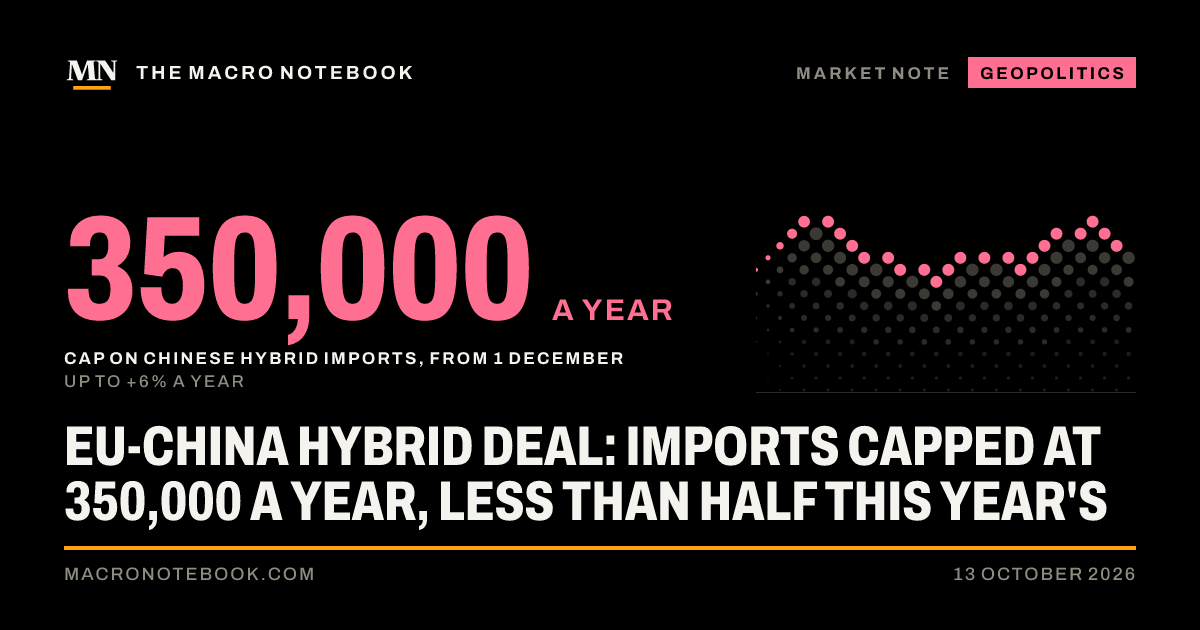
On Monday a Commission official put numbers on the deal. Imports of Chinese hybrids and plug-in hybrids will be capped at 350,000 vehicles a year from 1 December, rising by up to 6% a year, electrive reported. The Commission expects about 800,000 to arrive from China this year, so the cap is less than half of that.
The written text is vaguer. “Both sides have reached an understanding on trade in hybrid vehicles in a WTO compliant manner,” says the joint statement issued by Šefčovič and Wang Wentao, China’s commerce minister. It gives no volumes, no dates and no mechanism. EU leaders still have to back the deal at the European Council on 15 and 16 October.
Why Brussels wanted a limit on Chinese hybrids
Chinese carmakers have taken a large share of Europe’s hybrid market very quickly. In the first half of 2026 Chinese brands had 14% of European sales of hybrid cars, up from 2% in 2024, and 25% of plug-in hybrid sales, also up from 2%, according to ACEA, the European carmakers’ association.
Hybrids were the easier route in. Fully electric cars from China have paid extra anti-subsidy duties since October 2024, while hybrids and plug-in hybrids pay only the standard 10% duty on cars, electrive noted. Sigrid de Vries, ACEA’s director-general, warned of “a sharp and sudden destabilisation of the market in Europe, along with price wars that mirror the current market situation in China”. The deal, she said, can help “facilitate the transition to a new era of Chinese presence in the European market in an orderly way”.
China gets something in return, and so do other European exporters. Beijing will cut tariffs on some EU goods, including car parts, olive oil and footwear, exports worth almost €4bn, saving at least €225m in duties, The Next Web reported. It will also keep fast-tracking export licences for rare earths and permanent magnets, the joint statement says.
The deficit the deal does not touch
The car deal is a small part of a much larger imbalance. In 2025 the EU imported €571.0bn of goods from China and exported €199.5bn, Eurostat data show. The deficit of €371.6bn was 24% larger than in 2023 and works out at about €1bn a day. It is still growing: in the first seven months of 2026 it reached €238.1bn, 12% more than a year earlier.
The tariff cuts China offered cover exports worth about 1% of last year’s deficit, by our calculation. “It is unsustainable and it demands a credible path to rebalancing,” Šefčovič said of the gap. He called the Beijing results “only a first step”, and said the EU would use its trade tools where talks fail to deliver.
Can it be legal?
The deal raises a legal question. The WTO’s Agreement on Safeguards says that a member “shall not seek, take or maintain any voluntary export restraints, orderly marketing arrangements or any other similar measures”, in Article 11. A cap that China applies to its own exports, at the request of an importer, looks much like such a restraint. Both sides insist the arrangement is WTO compliant, but neither has published how the cap will work, which is where the answer lies.
What to watch
EU leaders meet on 15 and 16 October; if they back the deal, the Commission will start the procedures to put it in place, electrive reported. Officials will hold a video conference in January, and the third round of talks is planned for March 2027. Eurostat’s next monthly figures will show whether the deficit kept widening over the summer.
Disclosure
This is analysis and opinion, not investment advice.
WeeklyThe Notebook by email
The week, in one email
Once a week: the stories we published, and the releases and decisions due in the week ahead. Free. One click stops it.
We email you a link to confirm. By signing up, you agree to the Terms and the Privacy policy.
Check your email. We sent a link to . Open it within 15 minutes to confirm.
You are signed in as . You can change this on your Saved page.
You get the weekly email. To stop it, use the link at the end of any of them, or your Saved page.