CommoditiesMarket noteThursday 15 October 2026, 07:50
IEA Oil Market Report: oil demand to fall 2.6m barrels a day
The IEA's October Oil Market Report sees oil demand falling 2.6m barrels a day in 2026. Gulf supply is back, but stocks are 509m barrels below pre-war levels.
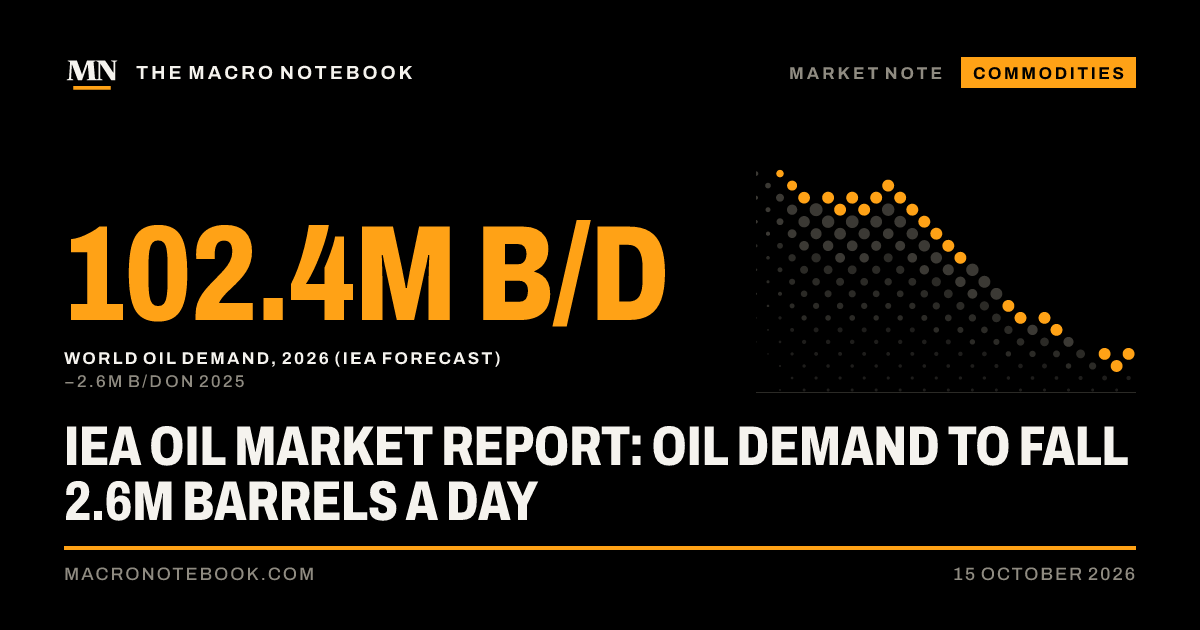
The world will use 2.6m barrels of oil a day less this year than last, the International Energy Agency said on Wednesday in its October Oil Market Report. Demand is set to average 102.4m barrels a day in 2026 as the Iran war shows up in scarce fuel, record diesel prices and a weaker economic outlook. Diesel accounts for a quarter of the drop.
The report is less gloomy about supply. Gulf producers pumped hard in September and global output rose by 2.5m barrels a day in the month, to 102.3m. But the agency warns that the recovery is fragile, that the market stays in deficit until the end of the year, and that diesel will stay short well into 2027.
The IEA’s oil demand forecast
The fall in demand is easing. Oil use was 5m barrels a day lower than a year earlier in the second quarter and 3.7m lower in the third. The IEA expects a gap of 2.5m in the fourth quarter. High prices and a deteriorating economic outlook in some countries weigh on consumption, it says.
The IEA expects a partial recovery of 2m barrels a day in 2027. That would still leave world oil use 620,000 barrels a day, or 0.6%, below its 2025 level.
Gulf supply is back, but not its fuel
Crude exports from Gulf producers, led by Saudi Arabia, jumped by 4.4m barrels a day to 13.9m in September, more than 75% of their pre-war level. Total oil flows through the Strait of Hormuz rose by 3.7m barrels a day to 10.9m, helped by ship-to-ship transfers in the Gulf of Oman. Exports that bypass the strait, such as those through Saudi Arabia’s East-West pipeline, rose to 5.6m barrels a day.
Refined fuels have not followed. Shipments of products from the Middle East rose to 1.9m barrels a day in September, against 4.7m before the war, and LPG to 670,000 against 1.5m. With lower supply from Russia and some Asian countries as well, the world had 1.7m barrels a day less diesel and gasoil in the third quarter than a year earlier, the IEA estimates.
For the year as a whole, the agency expects oil supply to fall by 5.8m barrels a day, to 100.7m, before rising by 7.7m in 2027. It left its projections for the rest of this year largely unchanged because of the Houthi attacks in the region in October.
Stocks are running down
The buffers are thinning. Global observed oil stocks fell by 10m barrels in September. On-land stocks fell by 113m barrels, while oil on water rose by 103m as Gulf exports surged. OECD stocks dropped by 37m barrels. Non-OECD crude stocks fell by 76m barrels, with China accounting for 78% of that decline.
By the end of September, global stocks were 509m barrels below their level at the end of February, before the war began. On-land stocks are at their lowest since at least 2016. Without a resolution to the conflicts in the Middle East, the IEA says, oil markets “may experience more turmoil in the months ahead before any eventual surplus emerges in 2027”.
Diesel is the tightest corner. Wholesale diesel passed $200 a barrel in Singapore in mid-September and reached all-time highs of around $220 in Europe and the United States. Prices have eased since but remain nearly double the price of crude. Even with refineries running harder towards the end of the year, gasoil supply falls short of demand in the fourth quarter, and the agency does not expect lost stocks to be rebuilt before the second half of 2027.
Prices and what to watch
North Sea Dated, the physical benchmark, rose by $26.17 to an average of $116.89 a barrel in September, after the 11 September bombing of the Saudi East-West pipeline and a surge in freight rates. At the time of writing it traded around $134. Brent futures had risen 13% since the start of September, to about $107. The gap shows how much more buyers pay for oil they can get now.
The IEA’s governing board meets on 15 October. Before the meeting, the agency’s head, Fatih Birol, asked members to release emergency diesel stocks faster, the IEA said on 11 October. As we reported on 13 October, countries that have not yet delivered the stocks they pledged in March were asked to speed up. The next Oil Market Report is due in November. The figures to watch are Gulf export flows after the October attacks, and whether on-land stocks keep falling into winter.
Disclosure
This is analysis and opinion, not investment advice.
WeeklyThe Notebook by email
The week, in one email
Once a week: the stories we published, and the releases and decisions due in the week ahead. Free. One click stops it.
We email you a link to confirm. By signing up, you agree to the Terms and the Privacy policy.
Check your email. We sent a link to . Open it within 15 minutes to confirm.
You are signed in as . You can change this on your Saved page.
You get the weekly email. To stop it, use the link at the end of any of them, or your Saved page.