PolicyMarket noteTuesday 13 October 2026, 06:16
IMF World Economic Outlook: growth slows to 3.1% as inflation rises to 4.7%
The IMF's October World Economic Outlook sees global growth of 3.1% in 2026 and 3.4% in 2027. AI investment offsets the energy shock, but inflation is rising.
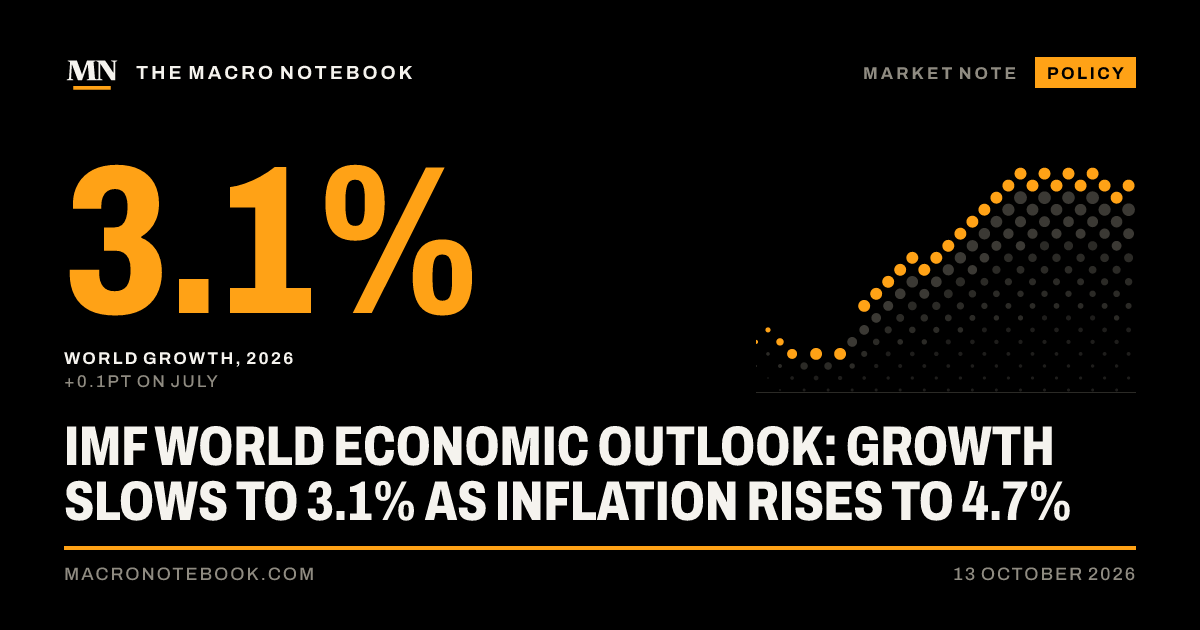
The world economy will grow 3.1% this year and 3.4% in 2027, the International Monetary Fund said on Tuesday in its World Economic Outlook, published at its annual meetings in Bangkok. Global inflation is set to rise “notably” to 4.7% in 2026, before easing to 4.1% next year. The IMF’s message is that the economy has held up through the war in the Middle East, but that the buffers which helped it are running out.
The growth forecast for this year is 0.1 percentage point higher than in July, and the one for 2027 is unchanged. Growth is still slower than the 3.5% of 2025. The IMF credits two things for the resilience: energy supplies were rerouted, stocks drawn down and output raised elsewhere, and “the artificial intelligence-driven investment boom boosted global activity and supported international trade”, it says in a blog post on the report.
The IMF growth forecasts: who was upgraded and who was cut
The rich world did better than expected. The IMF now sees 2.1% growth in advanced economies this year, up from 1.7% in its July update. The forecast for the US is unchanged at 2.3%. The euro area was raised to 1.1% from 0.9%, with Germany up to 1.3% from 0.7%, while France was cut to 0.4% from 0.6%. Britain was raised to 1.3% from 1.0%, and Japan to 0.7% from 0.6%.
The largest upgrade went to the group the IMF calls other advanced economies: 4.2%, up from 2.8%. It includes South Korea, which the IMF now sees growing 3.3% this year after 1.1% in 2025, its database shows. India was raised to 7.0% from 6.4% on its fiscal-year basis. China was trimmed to 4.5% from 4.6%.
The war has hit the Gulf hardest. The IMF now expects the Middle East and Central Asia to shrink by 0.3% this year, where it saw growth of 0.7% in July. Saudi Arabia’s forecast was cut to a contraction of 3.3%, from growth of 1.7%, followed by a rebound of 7.9% in 2027. Emerging and developing economies as a group were cut to 3.7% from 3.8%. Energy importers outside the technology supply chain “face the most difficult outlook”, the IMF says.
AI holds up the expansion, and concentrates the risk
The IMF is clear that the boom is a strength and a weakness. Technology investment is “concentrating risks – making the global expansion heavily reliant on a small number of firms, sectors, and economies”, the blog says. A reassessment of what AI can deliver is one of the main risks to the forecast. The IMF’s financial stability report, also out today, warns that a correction in AI-related asset prices could be amplified by rising leverage, as we explain in our lead story.
Inflation is rising again
Inflation is the other problem. Global core inflation, which leaves out food and energy, is projected at 3.9% this year and 3.7% in 2027. For the US, the IMF expects consumer prices to rise 3.6% this year, against 2.7% in 2025, its database shows. For the euro area it expects 3.1%, for Britain 3.3% and for Japan 2.0%.
Its advice to central banks is firm. “Where commodity price increases and technology-related investment (or other factors) add to persistent inflationary pressures, monetary policy will need to tighten further,” the blog says. Markets agree for Britain: they put the chance of a Bank of England rate rise on 5 November at 91%, according to Central Bank Watch. For the Fed’s meeting on 28 October the chance is about 20%.
Governments are told to tighten too. Borrowing costs have risen sharply in the big advanced economies and public debt is high. In a risk scenario in which fears about public finances push up the term premium and inflation expectations, global growth in 2027 would be “materially lower” than forecast, the IMF says.
What to watch
The annual meetings of the IMF and the World Bank run in Bangkok this week. The central banks then decide: the Fed on 28 October, the European Central Bank on 29 October, the Bank of Japan on 30 October and the Bank of England on 5 November.
Disclosure
This is analysis and opinion, not investment advice.
WeeklyThe Notebook by email
The week, in one email
Once a week: the stories we published, and the releases and decisions due in the week ahead. Free. One click stops it.
We email you a link to confirm. By signing up, you agree to the Terms and the Privacy policy.
Check your email. We sent a link to . Open it within 15 minutes to confirm.
You are signed in as . You can change this on your Saved page.
You get the weekly email. To stop it, use the link at the end of any of them, or your Saved page.