RatesMarket noteWednesday 14 October 2026, 23:33
AI crowding out: foreign buyers now prefer US corporate bonds to Treasuries
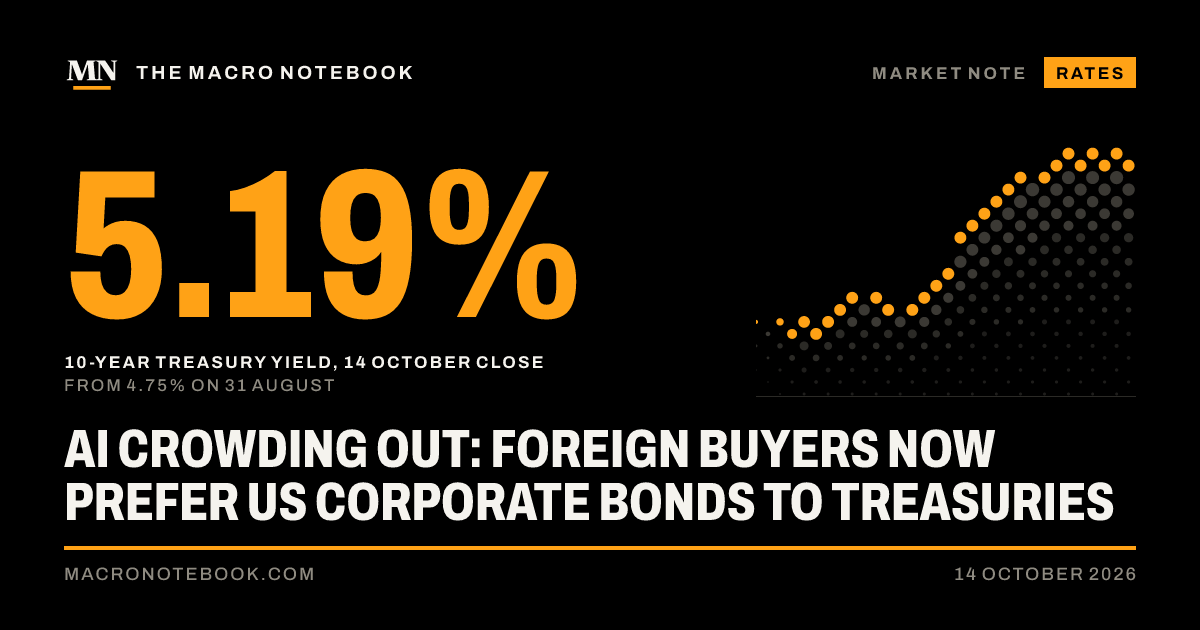
The 10-year Treasury yield is 5.19%, up 44bp since August. In the year to July, private foreign investors bought $392.3bn of US corporate bonds and $263.4bn of Treasuries.
Private foreign investors now buy more American corporate bonds than Treasury notes and bonds, as AI companies borrow on a record scale. In the 12 months to July they bought a net $392.3bn of US corporate bonds and $263.4bn of Treasury notes and bonds, the Treasury’s capital-flow figures show. A year earlier the order was the other way round: $305.4bn of corporate bonds and $506.3bn of Treasuries.
The government is paying for the competition. The 10-year Treasury yield closed at 5.19% on Wednesday, up from 4.75% at the end of August, Treasury’s daily rates show. It closed at 5.31% on 5 October, the highest since May 2002, and before this autumn it had last stood at 5.19% in July 2007, according to the long series on FRED.
Crowding out, the other way round
Crowding out usually describes a government whose borrowing squeezes companies out of the bond market. This time the squeeze may run the other way, from one industry to everyone else. “The step higher in global yields since the start of September fueled by the AI boom and energy prices will crowd out many types of non-AI related borrowing,” Krishna Guha of Evercore wrote in a note this week, Axios reported.
Torsten Slok, Apollo’s chief economist, puts it more sharply. “AI’s rate-insensitive boom is triggering ‘Dutch disease’ in the US economy by draining capital, power and labor from vulnerable sectors like housing and autos,” he wrote on 9 October. Dutch disease is what happened to the Netherlands after it found natural gas: one booming sector pulled money and workers away from the rest. Slok expects the Fed to keep rates higher for longer as a result.
The difference is that the AI builders keep borrowing as rates rise, because they expect a large prize. Home buyers do not. The average 30-year fixed mortgage rate was 7.40% last week, up from 6.66% at the end of August and the highest since November 2023, Freddie Mac’s weekly survey shows. We reported on 11 October that spending on data centre construction is up 73% in a year while the rest of private building shrinks.
Where foreign money is going
The July figures alone show the shift. Private foreign investors sold a net $29.1bn of Treasury notes and bonds in the month and bought $20.5bn of corporate bonds. Foreign central banks and other official holders bought $25.5bn of Treasuries in July, but over the 12 months they were net sellers of $16.8bn.
Shares drew the most money of all. Private foreign investors bought a net $802.3bn of US equities in the 12 months to July, up from $606.1bn a year earlier. “The Treasury market is having to compete really hard against these other spaces,” Yesha Yadav, a Vanderbilt law professor who studies the Treasury market, told Axios.
Not everyone buys the crowding-out story
PIMCO looked for the effect directly and did not find it. Its analysts studied six surprise AI bond deals over the past year and found no statistically significant rise in 10-year yields, term premia or swap spreads around them. “The data do not support direct Treasury crowding out,” they wrote on 21 September. AI can still push rates up, they argue, but by another route: an investment boom “absorbs labor, power, equipment, and construction capacity” and lifts real interest rates unless saving rises to match.
The Treasury’s own numbers fit that reading. The 10-year real yield, on inflation-protected bonds, rose from 2.44% to 2.84% between 31 August and Wednesday, Treasury’s real yield curve shows. That is 40bp of the nominal yield’s 44bp rise, by our calculation. As we wrote on 29 September, this sell-off is about real yields, not inflation.
The borrowing itself has slowed. Tech companies raised $23bn of AI-related debt worldwide in September, less than half of August’s total and far below June’s record $113bn, according to Morgan Stanley figures reported by Investing.com. AI-related issuance in the US investment-grade market stopped completely in September. Morgan Stanley put the pause down to the heavy borrowing earlier in the year and to growing doubts about returns. Even so, AI-linked borrowing so far this year is about $466bn, against $101bn in the same period of 2025.
What to watch
The Treasury publishes its capital-flow figures for August on 16 October, which will show whether foreign buyers kept selling Treasuries in the sell-off. The big cloud companies report third-quarter results in the coming weeks, and their spending plans for 2027 will decide how much they need to borrow. The Fed meets on 27 and 28 October.
Disclosure
This is analysis and opinion, not investment advice.
WeeklyThe Notebook by email
The week, in one email
Once a week: the stories we published, and the releases and decisions due in the week ahead. Free. One click stops it.
We email you a link to confirm. By signing up, you agree to the Terms and the Privacy policy.
Check your email. We sent a link to . Open it within 15 minutes to confirm.
You are signed in as . You can change this on your Saved page.
You get the weekly email. To stop it, use the link at the end of any of them, or your Saved page.