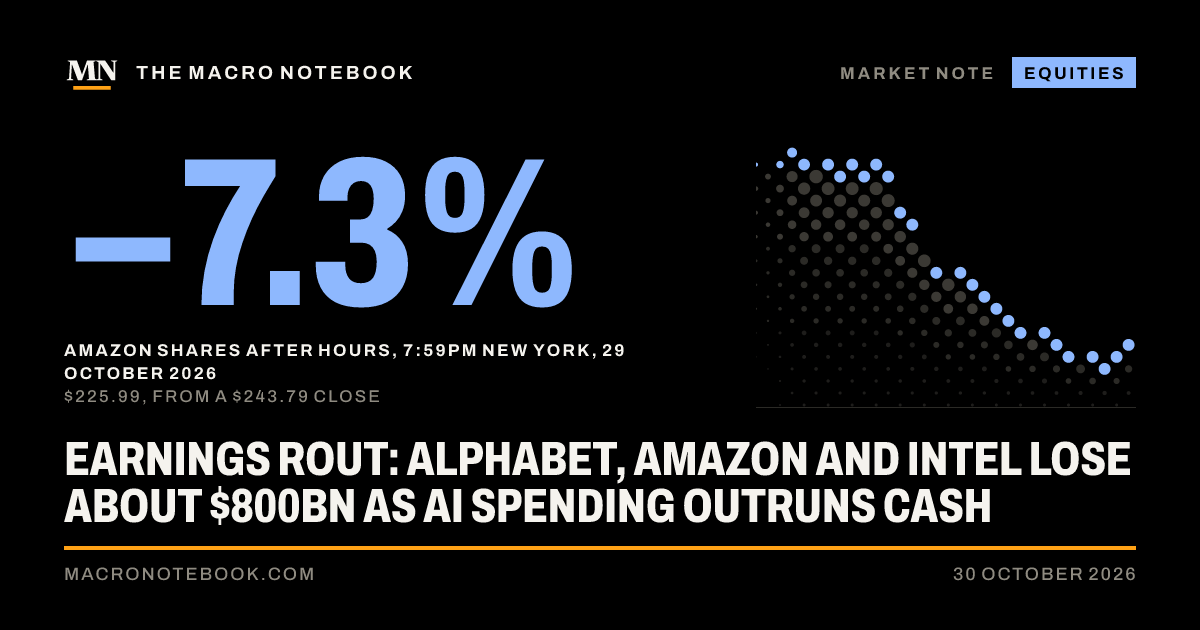
Amazon earnings sent its shares down 7% after the bell on Thursday, and Intel fell 23%, hours after Alphabet closed with its worst fall since it listed in 2004. Amazon’s shares were at $225.99 at 7:59pm New York time, 7.3% below the $243.79 close, Yahoo Finance prices show. Earnings of $1.89 a share and revenue of $201.94bn both fell short of the $1.96 and $202.31bn analysts expected, CNBC reports.
Four of the biggest technology companies reported in about 24 hours. Three were punished. By our rough calculation, Alphabet, Amazon and Intel lost about $800bn of market value between them: about $500bn for Alphabet in the regular session, and about $190bn for Amazon and more than $100bn for Intel after hours. Only Microsoft held its ground.
The businesses grew. What the market sold was the cost of growing them. Alphabet and Amazon spent more on data centres than their operations brought in, and Intel promised less profit than analysts expected. Microsoft, which paid for its building from its own cash, was the exception.
Alphabet: fast growth, the worst day in 22 years
On paper, Google had a strong quarter. Revenue rose 25% to $127.6bn, operating income rose 30% to $40.6bn, and Google Cloud more than doubled its revenue, up 103% to $30.7bn, Alphabet’s results show. Cloud’s operating profit tripled, to $11.1bn from $3.6bn. Search and other revenue grew 12% to $63.35bn, and YouTube advertising 9% to $11.2bn.
The market saw three problems. First, the misses: search revenue fell short of the $64.96bn analysts expected, and total revenue of $127.58bn short of $128.22bn, CNBC reported before the open. Second, earnings per share of $2.12 were held down by an $8.7bn loss on equity securities, a paper loss that cut 55 cents a share. Third, and most important, the cash.
Alphabet spent $51.4bn on property and equipment in the quarter, more than the $42.3bn its operations brought in, so free cash flow was −$9.1bn. It bought back no shares, against $11.5bn a year earlier. Instead it sold $12.4bn of new shares and raised $29.0bn of debt. Long-term debt reached $125.1bn, from $46.5bn at the end of 2025.
Alphabet’s class A shares closed 12.6% lower on Thursday, at $283.82. That is the largest one-day fall since the shares listed in August 2004, by our count from Yahoo Finance price history; the previous worst was 11.6%, on 16 March 2020. Across its 12.29bn shares, that took roughly $500bn off the company’s value. The after-hours fall of 10% that we reported on Wednesday night grew in the regular session rather than shrinking.
Microsoft: the same bet, paid for in cash
Microsoft reported the same evening and told a simpler story. Revenue rose 19% to $92.3bn, and Azure, its cloud platform, grew 48%, its results show. The Microsoft Cloud brought in $63.9bn, up 30%. Contracted revenue not yet booked rose 73% to $677bn. Both revenue and adjusted earnings of $4.89 a share beat the $90.69bn and $4.73 analysts expected, CNBC reported.
Microsoft spends as hard as its rivals. Its capital spending doubled to $39.4bn, from $19.4bn a year earlier. The difference is that its operations brought in $58.0bn, which left $18.6bn of free cash flow. It still bought back $4.4bn of shares and paid $6.8bn in dividends.
The shares rose about 2% before the open on Thursday, but the gain did not last. Microsoft ended the day almost flat, down 0.2% at $530.14. On a day when Alphabet lost an eighth of its value, that was a good result.
Free cash flow, July to September 2026, $
Free cash flow, July to September 2026, $. Source: Amazon, Alphabet and Microsoft quarterly results (Form 8-K), 28 and 29 October 2026. Operating cash flow less purchases of property and equipment (Amazon: net of proceeds and incentives).
Amazon
−33.5bn
Alphabet
−9.1bn
Microsoft
+18.6bn
Source: Amazon, Alphabet and Microsoft quarterly results (Form 8-K), 28 and 29 October 2026. Operating cash flow less purchases of property and equipment (Amazon: net of proceeds and incentives).The Macro Notebook
Amazon: record margin, deeper cash hole
Amazon’s quarter was also strong on its face. Operating income rose 61% to $28.1bn, and the operating margin of 13.9% was Amazon’s highest ever, its results show. AWS, its cloud business, grew 39% to $46.0bn, its fastest in nearly five years, and earned $17.8bn of operating profit. Sales rose 12% to $201.9bn; Amazon says growth would have been about 4 points higher had Prime Day not moved into the second quarter this year.
Earnings per share fell from $1.95 a year ago. The reason sits below operating profit: a year ago, Amazon booked $9.5bn of pre-tax gains on its stakes in Anthropic. This quarter, other income was a $0.7bn loss.
The cash is the problem, and it is bigger than Alphabet’s. Amazon’s operations brought in $42.4bn in the quarter, but it spent $75.9bn, net, on property and equipment, so free cash flow was about −$33.5bn. Over twelve months it was −$42.4bn, against +$14.8bn a year earlier. Amazon raised $48.1bn of long-term debt in the quarter and $115.1bn so far this year. It kept its forecast of about $220bn of capital spending in 2026.
Andy Jassy, the chief executive, said AWS revenue should grow by more than 40% in both 2027 and 2028. For the fourth quarter, Amazon expects sales of $240bn to $247bn and operating income of $28.5bn to $33.5bn, against $25.0bn a year earlier. At the after-hours price, it had lost about $190bn of market value, by our rough calculation from its 10.8bn shares.
Intel: a good quarter, a weak forecast
Intel’s fall had a different cause. Revenue rose 21% to $16.5bn, and its data centre business grew 78% to $7.3bn, which David Zinsner, the finance chief, called its strongest data centre growth in 15 years, Intel’s results show. Revenue, gross margin and earnings per share all beat Intel’s own guidance.
The forecast did the damage. Intel expects fourth-quarter revenue of $15.0bn to $16.0bn and adjusted earnings of 25 cents a share; analysts expected $17.1bn and 43 cents, CNBC reports. Its adjusted gross margin is set to drop to 38.0% from 44.1%, and Zinsner said the PC slowdown will last “at least through the first half of next year”.
Intel’s shares were at $70.89 after hours, 23.0% below their $92.07 close. If that holds on Friday, it would be Intel’s worst day since August 2024, when it fell 26.1%, Yahoo Finance’s price history shows. The shares had risen 150% this year, from $36.90 at the end of 2025, so the fall takes back part of a large gain. On its 5.24bn average shares in the quarter, the after-hours fall is worth more than $100bn, by our rough calculation.
Beyond Big Tech: winners and losers
Thursday’s other results split the same way: a beat was not enough if the outlook or the margins slipped. Caterpillar fell 9.3% to $647.39 even though its earnings and revenue beat estimates, because sales in its construction business came in below them, CNBC reported. That was its worst day since March 2020, Yahoo Finance’s price history shows.
Software was hit hardest. ServiceNow closed 27.0% lower, at $109.67, after adjusted profit of $1 a share missed the $1.02 analysts expected. By midday Fortinet was down 21%, on a gross margin of 79.6% against the 80.1% analysts wanted, even though its sales and profit beat, CNBC reported. Sprouts Farmers Market was down 22% after it cut its full-year earnings forecast to about $4.80 a share, from $5.32 to $5.40.
The winners beat clearly. Eli Lilly closed 6.6% higher after adjusted earnings of $7.48 a share beat the $6.26 expected, on revenue of $24.4bn against $22.61bn, Yahoo Finance prices show. Chipotle was up 8% at midday on same-store sales growth of 2.1%, against the 1.5% expected. DoorDash was up 4% after it beat estimates and agreed to buy Maplebear, the owner of Instacart, for $65 a share.
Share price change, 29 October 2026, %
Share price change, 29 October 2026, %. Source: Yahoo Finance, daily closes, 28 and 29 October 2026. Alphabet is the class A share. Amazon and Intel reported after the close.
Eli Lilly
+6.6%
Microsoft
−0.2%
Caterpillar
−9.3%
Alphabet
−12.6%
ServiceNow
−27%
Source: Yahoo Finance, daily closes, 28 and 29 October 2026. Alphabet is the class A share. Amazon and Intel reported after the close.The Macro Notebook
After the bell, more forecasts disappointed. Reddit fell 18% and Roblox 17% on weak guidance, Twilio 17%, and Pinterest 8% after it missed estimates, CNBC reports.
The wider market held up better than the tech headlines suggest. The S&P 500 fell only 0.3%, while the Nasdaq Composite fell 1.38% to 26,184.72, Yahoo Finance shows.
What ties it together
On Sunday we showed that AI spending already used 98% of Big Tech’s operating cash. This week, two of the biggest spenders went past 100%. Amazon’s quarterly spending was about 1.8 times the cash its operations brought in, and Alphabet’s about 1.2 times. Both filled the gap with debt, and Alphabet also with new shares.
Until now, investors paid for this spending as long as the cash kept up with it. This week they began to charge for it. Alphabet and Amazon both grew their cloud businesses fast and still lost a large part of their value in a day. Microsoft, the one that paid for its building from its own cash, kept its value.
What to watch
Friday’s regular session, when the after-hours moves in Amazon and Intel are tested with full volume.
The lek has not bought so many euros since at least 1995, when Eurostat's records begin. In September 2026 a euro cost 91.85 lek on average, the lowest monthly figure in those records. In 2019 it cost 123.01. Put the other way round, the lek now buys 33.9% more euros than it did in 2019, and 37.7% more dollars.