A daily read on economics, equities and geopolitics.
Markets now
UST 2Y 4.79% ▲2bp
UST 10Y 5.12% ▼3bp
UST 30Y 5.42% ▼6bp
BUND 10Y 3.45% ▼1bp
EURUSD 1.1215 ▼0.1%
USDJPY 158.13 ▼0.1%
GBPUSD 1.3347 ▲0.1%
EURALL 90.77 ▼0.33
GOLD 4,114.04 ▼0.4%
SILVER 57.79 ▲1.6%
BTC 82,944 ▲1.3%
ETH 2,446 ▲1.7%
EquitiesMarket noteWednesday 21 October 2026, 07:40
SpaceX earnings: AI overtakesStarlink, and the companyspent $19.6bn in a quarter
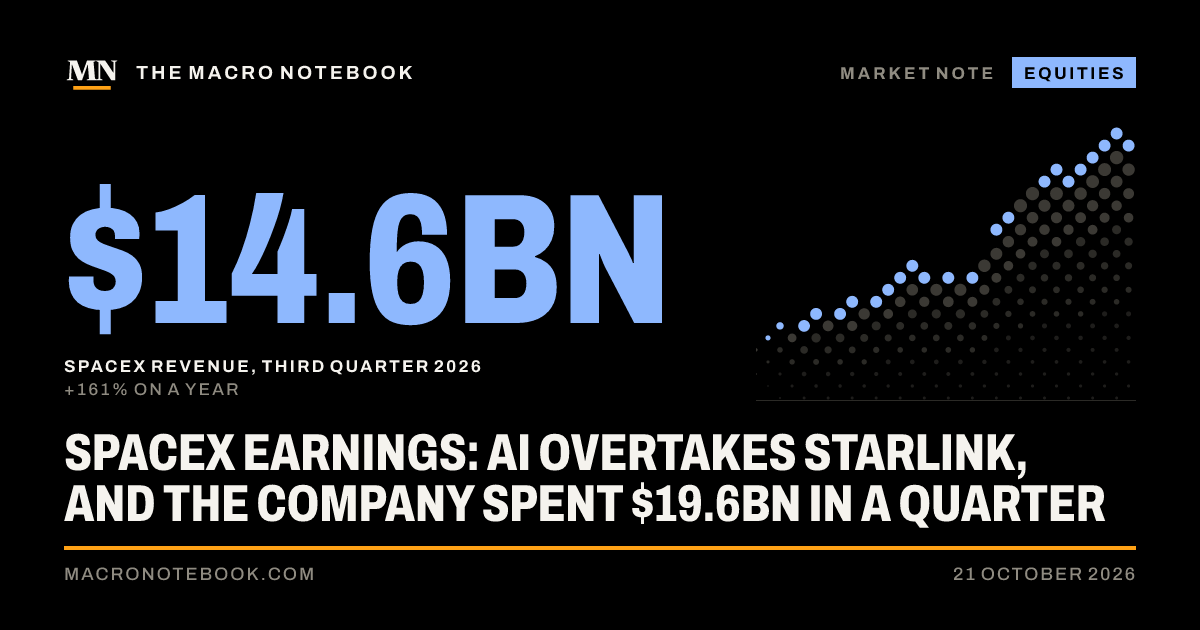
SpaceX earnings: revenue rose 161% to $14.6bn as its AI arm outgrew Starlink. It spent $19.6bn on capital projects in the quarter, more than it took in.
SpaceX earnings for the third quarter show a company that is now more about artificial intelligence than rockets or satellites. Revenue rose 161% on a year to $14.6bn, and its AI business, which it calls Super Intelligence, brought in more than Starlink and its other connectivity services, which were larger a quarter earlier, its results filed with the SEC on Tuesday show. The company made a net profit of $4.4bn, against a loss of $1.1bn a year earlier.
The other side of the ledger is just as striking. SpaceX spent $19.6bn on capital projects in the quarter, most of it on computing power. That is more than its revenue.
What drove SpaceX earnings
The Super Intelligence segment, which holds the Grok models, advertising and, since August, the coding company Cursor, had revenue of $7.6bn, up from $0.8bn a year earlier and from $2.6bn in the second quarter. Nearly all of the jump came from what SpaceX calls SI solutions and infrastructure, which rose from $2.2bn to $7.0bn in three months. The company puts it down to new cloud services agreements, under which it rents computing power to other firms, to Cursor, and to wider use of Grok.
Cursor alone added $608m between the deal closing on 14 August and the end of September. SpaceX valued the purchase at $60bn of equity.
Connectivity, mostly Starlink, grew too. Its revenue rose 69% to $5.2bn, and its operating profit almost doubled to $2.4bn. Starlink had 13.6 million consumer subscribers at the end of September, up from 7.2 million a year earlier. But each pays less: average revenue per consumer was $69 a month, against $83 a year ago. We noted in September that Starlink had doubled its customers in a year; it has nearly kept that pace.
The rocket business was the smallest part. Space revenue rose 6% to $1.8bn, and SpaceX flew 35 launches, against 44 a year earlier. In the quarter Starship made its first flight that SpaceX counts as revenue-generating, carrying 26 Starlink satellites.
How the profit adds up
The $4.4bn net profit flatters the business a little. Operating income, the profit from running the company, was $2.8bn. The rest came from $873m of interest income on the cash raised at the listing, $1.0bn of other income and a $390m tax credit.
The segment that grew fastest is still thinly profitable on that measure. Super Intelligence made an operating profit of $431m, after $1.2bn of share awards tied to the Cursor deal. On adjusted EBITDA, the measure its management uses, which leaves out depreciation and share awards, the company earned $8.8bn.
The bill for computing power
Capital spending is where SpaceX differs most from a normal profitable company. Of the $19.6bn spent in the quarter, $16.4bn went to the AI segment, as it builds out computing infrastructure, including its Colossus II project. Its computing capacity reached 1.7 gigawatts at the end of September, from 0.6 a year earlier.
Over nine months, the gap is wide.
SpaceX, first nine months of 2026, $bn
SpaceX, first nine months of 2026, $bn. Source: Space Exploration Technologies Corp., third quarter 2026 results (Form 8-K, Exhibit 99.1): revenue, net cash from operating activities, purchases of property, plant and equipment.
Revenue
27.1
Cash from operations
13.1
Capital spending
48.1
Source: Space Exploration Technologies Corp., third quarter 2026 results (Form 8-K, Exhibit 99.1): revenue, net cash from operating activities, purchases of property, plant and equipment.The Macro Notebook
The company took in $13.1bn of cash from its operations in the nine months and spent $48.1bn on property and equipment, so it used about $35bn more than its businesses generated. The listing paid for that. SpaceX raised $85.7bn, net of fees, and ended September with $51.3bn in cash and $38.6bn in marketable securities.
Customers are paying in advance, which helps. Deferred revenue, money received for services not yet delivered, added $4.9bn to cash in the nine months, against $0.4bn a year earlier.
What SpaceX earnings mean for the AI trade
SpaceX is now one of the companies whose spending holds up the AI build-out, alongside the big cloud groups. Its results show both halves of that story. The revenue is real and growing fast, much of it from renting out the computers it builds. But the computers cost more than the revenue they bring in, for now, and the cash to buy them came from shareholders. Power is already a limit for some of these projects.
What to watch
Starlink Mobile. SpaceX agreed on 8 October to buy 800 MHz spectrum licences, a deal it expects to close in the first half of 2027.
Starship. The company is building a new spaceport in Louisiana for its heavy rocket; the first launch there is targeted for 2029.
Capital spending. Whether the AI segment’s spending slows, or keeps outrunning the revenue it brings in.
Disclosure
This is analysis and opinion, not investment advice.
WeeklyThe Notebook by email
The week, in one email
Once a week: the stories we published, and the releases and decisions due in the week ahead. Free. One click stops it.
We email you a link to confirm. By signing up, you agree to the Terms and the Privacy policy.
Check your email. We sent a link to . Open it within 15 minutes to confirm.
You are signed in as . You can change this on your Saved page.
You get the weekly email. To stop it, use the link at the end of any of them, or your Saved page.
The lek has not bought so many euros since at least 1995, when Eurostat's records begin. In September 2026 a euro cost 91.85 lek on average, the lowest monthly figure in those records. In 2019 it cost 123.01. Put the other way round, the lek now buys 33.9% more euros than it did in 2019, and 37.7% more dollars.