EquitiesMarket noteFriday 16 October 2026, 09:23
Indonesia stocks fall 11.5% after MSCI proposes a downgrade
Indonesia stocks fell 11.5%, their worst day since 1998, after MSCI proposed moving Indonesia from emerging to standalone status. It will decide by June 2027.
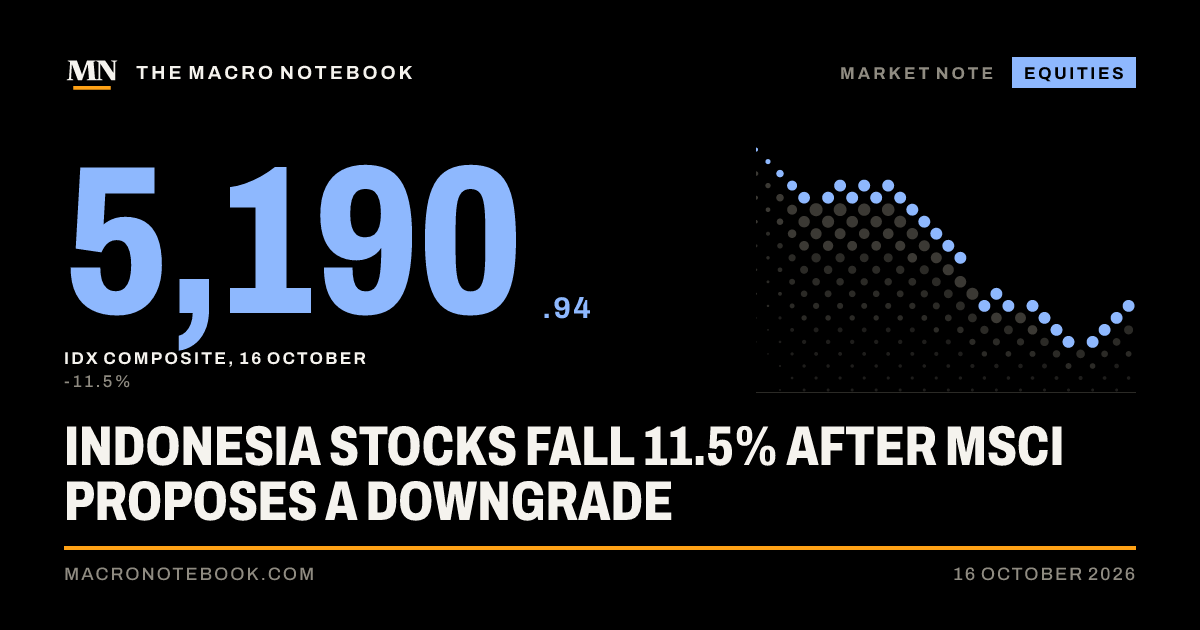
Indonesia stocks had their worst day since 1998 on Friday, after MSCI proposed to strip the country of its emerging-market status. The IDX Composite, Jakarta’s main index, fell 11.5%, or 672.84 points, to 5,190.94, the Indonesia Stock Exchange’s index summary shows.
The index provider said late on Thursday, New York time, that it was launching a consultation on moving the MSCI Indonesia indexes from Emerging Market to Standalone Market status, MSCI said in a statement. It passed over frontier status, the next tier down. Feedback from investors suggests that would not reflect how deep the problems are, MSCI said.
What MSCI proposed
The complaint is about how the market works, not about the economy. At its June review, MSCI said investors had raised serious concerns about Indonesian stocks: shareholdings that are hard to see through, and trading that looked coordinated. Indonesia’s authorities then announced reforms. Shareholders with more than 1% must be disclosed, investors are classified in more detail, and stocks with high concentrations of ownership are reported. A minimum free float of 15% is planned.
MSCI said in June that it would consider a consultation if it saw too little progress by its November 2026 index review. Investors have now told it that progress has not been consistent. Suspected coordinated trading continues, they say, and there is little evidence of enforcement. MSCI therefore considers Indonesia’s emerging-market status no longer appropriate. It expects to go ahead with the downgrade unless the consultation brings clear evidence of material improvement.
Until then, a freeze stays in place. MSCI will not raise the weights of Indonesian stocks, add new ones to its Indonesia indexes, or move any up into larger size groups. It will keep deleting stocks that the Indonesian authorities flag for high ownership concentration. Feedback is open until 30 April 2027, and MSCI will announce its decision on or before 30 June 2027.
How bad Friday was
Large stocks fell hardest. The LQ45 index of the biggest and most traded stocks lost 13.7% to 509.35, and the INFOBANK15 index of bank shares fell 13.8%, the exchange’s figures show.
It was the Jakarta index’s steepest one-day fall since January 1998, during the Asian financial crisis, Reuters reports. During the day the index touched its lowest level since November 2020. Blue-chip banks, miners and energy companies fell by nearly 15%, the exchange’s daily limit. The rupiah weakened to 18,070 to the dollar, its weakest since late July, before recovering to 18,000.
The fall comes on top of a bad year. Indonesian shares have lost nearly 40% in 2026, the worst performance of any stock market in the world, Reuters says. Foreign investors have taken $4.6bn out of Indonesian stocks this year, according to LSEG data that Reuters cites. Most other Asian markets rose on Friday, as chip stocks recovered from the week’s sell-off.
What standalone status means
A downgrade would take Indonesian stocks out of the indexes that global funds track, so funds that follow them would have to sell. If the downgrade goes ahead, Indonesia would join Argentina, Lebanon, Palestine and Ukraine in the standalone group. It would be the only Asia-Pacific market there and by far the largest economy, according to Reuters.
The selling could be large. UBS estimates that removal from global indexes could trigger $4bn of selling by passive funds and about $15bn by active managers, Reuters reports. Active managers need not wait for a decision. Citi’s analysts warn that their selling could pick up in the short term, although Citi still assumes Indonesia keeps its emerging-market status.
What to watch next
The burden is now on Jakarta. MSCI has said what would change its mind: clear evidence of better market governance and functioning, not more announced reforms. The tests are the ones it named. They are enforcement against coordinated trading, real disclosure of who owns what, and progress towards the 15% free float.
The dates to watch are MSCI’s November index review, where the freeze on Indonesian stocks continues, and any interim update on investors’ feedback, which MSCI says it may give during the consultation. The window for feedback closes on 30 April 2027. The decision comes by 30 June 2027.
Disclosure
This is analysis and opinion, not investment advice.
WeeklyThe Notebook by email
The week, in one email
Once a week: the stories we published, and the releases and decisions due in the week ahead. Free. One click stops it.
We email you a link to confirm. By signing up, you agree to the Terms and the Privacy policy.
Check your email. We sent a link to . Open it within 15 minutes to confirm.
You are signed in as . You can change this on your Saved page.
You get the weekly email. To stop it, use the link at the end of any of them, or your Saved page.