EquitiesMarket noteWednesday 14 October 2026, 23:32
Chip stocks lose 11.6% in six days, and S&P 500 profit growth leans on them
The Philadelphia semiconductor index fell 4.3% on Wednesday after a hot inflation report. Chipmakers are expected to provide much of the S&P 500's third-quarter profit growth.
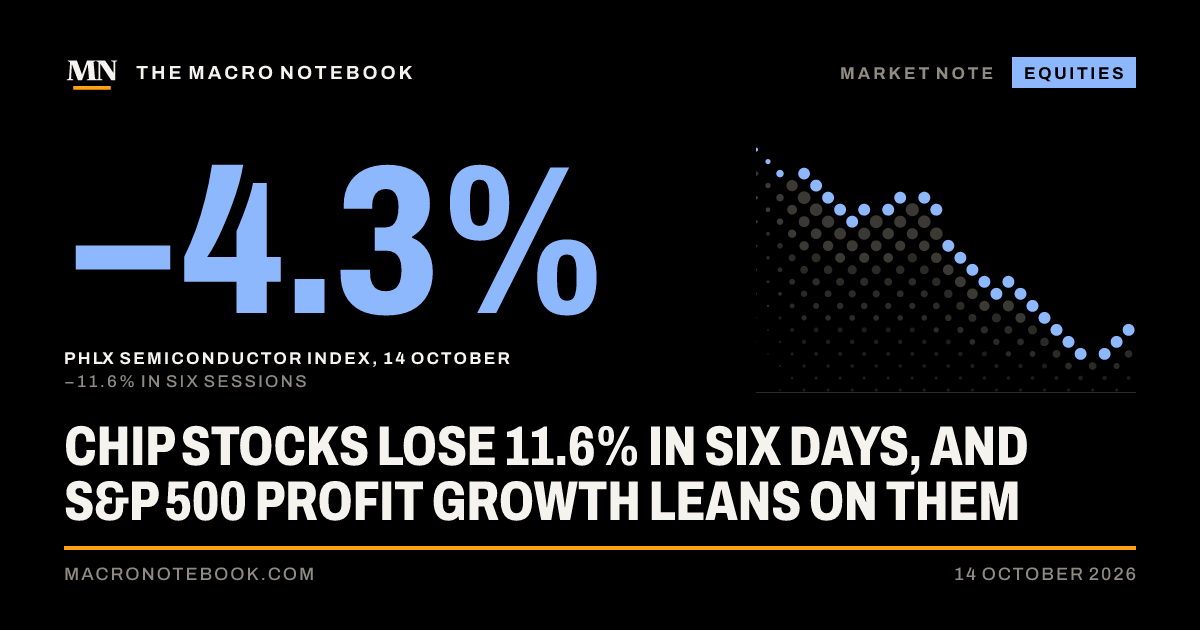
Chip stocks had another bad day on Wednesday, and this time they took the wider market with them. The PHLX Semiconductor Index fell 4.3%, its sixth fall in a row, and has lost 11.6% in those six sessions, TheStreet reported. The S&P 500 fell 1.1%, its first drop of more than 1% in 54 sessions, and the Nasdaq Composite fell 1.9%, its worst day since July.
The trigger was inflation. Consumer prices rose 3.7% in the year to September, up from 3.4% in August, by our calculation from the Bureau of Labor Statistics index on FRED. Core prices rose 0.3% in the month, against forecasts of 0.2%. The 10-year Treasury yield rose above 5.32% early in the session but closed at 5.19%, Treasury’s daily rates show.
The chips carry the earnings season
The fall matters because so much of this year’s profit growth comes from a few chipmakers. Analysts expect S&P 500 companies to report earnings growth of 29.6% for the third quarter, FactSet’s weekly report shows. For the semiconductor and chip-equipment industry the expected figure is 130%. Without that one industry, expected growth for the whole technology sector falls from 65.1% to 24.4%.
Three companies do much of the work. Micron, Nvidia and Broadcom are expected to provide nearly 40% of the S&P 500’s third-quarter earnings growth, according to Goldman Sachs figures published by Axios. The other large contributor is energy, where FactSet expects profits to more than double on higher oil prices.
Strong profits are why shares have held up as bond yields climbed. The S&P 500 closed at a record 7,818.93 on 6 October and was 14.0% higher this year on Tuesday, by our calculation from the index on FRED. Since the end of June the index has risen 3.5% while expected earnings for the next 12 months have risen 10.4%, FactSet says, so its forward price-to-earnings ratio has fallen to 19.1, equal to its 10-year average.
The doubts started before the inflation report
The selling began last week. On Tuesday the semiconductor index slipped 0.2% for its fifth loss in a row, and Applied Materials, which makes chip-making equipment, fell 6.7%, the second-worst performer in the S&P 500, Axios reported. A day earlier the company had unveiled a $5bn research centre in Sunnyvale, California, with 600,000 square feet of space to develop chips with its customers.
Investors have also had to absorb a warning from inside the boom. Speaking in Singapore on Monday, Broadcom’s chief executive, Hock Tan, said many investors “have no clue what they are investing in”, according to Axios, which cited Singapore’s Business Times. “Most companies out there cannot find any bloody return on investment, I’m telling you,” he said. “People are just wasting money spending tokens.” Broadcom sells custom AI chips and is one of the three companies Goldman expects to lead the quarter’s earnings growth.
Borrowers and builders fell hardest
On Wednesday the heaviest losses were in companies that borrow to build AI capacity or sell the hardware. CoreWeave, which rents out AI computing power, fell 15.5%, Dell 11.4% and Oracle 8.8%, TheStreet reported. Among chipmakers, AMD fell almost 6% and Micron 4%. ASML fell 3.9% in New York, a day after it reported record sales and said customers want more machines than it can build in 2027 and 2028, as we reported on 14 October.
Good results are no longer enough to lift these shares on their own. With yields above 5% and inflation rising, investors are asking how much of the AI spending will pay off and how much of it is paid for with debt.
What to watch
TSMC, the world’s largest contract chipmaker, holds its third-quarter results call on Thursday at 14:00 Taiwan time, its investor site shows. Its view of AI demand for 2027 will be the first test after this week’s fall. FactSet expects S&P 500 earnings growth to slow sharply next year, to 2.6% in the second quarter of 2027, as the comparison with this year’s surge gets harder.
Disclosure
This is analysis and opinion, not investment advice.
WeeklyThe Notebook by email
The week, in one email
Once a week: the stories we published, and the releases and decisions due in the week ahead. Free. One click stops it.
We email you a link to confirm. By signing up, you agree to the Terms and the Privacy policy.
Check your email. We sent a link to . Open it within 15 minutes to confirm.
You are signed in as . You can change this on your Saved page.
You get the weekly email. To stop it, use the link at the end of any of them, or your Saved page.