EquitiesMarket noteWednesday 14 October 2026, 23:30
AI skills now set pay on Wall Street: a quarter of finance firms tie bonuses to them
A quarter of US finance HR staff say their firms tie raises, promotions and bonuses to AI proficiency. PwC puts the pay premium for AI skills at 62%, up from 57% a year earlier.
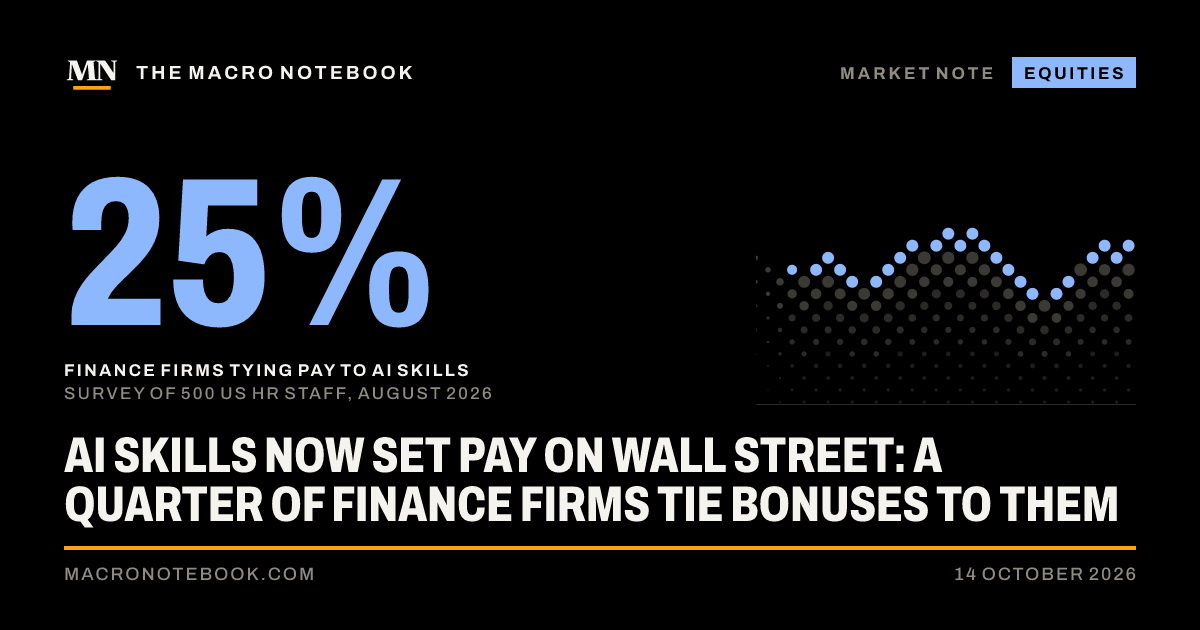
Wall Street has started to pay for AI skills. A quarter of HR professionals at US finance firms say their organisation now ties raises, promotions and bonuses to how well staff use AI, according to a survey for the recruiter Selby Jennings. Thirty per cent say employees must now disclose their use of AI in formal performance reviews.
The survey, carried out by Censuswide among 500 HR professionals in US finance between 19 and 26 August, shows how far the idea of a good hire has moved. Asked which factor will carry the most weight in their next hiring round, 40% chose the ability to prompt or use AI tools well, 33% the ability to catch or correct AI’s mistakes and 30% the ability to turn AI output into business decisions. “Ivy League pedigree is out. AI fluency is in,” the report says.
A premium for the people who make AI pay
Across the world’s job markets the premium is already large. PwC’s 2026 Global AI Jobs Barometer, built from more than one billion job ads, puts the average wage premium for workers with AI skills at 62%, up from 57% in last year’s report. Jobs that need specific AI skills are growing almost eight times as fast as the jobs market as a whole, 69% against 9%. The premium ranged from 118% in some sectors, such as consumer markets, to 16% in government.
The firms that use AI best are pulling away. The fifth of companies most exposed to AI raised labour productivity by 163% relative to 2018, PwC says, almost five times the figure for the most AI-exposed companies as a group. Since 2018 the companies most exposed to AI have grown headcount by 52%, against 36% at the least exposed, and PwC finds faster wage growth too, 24% against 17%.
Put together, the figures describe a market that prizes a small group of people who can turn AI into output. In the right hands AI acts as “a force multiplier for experts”, in PwC’s words, and employers are competing to find those hands. Selby Jennings reports 74% growth in hiring for AI-enabled roles over the past year and a 70% increase in what firms spend to hire them. Almost a quarter of respondents, 23%, say HR or legal cannot close offers fast enough before candidates walk away.
Hard to find, harder to judge
The trouble is telling who really has the skills. Half of the HR professionals surveyed say the share of underqualified candidates they interview has risen over the past year, and 31% say the main obstacle to hiring is that nobody inside the firm can confidently judge applicants. Some would rather wait: 24% say their firm would leave a seat empty rather than make the wrong hire.
“For decades, leaders on Wall Street wanted talent with specific backgrounds, degrees, and experience, creating an almost formulaic process for vetting and hiring candidates,” said Ben Hodzic, a managing director at Selby Jennings. “AI has broken that framework, and most firms haven’t built a new one yet.”
No formula for pay yet
How much pay depends on AI is still loose. There is “no established formula on how much compensation is getting tied to AI usage”, Dylan Gomez, an executive director at Selby Jennings, told Reuters. He expects the link to become “more defined by next year”. The practice is more common at fintech start-ups and smaller firms than at the big banks and trading houses, Selby Jennings’ head of tech recruiting told Semafor.
Firms are also building the machinery to check. In the survey, 42% have written new guidelines for assessing staff’s AI skills, and 30% have created roles or whole departments to prove that AI spending pays off. “Firms want ongoing proof that the investment is actually producing results,” Hodzic said.
The same shift has a harder side for workers without those skills. We reported on 30 September that Oracle, Amazon and Microsoft have cut thousands of jobs and named AI as a reason.
What to watch
Year-end bonus season on Wall Street will be the first big test of pay tied to AI. If Gomez is right, next year’s reviews will come with clearer rules, and the gap between staff who can show what AI does for them and those who cannot will be written into pay.
Disclosure
This is analysis and opinion, not investment advice.
WeeklyThe Notebook by email
The week, in one email
Once a week: the stories we published, and the releases and decisions due in the week ahead. Free. One click stops it.
We email you a link to confirm. By signing up, you agree to the Terms and the Privacy policy.
Check your email. We sent a link to . Open it within 15 minutes to confirm.
You are signed in as . You can change this on your Saved page.
You get the weekly email. To stop it, use the link at the end of any of them, or your Saved page.