EquitiesMarket noteWednesday 14 October 2026, 07:03
Flight to quality: investors are buying Microsoft, not McDonald's
In the flight to quality, quality stocks beat momentum by the widest margin since 2023. The money went into tech: McDonald's and Home Depot are down this year.
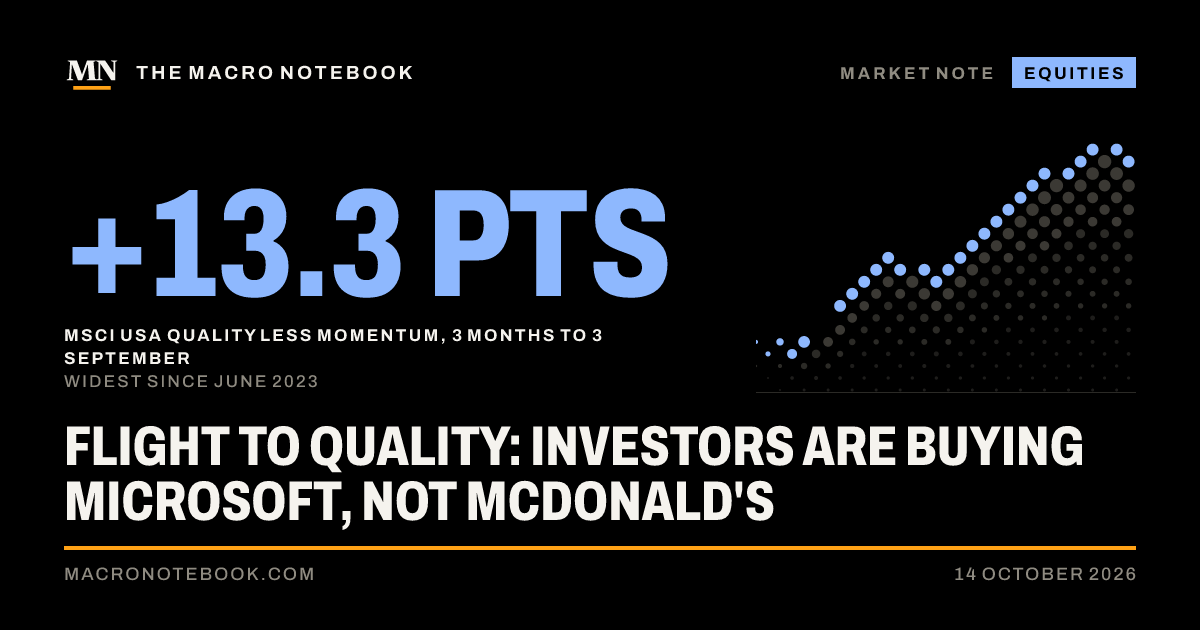
There is a flight to quality in the American stock market, and it is not going where most people would expect. In the three months to 3 September the MSCI USA Quality index, which holds companies with high returns on equity, steady earnings and little debt, beat the MSCI USA Momentum index by 13.3 percentage points, by our calculation from MSCI’s daily index levels. That was the widest gap since June 2023. On Monday the quality index closed at its highest level this year. The momentum index, made of last year’s biggest risers, ended Tuesday 10.5% below its peak of 22 June.
Quality is the safe end of the stock market. When investors crowd into it, they are telling you they are worried. The question is what about, and whether the safe trade is still a good one. Our view: the flight to quality has become a crowded bet on big technology, and the quality bargains are in the companies it left behind.
Why investors fly to quality
There are two usual reasons, and both are in the price today. The first is the cost of money. The 10-year Treasury yield ended Tuesday at 5.21%, the Treasury’s daily curve shows, and futures price 82bp of Fed rate rises over the next nine meetings, about 3.3 hikes, according to Central Bank Watch. A company with high margins and little debt does not need to borrow at those rates. A company that lives on credit does.
The second is fear about AI. Here the flight to quality looks odd. Information technology makes up 36.3% of the quality index and communication services another 12.2%, MSCI’s data at 30 September show. Its five largest holdings are Microsoft, Meta, Eli Lilly, Apple and Nvidia, and two chip-equipment makers, Lam Research and Applied Materials, are in the top ten. Investors worried about AI spending have not left AI. They have moved from its riskiest names to its richest ones.
There is a third, less dramatic reading. Funds can buy quality as a place to park money while they bet against weaker and more fashionable stocks. That trade can run for months, but it is crowded, and crowded trades end in a rush.
Quality stocks are no longer cheap
That is the trouble with any flight to quality: it makes quality expensive. At the end of September the quality index traded at 22.6 times expected earnings. The MSCI USA index, the whole market, traded at 19.4 times, and the momentum index at 19.7. Investors are paying a premium of about 17% over the market for safety. On those numbers, quality is now dearer than momentum.
Paying more for better companies is sensible, up to a point. But a premium bought in a hurry is the way investors get trapped: safe companies at unsafe prices.
The flight to quality has missed the old quality stocks
The names that most people picture when they hear “quality stocks”, companies that sell burgers, soft drinks and paint to everyone, every week, have gone the other way. McDonald’s shares closed on Tuesday 22.8% lower than at the end of 2025, Nasdaq’s quotes show. Lowe’s is down 21.7%, Home Depot 14.6% and PepsiCo 11.3%. Walmart is up 0.8%. All five are lower than they were two months ago. Consumer discretionary companies, the group that holds McDonald’s, Home Depot and Lowe’s, are 2.6% of the quality index.
The market is pricing these businesses as if the American shopper were in trouble, and with borrowing costs where they are, some caution is fair. But people still eat, drink and fix their houses when rates are high. If the flight to quality is about safety, these are safe companies that have not been bid up. That is where a patient investor would start looking, rather than at the quality names that have already run.
What to watch
The other choice is to wait. Factor trades turn fast. In the three months to 22 June, momentum beat quality by 33.8 points. By 3 September quality was 13.3 points ahead: a swing of 47 points in less than three months. What is crowded today tends to be sold hardest tomorrow, and if the AI trade cracks, an index that is half technology will not be a shelter.
Two things would end this phase: a fall in long-term yields from above 5%, which would ease the pressure on borrowers, or results from the big technology companies that disappoint. If either comes, the leaders of the past three months are likely to fall hardest. The laggards, already marked down, have less far to fall.
Disclosure
This is analysis and opinion, not investment advice.
WeeklyThe Notebook by email
The week, in one email
Once a week: the stories we published, and the releases and decisions due in the week ahead. Free. One click stops it.
We email you a link to confirm. By signing up, you agree to the Terms and the Privacy policy.
Check your email. We sent a link to . Open it within 15 minutes to confirm.
You are signed in as . You can change this on your Saved page.
You get the weekly email. To stop it, use the link at the end of any of them, or your Saved page.