Albania’s protests entered a sixth day on Sunday, and Edi Rama, the prime minister, again refused to resign. He framed the stakes in terms of Albania’s EU membership instead. “I am not being challenged, the government is not being challenged… but a path is being challenged, a mission is being challenged,” he said in a live address on Facebook, Reuters reported. In his telling, the threat is to Albania’s bid to join the European Union.
That bid comes with money attached, and most of it has not been paid yet. The EU is also Albania’s main market: in July, 68.4% of the country’s exports went to EU countries, INSTAT, the statistics office, says.
The EU money tied to Albania’s membership bid
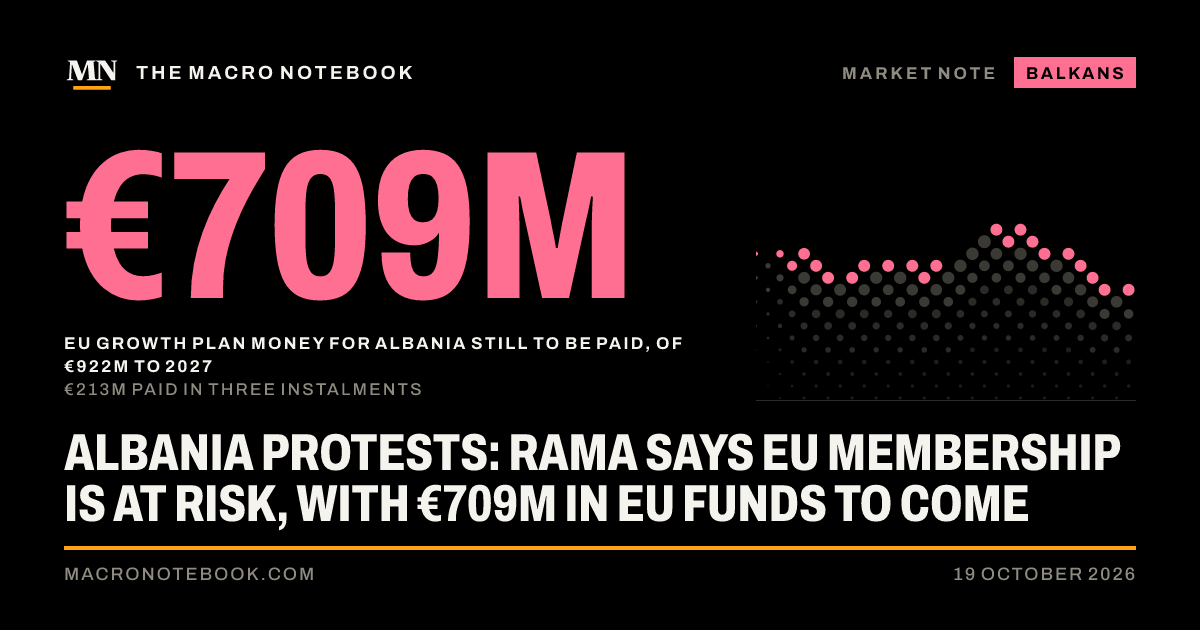
Under the EU’s Growth Plan for the Western Balkans, Albania can receive up to €922.1m until 2027, in grants and cheap loans, the EU delegation in Tirana says. The money is paid only as Albania completes reforms agreed with the European Commission, in five areas: the rule of law and fundamental rights, renewable energy, the digital economy, skills and private business.
So far the EU has paid €213m of it, in three instalments, the delegation said in June. That leaves about €709m still to come, more than three-quarters of the total. Albania completed 21 of 41 reform steps in the first reporting period and 12 of 21 in the second. The EU called it one of the best performers in the region.
The last payment came in May. The Commission released €49m, of which €22.8m went straight to the state budget and the rest to investment projects, it said on 20 May. It assessed reforms on business conditions, investment and access to finance. The next tranche rests on Albania’s report for the period to June, due in July. At the June review, the Commission’s Sigrid Brettel said that “some reform implementation deadlines are approaching”, and that the best performers would get extra funds.
The rule of law is one of the five areas, and it is also what the protesters say is wrong. Their complaints include corruption in government, along with too few jobs and poor universities.
Six days on the streets
The protests began with students and grew. Police fired rubber bullets on Saturday for the first time since they started, Al Jazeera reported. The national police chief, Skender Hita, said 167 people had been arrested and 132 officers injured over five days. Seven officers were suspended over claims that they had used too much force.
By Sunday, police said 388 people had been charged with criminal offences, Reuters reported. Protesters have set fire to government buildings and banks, and the unrest has spread from Tirana to other cities. Rama blamed unnamed foreign interests, invited students to talks and cancelled a trip to Vienna. The European Commission condemned the violence, backed the right to protest and said the response “must remain proportionate”.
As we reported on 15 October, the students joined the “flamingo” movement, which began in June against a coastal resort deal and turned against the government. Albania is not alone: cost-of-living protests have spread to France, Italy and Portugal this month.
The lek still holds
Markets have stayed calm. The lek strengthened through the week of protests, to 91.32 per euro on Friday from 91.61 the Monday before, the Bank of Albania’s official rate shows. A weaker lek would show that investors were worried. There is no sign of it yet.
What to watch
Three things. First, whether students accept Rama’s offer of talks, which would split them from the wider movement that wants him gone. Second, the Commission’s verdict on Albania’s July report, which decides the next payment. Third, the tone from Brussels, which so far has condemned the violence and asked for a proportionate police response.