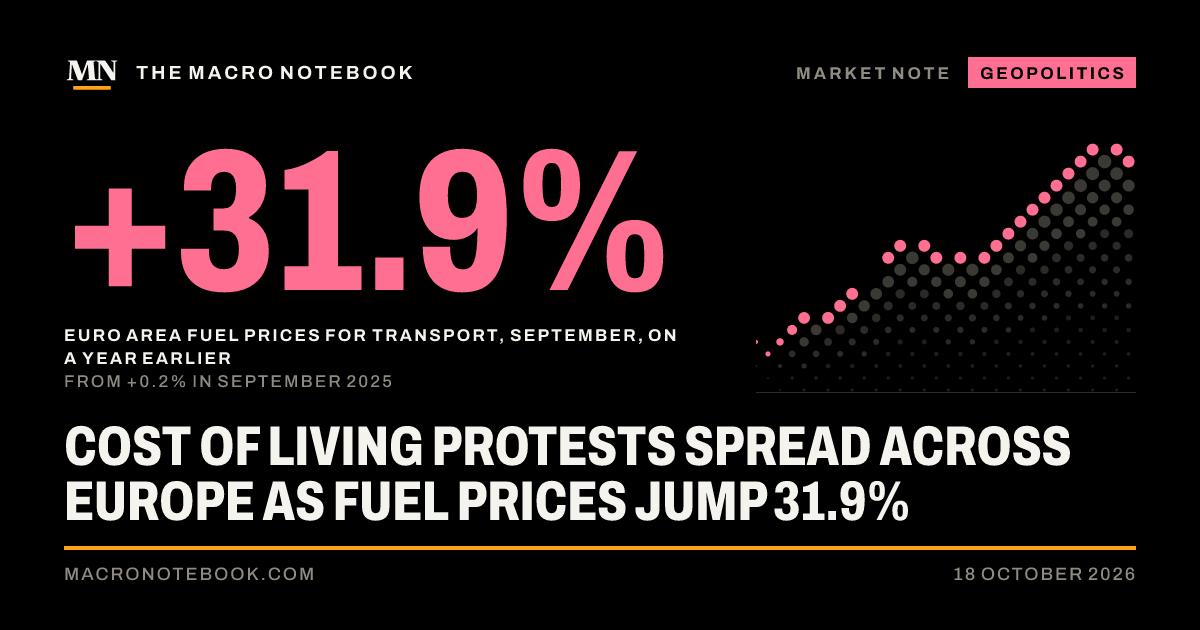
Fuel for cars and vans cost 31.9% more across the euro area in September than a year earlier, Eurostat’s final figures show. A year ago fuel prices were flat. That jump lifted euro area inflation to 3.8%, and it sits behind the cost of living protests that spread across Europe this weekend.
In France, 550,000 people marched on Saturday, on interior ministry figures, and more than 1,800 were arrested as some marches turned to rioting and looting, the Guardian reported. In Milan, rioters clashed with police, and in Lisbon protesters set up a tent camp over housing costs. The grievances differ, from school conditions in France to rents in Portugal and Spain, but higher prices link them.
Where the cost of living protests are
France saw the largest. The movement began last month in schools in the poor northern suburbs of Paris, over teacher absences and run-down buildings, and grew into a nationwide protest against inequality and high prices. On Saturday the town hall in Limoges was largely destroyed by fire, and protesters briefly stormed the town hall in Marseille. Interior minister Laurent Nuñez said the state did not plan to declare a state of emergency.
In Italy, a march in central Milan on Saturday against rising living costs began peacefully but ended in clashes. Two police officers were hurt and about 50 people were detained, the Guardian reported, citing the LaPresse agency. Prime minister Giorgia Meloni blamed “hooligans”.
In Portugal, hundreds of people camped in Rossio Square in Lisbon after marches across the country, copying a camp set up in Madrid three weeks ago. In Spain, anger over rents led prime minister Pedro Sánchez to call a snap general election for the end of November. Albania has seen its own violent protests, as we reported on 15 October in our piece on the student riots in Tirana.
Fuel is driving inflation
Euro area inflation rose to 3.8% in September from 3.2% in August and 2.2% a year earlier. Energy prices rose 18.9% over the year. Food prices rose only 1.1%, and services 3.2%. So most of the jump comes from energy, and most of the energy rise comes from fuel. As we reported on 2 October, the flash estimate had already shown the rise; the final figures confirm it.
Fuel prices for transport, September 2026, change on a year earlier, %
Fuel prices for transport, September 2026, change on a year earlier, %. Source: Eurostat, HICP, fuels and lubricants for personal transport equipment (prc_hicp_minr). September 2026.
Germany
36.8
France
34.3
Euro area
31.9
Spain
30.8
Portugal
30.3
Italy
26.7
Source: Eurostat, HICP, fuels and lubricants for personal transport equipment (prc_hicp_minr). September 2026.The Macro Notebook
The jump is sharpest in France. French inflation was 1.1% a year ago, the lowest in the euro area’s big economies. In September it reached 3.4%, with fuel up 34.3%. In Italy, inflation rose from 1.7% to 4.2% over the year, with fuel up 26.7%. Spain’s inflation reached 5.0%.
Housing is the second grievance
In Portugal and Spain, the protests are as much about homes as fuel. Portuguese house prices in the second quarter of 2026 were three times their 2015 level, and 16.5% higher than a year earlier, Eurostat’s house price index shows. Across the EU, prices rose by 69% over the same eleven years. Spanish prices have doubled since 2015 and rose 12.1% in the past year.
Rents in Portugal rose 5.2% over the year to September, twice the euro area’s 2.6%, the HICP figures show. Portuguese inflation as a whole was 3.6%.
France is the exception on housing. French house prices were lower in the second quarter than a year earlier. There, the anger is about wages, public services and the price of fuel.
What it means for the ECB
The European Central Bank raised its deposit rate to 2.50% in September, its second rise this year, after June. Higher rates do little about the price of oil, but they aim to stop it spreading into wages and other prices.
Markets see little chance of a move at the next meeting, on 29 October: about 3%, according to Central Bank Watch, at the close on 16 October. By the December meeting they put the chance of a higher rate at about 85%. The protests add a political cost to that choice. Governments facing angry voters may turn to fuel tax cuts and subsidies, which would ease prices at the pump but add to public borrowing.
What to watch next
Watch for further marches this week, particularly in France, where unions such as the CGT back the movement, and in Lisbon and Porto, where protesters have set up tent camps. The ECB meets on 29 October. Spain votes at the end of November, with housing at the centre of the campaign. And the next oil move will show up in the October inflation figures.
Disclosure
This is analysis and opinion, not investment advice.
WeeklyThe Notebook by email
The week, in one email
Once a week: the stories we published, and the releases and decisions due in the week ahead. Free. One click stops it.
We email you a link to confirm. By signing up, you agree to the Terms and the Privacy policy.
Check your email. We sent a link to . Open it within 15 minutes to confirm.
You are signed in as . You can change this on your Saved page.
You get the weekly email. To stop it, use the link at the end of any of them, or your Saved page.
The lek has not bought so many euros since at least 1995, when Eurostat's records begin. In September 2026 a euro cost 91.85 lek on average, the lowest monthly figure in those records. In 2019 it cost 123.01. Put the other way round, the lek now buys 33.9% more euros than it did in 2019, and 37.7% more dollars.