Microsoft has pulled out of Nscale’s planned AI data centre at Loughton in Essex, which ministers had billed as the UK’s largest, because the site cannot get enough power from the grid. Microsoft was the anchor tenant and the only customer Nscale had named for the site, the Guardian reported on Sunday. The Telegraph first reported the news.
Nscale did not deny the loss. “We remain committed to both the Loughton project and the UK, and we are exploring alternative power sources for the site,” a spokesperson told the Guardian. The company called the problem “this unfortunate London-wide grid issue” and said it had no impact on its other contracts.
What Microsoft was meant to get at Loughton
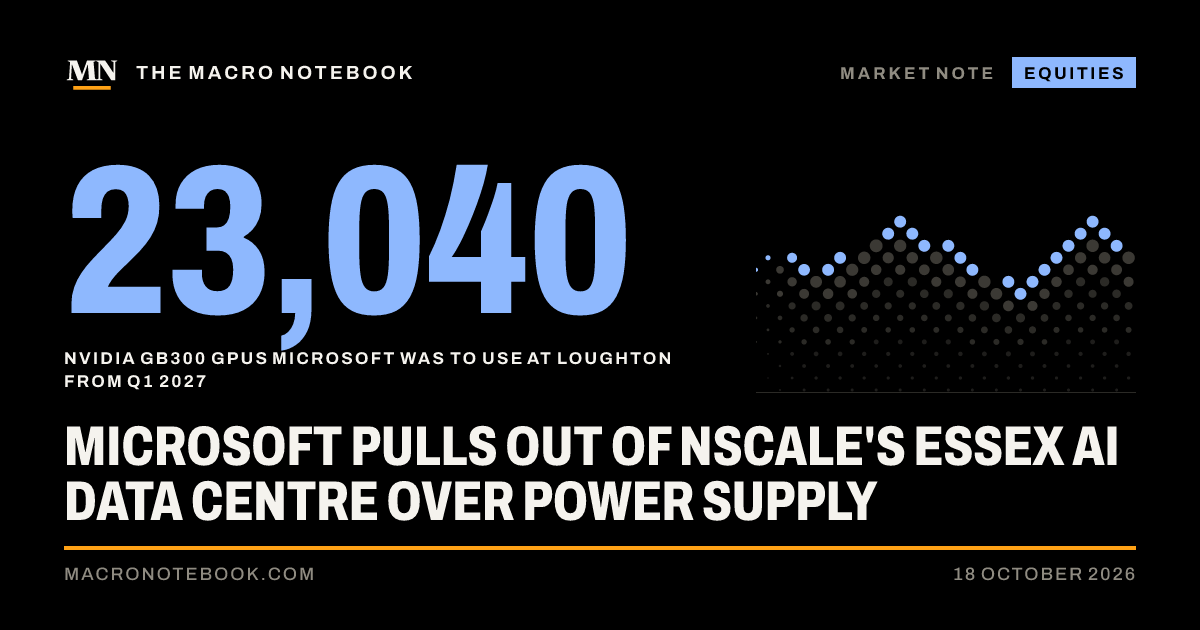
The deal was a centrepiece of the UK-US technology partnership signed during the US president’s state visit in September 2025. Nscale and Microsoft said then that Loughton would be the UK’s largest AI supercomputer, with 50MW of capacity that could grow to 90MW. It would house 23,040 Nvidia GB300 GPUs, the chips that train and run AI models, from the first quarter of 2027, Nscale’s announcement said. The chips were to power Microsoft’s Azure cloud services in the UK.
Loughton was the largest part of a wider British plan. Nscale said it would deploy up to 58,640 Nvidia GPUs across the UK, including up to 31,000 for Stargate UK, its venture with OpenAI and Nvidia, over time. The government held up Loughton as the “largest UK sovereign AI datacentre” when it set out its AI plans.
A month later, Nscale signed a far larger deal with Microsoft for about 200,000 GB300 GPUs across Europe and the US, which Nscale called one of the largest AI infrastructure contracts ever signed. Most of the chips were for a 240MW campus in Texas, about 104,000 of them, from the third quarter of 2026. Portugal was to get about 12,600, and Narvik in Norway about 52,000. That announcement restated the Loughton plan.
Power, not demand, is the problem
The reason given is the grid. Nscale’s spokesperson spoke of a London-wide issue. The Guardian reported last month that power supply problems meant the project faced a long wait before it could come online. In March, the paper found that the site was still a working scaffolding yard.
Scale explains why. Loughton’s first phase alone needs 50MW, and up to 90MW if it grows, from the day the chips arrive. A site can have the land, the building and the customer, and still wait for the grid.
Microsoft’s own choices point the same way. It stays on board at Nscale’s Narvik campus, the Guardian reported. In April Nscale said it would add more than 30,000 of Nvidia’s next-generation Rubin GPUs at Narvik for Microsoft in 2027, expanding the 230MW site. In other words, the demand for chips is still there. It is moving to where the power is.
What it means for Nscale’s listing
The timing is awkward for Nscale. The company wants to list in New York this year, at a valuation that could reach $35bn (£26bn), according to the Guardian. Losing the anchor tenant at its flagship British site could undermine that plan.
Nscale’s own figures show how much it has riding on Microsoft. On 1 October it said it had deployed 24,000 GPUs in the previous month, taking its fleet to more than 50,000 in six data centres in five countries, and that it held more than $103bn of total contract value. It did not break that down by customer, but Microsoft is the largest it has named.
For the UK the setback is political as much as commercial. The government made AI a pillar of its growth plans, and Loughton was the flagship of the 2025 pledges. Its anchor tenant has now walked away for want of power. The contrast with the United States is sharp: as we reported on 11 October, spending on data centre construction there is surging.
What to watch next
The next signs will come from Nscale itself. Watch whether it names a new tenant for Loughton, or a source of power other than the grid, as its spokesperson suggested. Any filing for its planned listing in New York would show how much of its contract value depends on Microsoft. In Britain, the government’s response will show whether grid connections for AI data centres move up its list of priorities.