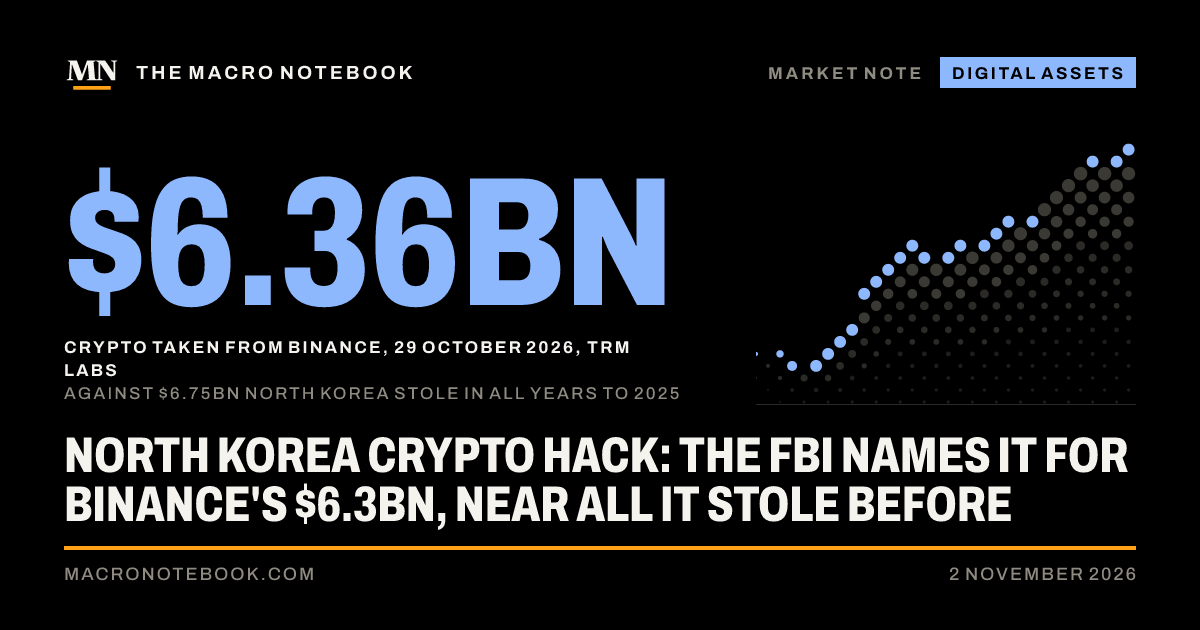
North Korea crypto hack:the FBI names it for Binance's$6.3bn, near all it stole before
The FBI says North Korea's TraderTraitor hackers took over $6bn from Binance: one night's haul, close to the $6.75bn it stole in crypto in all years to 2025.
The FBI said on 31 October that North Korea stole more than $6bn in crypto from Binance, the world’s biggest crypto exchange, on or about 29 October, its alert says. That makes the North Korea crypto hack the largest theft the industry has seen, and a jump in scale even for a state that has made stealing crypto a source of revenue. One night’s haul comes close to everything North Korea had stolen in crypto before it: $6.75bn up to the end of 2025, by the count of the blockchain analysts at Chainalysis.
What the FBI said about the North Korea crypto hack
The alert names “TraderTraitor”, the FBI’s label for this strand of North Korean hacking. It used the same name in February 2025, when it held North Korea responsible for the theft of about $1.5bn from the exchange Bybit, its alert then said. This time, the FBI says, TraderTraitor is turning the stolen assets mainly into ether, and it expects the money to pass through decentralised finance (DeFi) and instant swap services on its way to further laundering.
With the Secret Service and the tax agency’s criminal investigators, the FBI asks node operators, swap services, exchanges and analytics firms to block transactions with 628 addresses it lists: 608 on Ethereum, 19 on Bitcoin and one on Solana. The alert gives no evidence for the attribution. The analysts at TRM Labs had already blamed North Korea on the night of the theft, as we reported on 30 October. The FBI’s word turns an analyst’s judgment into the position of the US government, and that matters to the firms it asks to act.
How it compares with North Korea’s earlier thefts
North Korean hackers stole at least $2.02bn in crypto in 2025, 51% more than in 2024, Chainalysis estimates, a record year built mostly on Bybit. Their attacks made up 76% of all hacks of crypto companies that year. Three years earlier, the FBI held the Lazarus Group and APT38, units tied to North Korea, responsible for the theft of $620m in ether reported on 29 March 2022, its statement of April 2022 says, from Ronin, the network behind the game Axie Infinity.
Binance dwarfs all of it. TRM counts $6.36bn taken from Binance wallets, its report says: more than three times North Korea’s record year, and four times Bybit.
North Korea's crypto thefts, $bn
North Korea's crypto thefts, $bn. Source: TRM Labs (Binance, 29 October 2026); Chainalysis (yearly and all-time totals, lower bounds; 2024 is 2025's $2.02bn less $681m); FBI (Bybit, about $1.5bn; Ronin, $620m). Our calculation.
All thefts to end-2025
6.75
Binance, 29 Oct 2026
6.36
All of 2025
2.02
Bybit, Feb 2025
1.50
All of 2024
1.34
Ronin, Mar 2022
0.62
Source: TRM Labs (Binance, 29 October 2026); Chainalysis (yearly and all-time totals, lower bounds; 2024 is 2025's $2.02bn less $681m); FBI (Bybit, about $1.5bn; Ronin, $620m). Our calculation.The Macro Notebook
Where the money goes next
North Korea’s laundering follows a pattern. Chainalysis finds a cycle of about 45 days after a large theft, a strong preference for Chinese-language money movement services, cross-chain bridges and mixers, and transfers kept small: slightly over 60% of the volume moves in pieces worth less than $500,000. If Binance follows the same path, the money will be on the move until about mid-December.
Some of it is out of reach for good. Stablecoin issuers froze about $2.7bn within hours, but about $2.4bn in ether and bitcoin cannot be frozen by any issuer, TRM counted on 30 October. That leaves the exchanges and brokers where the money surfaces, and banks that miss suspect payments pay a price for it, as with Bank of America’s fine this month.
Binance customers took out $3.64bn
Binance began to restore withdrawals at 06:00 UTC on 1 November. Between 06:00 and 15:30 UTC it paid out $4.649bn and took in $1.01bn, a net outflow of about $3.64bn, its post on X says. That is 2.1% of the $171bn it held for customers in its proof of reserves of 28 October. Withdrawals fell after an early spike, Binance says, and deposits stayed high. Its chief executive, Richard Teng, said on 31 October that Binance had replaced 90% of the stolen assets and would cover the rest, on X.
Prices took the news calmly. Bitcoin was at $78,277 at 08:42 UTC on 2 November, against $77,766 on the morning after the theft, and BNB, Binance’s own token, at $709.89, CoinGecko’s prices show.
What to watch
Binance’s new proof of reserves, from a snapshot taken on 31 October, due today. It will show whether its holdings still cover what customers are owed after the theft and the withdrawals.
The next phase of withdrawals, for the networks still shut.
The laundering. On North Korea’s usual 45-day cycle, the stolen ether moves through bridges and brokers until about mid-December.
Whether exchanges block the FBI’s 628 addresses. Every firm that takes the funds now does so after a public warning from the US government.
Disclosure
This is analysis and opinion, not investment advice.
ContactWrite to the Notebook
Something to add?
Spotted an error, or a source this piece should cite? Want your own research linked or featured? Tell us. We read every message.
The lek has not bought so many euros since at least 1995, when Eurostat's records begin. In September 2026 a euro cost 91.85 lek on average, the lowest monthly figure in those records. In 2019 it cost 123.01. Put the other way round, the lek now buys 33.9% more euros than it did in 2019, and 37.7% more dollars.