Jensen Huang, Nvidia’s founder, has resigned as its president, chief executive and a director, effective immediately. Nvidia’s chief financial officer, Colette Kress, is now interim chief executive while the board looks for a permanent successor, the company said on 12 November.
Why did Jensen Huang resign? He quit four days after Nvidia’s board opened an inquiry into reports that he had been the target of a foreign intelligence effort, and after he admitted to staff that he had been unfaithful to his wife. The shares fell hard at the open: at 10:33 a.m. New York time they were at $163.44, down 5.9% on the day, after a low of $148.80, Nasdaq’s quote showed.
What Nvidia announced
The board accepted Huang’s resignation on Wednesday, 11 November, Nvidia’s filing with the SEC says. The company announced it on Thursday.
Three things changed at once:
Kress, 59, runs the company and keeps her old job. She has been chief financial officer since September 2013, and before that spent nearly 25 years in finance at Cisco, Microsoft and other technology companies.
Nvidia has a chair for the first time. The board appointed Harvey C. Jones, 73, a director since 1993 and a former chief executive and executive chairman of Synopsys.
The search for a permanent chief executive has begun. The board will consider internal and external candidates.
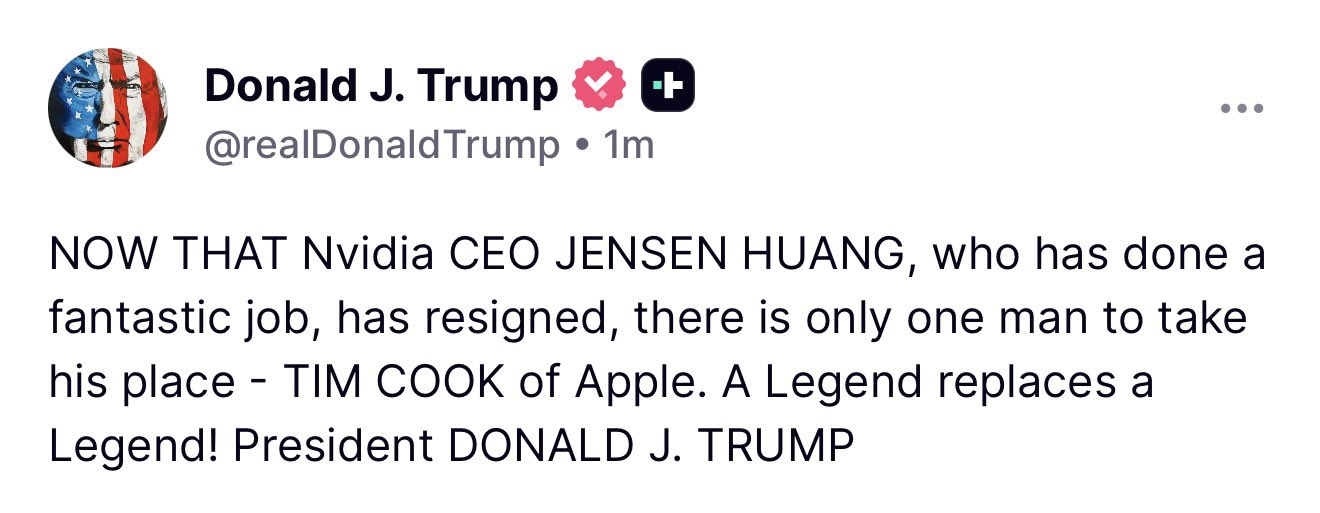
President Trump has already named his pick: Apple’s chief executive, Tim Cook. “NOW THAT Nvidia CEO JENSEN HUANG, who has done a fantastic job, has resigned, there is only one man to take his place - TIM COOK of Apple. A Legend replaces a Legend!” he wrote on Truth Social on 12 November.
Donald J. Trump on Truth Social, 12 November 2026.
“The Board has full confidence in Colette and the leadership team, and we expect the company’s operations, customer commitments and product roadmap to continue without interruption,” Jones said. Kress said she would build “on the extraordinary foundation Jensen created over the last 33 years”.
Why did Jensen Huang resign? What we know
The record of the week before tells the story. No inquiry finding has been published.
On Sunday, 8 November, the board said it was opening an independent investigation “in light of recent reporting that founder and CEO Jensen Huang has been the target of a foreign intelligence effort”. It said it had “no reason to believe that either national security or NVIDIA secrets were compromised”, and that it had confidence in Huang. The same day, Huang wrote a message to Nvidia’s staff: “I was unfaithful to my wife.” He said he would cooperate fully with the inquiry.
On 10 November, the independent directors said they had hired Joon H. Kim, a former acting US Attorney for the Southern District of New York, and his firm, Wachtell, Lipton, Rosen & Katz, to run the investigation. The next day, the board accepted his resignation.
The fall that began with the inquiry deepened. From its close of $186.64 on Friday, 6 November, the last trading day before the board’s statement, to $163.44 at 10:33 a.m. on Thursday, Nvidia lost 12.4%, Nasdaq’s price history and quote show. Its low on Thursday morning, $148.80, was 14.3% below Wednesday’s close of $173.73.
Nvidia, share price, $
Nvidia, share price, $. Source: Nasdaq, NVDA historical prices (closes, 6 to 11 November 2026) and NVDA quote (12 November 2026 at 10:33 a.m. New York time).
6 Nov
186.64
9 Nov
178.67
10 Nov
168.89
11 Nov
173.73
12 Nov, 10:33
163.44
Source: Nasdaq, NVDA historical prices (closes, 6 to 11 November 2026) and NVDA quote (12 November 2026 at 10:33 a.m. New York time).The Macro Notebook
On the 24.1 billion shares Nvidia had outstanding on 21 August, its latest quarterly filing says, that is about $560bn of market value gone since 6 November, by our calculation. At Thursday morning’s price the company was still worth about $3.9tn.
Investors call this key-person risk. A chief financial officer who also runs the company is a stopgap, and the board has said so: the arrangement lasts until a permanent successor is named. As we wrote in October, Nvidia is too big to fail: its leadership is a question for the whole market, not only for its own shareholders.
Our view: the board moved too fast
Our view: accepting Huang’s resignation at once was a mistake. The inquiry the board set up on 8 November has not reported. The only word on the record is the board’s own, that day: it had “no reason to believe that either national security or NVIDIA secrets were compromised”. The board could have asked Huang to step aside while the investigation ran, and decided his future on its findings, in six months or so.
Instead, Nvidia goes into its results, its customer talks and the next round of the AI race with a finance chief doing two jobs. Nvidia’s lead rests on moving faster than its rivals. We think the risk that it now falls behind is bigger than the risk the board has removed. That is a judgement, not a finding: we do not know what the board knows.
Where Huang could go next
Two names come up. Neither has said it has made him an offer, and both are speculation.
The market is already speculating about Elon Musk.Speculation about a Musk-Huang partnership has grown since Huang left, Investing.com reported. Musk fed it himself: when a user on X urged him to hire Huang, he replied, “That would be an honor.” Investing.com found no sign of talks. The obvious job is Terafab, the chip-making complex SpaceX and Tesla are building. Huang praised it in September: “If anybody could do it, he can,” he said at the All-In Summit, Benzinga reported. In our view the fit is plain: Terafab needs someone who knows how to design chips worth building a factory for, and Musk would give him room.
Our dark horse is Intel. This is our own speculation; we have seen no report of it. Intel already has a chip veteran in charge: Lip-Bu Tan, who ran Cadence Design Systems for 12 years, has been chief executive since March 2025, Intel says. He studied nuclear engineering at MIT. So a move would be a long shot. In our view, though, Tan does not carry Huang’s name, and no one else in the industry could give Intel the same immediate lift. Intel joined Terafab in April, Benzinga reported, and it has an unusual owner: the US government, which agreed in August 2025 to buy 433.3 million Intel shares, about 9.9% of the company, Intel announced. The stake is passive, with no board seat. Still, a rising Intel is a win the White House can point to, and we would not be surprised to see President Trump take an interest in who runs it. He has already told Nvidia whom to hire. Hiring Huang would cost a fortune; we think Intel should find the money. Our bet: Intel could be the biggest winner of Nvidia’s mistake.
What to watch
17 November: third-quarter results, the first under Kress as interim chief. Nvidia says they come “as previously scheduled”, at about 1:20 p.m. Pacific time, with the call at 2 p.m.
The inquiry: the board has not said whether the investigation continues now that Huang has gone, or whether its findings will be published.
The search: any shortlist or timetable, and whether the board, or Cook, answers the President.
Disclosure
This is analysis and opinion, not investment advice.
The lek has not bought so many euros since at least 1995, when Eurostat’s records begin. In September 2026 a euro cost 91.85 lek on average, the lowest monthly figure in those records. In 2019 it cost 123.01. Put the other way round, the lek now buys 33.9% more euros than it did in 2019, and 37.7% more dollars.
In four days, three systems that America runs on stopped working. On Friday the Federal Aviation Administration stopped departures across the country. On Monday United Airlines held its departing flights, and JPMorgan Chase slowed payments that reached other banks. Every official account says the opposite: there is no evidence of an attack in any of the three.
Credit> $3tnLeases, contracts and guarantees of seven big tech firms, undiscounted, mid-2026Leases, contracts and guarantees of seven big tech firms, undiscountedtheir debt: over $800bn by year end, Barr says
The Federal Reserve has looked under the bonnet of the AI boom and found that much of what holds it up does not show on the balance sheets. In its Financial Stability Report, published on Friday, the Fed sets out how data centres are financed, and its central finding is that the promises investors cannot see have grown faster than the debt they can.
Why is Nvidia stock down? Shares fell 6.9% after its board opened a spying inquiryWhy is Nvidia stock down? On 8 November its board opened an inquiry into reports that CEO Jensen Huang was a spying target. The shares lost 6.9%, about $311bn.
Equities$108.5bn
Our story, 4 min read
Nvidia is too big to failNvidia guarantees $108.5bn of data-centre leases, $105bn of them for OpenAI, and holds $51.2bn of private stakes. Its filings show why it is too big to fail.
Cookies for Google Analytics? We would like to use them to see which stories people read and how they move through the site. Nothing for advertising. How we use them