A daily read on economics, equities and geopolitics.
Markets now
UST 2Y 4.79% ▲2bp
UST 10Y 5.12% ▼3bp
UST 30Y 5.42% ▼6bp
BUND 10Y 3.45% ▼1bp
EURUSD 1.1215 ▼0.1%
USDJPY 158.13 ▼0.1%
GBPUSD 1.3347 ▲0.1%
EURALL 90.77 ▼0.33
GOLD 4,114.04 ▼0.4%
SILVER 57.79 ▲1.6%
BTC 82,944 ▲1.3%
ETH 2,446 ▲1.7%
EquitiesMarket noteWednesday 21 October 2026, 23:45
Anthropic's $750bn compute plan:the cost of AI can fall as fast as it rose
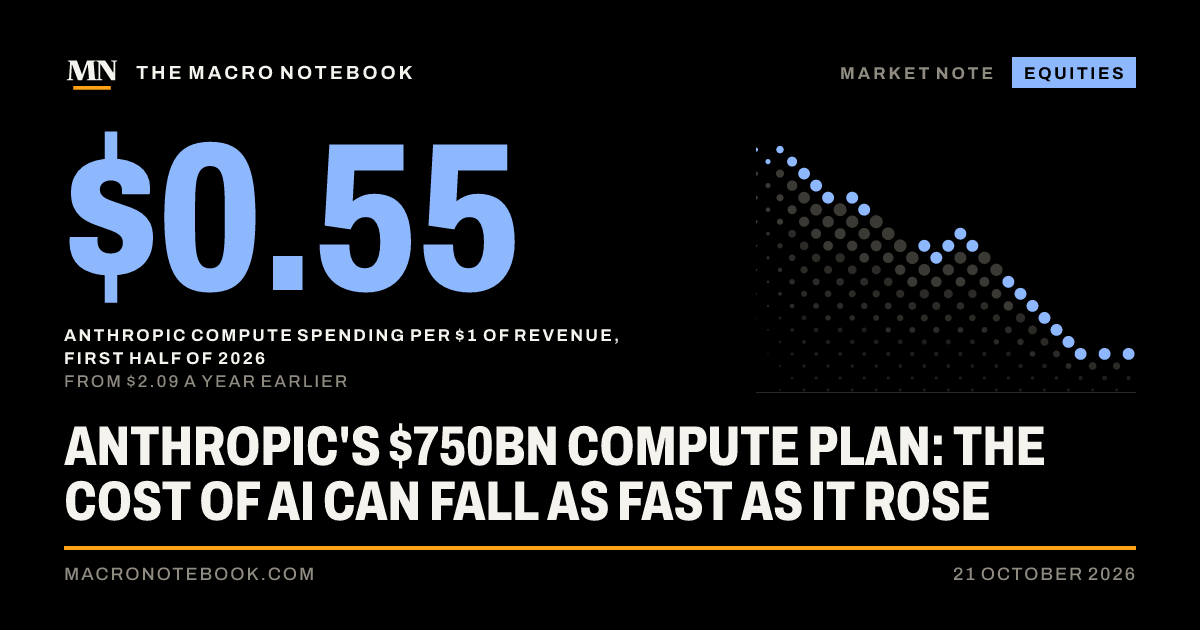
Anthropic compute costs: its draft prospectus plans $750bn of capacity. But each dollar of revenue now needs 55 cents of compute, down from $2.09 a year ago.
Anthropic compute costs now run into the hundreds of billions of dollars. The company plans to spend about $750bn on computing capacity in the coming years, including deals still being negotiated, according to a draft prospectus for its listing seen by The Wall Street Journal. About $450bn of that is in cloud contracts running seven to ten years, most of which cannot be cancelled: $111bn with Google Cloud, $110bn with Amazon Web Services and $31bn with Microsoft, TNW reported from the Journal’s account.
The numbers have fed the fear of a bubble. Anthropic may seek a valuation of about $2tn when it lists, and OpenAI is speeding up a funding round that could value it at $1.4tn, Reuters reported. Citadel’s Ken Griffin said this week that AI is “almost certainly” in a bubble.
Our view: the cost of building and serving frontier models has risen fast, but it can fall just as fast, and the same prospectus already shows it happening. Whoever finds the next large saving in serving these models stands to save the biggest buyers of computing power billions of dollars.
What Anthropic’s prospectus shows about compute costs
Revenue rose to $16.3bn in the first half of 2026, from $1.1bn a year earlier, according to the TNW account of the draft. Spending on computing power rose too, to almost $9bn from $2.3bn. But it rose far more slowly than revenue.
Anthropic compute spending per $1 of revenue, first half of each year, $
Anthropic compute spending per $1 of revenue, first half of each year, $. Source: Anthropic draft prospectus, as reported by The Wall Street Journal and TNW: compute spending ($2.3bn, then about $9bn) divided by revenue ($1.1bn, then $16.3bn).
First half 2025
2.09
First half 2026
0.55
Source: Anthropic draft prospectus, as reported by The Wall Street Journal and TNW: compute spending ($2.3bn, then about $9bn) divided by revenue ($1.1bn, then $16.3bn).The Macro Notebook
A year ago, each dollar of revenue took about $2.09 of computing power. In the first half of this year it took about 55 cents, on our numbers. Some of that may come from pricing and the mix of customers. Some comes from serving models more cheaply, as the price data below show. The headline loss, $80.7bn in the half, is mostly a $72bn accounting charge tied to bonds that can turn into shares, not cash spent.
Why the price of a model keeps falling
The fall is visible in Anthropic’s own price list. Its Claude Opus models cost $75 per million output tokens at the Opus 4 release. Opus 4.5 cut that to $25, and the current Opus 5.5 charges $20, its pricing page shows. Input tokens fell from $15 to $4. That is a cut of about 73% per token. The smallest model fell further: Haiku 5.5 costs $0.10 per million input tokens for most prompts, a tenth of what Haiku 4.5 costs.
Across the industry the fall is steeper still. The price of reaching a fixed level of performance has dropped by between 9 and 900 times a year, depending on the task, Epoch AI found in a study of six benchmarks. The price of matching GPT-4 on PhD-level science questions fell by 40 times a year. Epoch warned that the fastest declines came in the most recent year and may not last.
Energy use per answer is falling too. Google said the energy used by the median text prompt in its Gemini apps fell 33 times over 12 months, to 0.24 watt-hours, on its own measurements, which have not been checked by an outside party. Better models and software did most of the work, not new buildings.
The incentive to make AI cheaper
This is where the size of the bill works in reverse. Non-cancellable contracts fix the capacity a company pays for, so every gain in efficiency means more users served on hardware already paid for. On a $750bn plan, a 1% saving is worth $7.5bn. A way to serve the same model at half the cost would be worth more than any single product launch.
That is the pull on every lab and cloud company now. Once a model is good enough for most work, the race shifts from making it smarter to making it cheaper to run: smaller models that match older large ones, chips built for serving answers, and software that wastes fewer cycles. Power is already a hard limit for some projects, as Microsoft’s exit from an Essex data centre showed, which adds to the reward for doing more with less.
Why total spending still rises
Cheaper tokens do not mean smaller bills. When a service gets cheaper, people use more of it, and agents that work for hours use far more tokens than a chat. That is why Anthropic plans to spend more even as each unit costs less, and why SpaceX’s AI arm spent $16.4bn on capital projects in one quarter, as we reported yesterday.
The risk in the prospectus is not that costs never fall. It is timing: the contracts are fixed for up to ten years, while prices for AI fall every few months. A company that commits to capacity at today’s cost has to grow its use fast enough to fill it.
What to watch
The public prospectus. Anthropic could start marketing its shares as soon as the week of 9 November. The filed document will show compute costs by quarter, not just by half.
Price cuts. Any new model priced below the last one, at Anthropic or its rivals, is the trend continuing.
Gross margins. Whether the share of revenue spent on computing power keeps falling in the third quarter.
Disclosure
This is analysis and opinion, not investment advice.
WeeklyThe Notebook by email
The week, in one email
Once a week: the stories we published, and the releases and decisions due in the week ahead. Free. One click stops it.
We email you a link to confirm. By signing up, you agree to the Terms and the Privacy policy.
Check your email. We sent a link to . Open it within 15 minutes to confirm.
You are signed in as . You can change this on your Saved page.
You get the weekly email. To stop it, use the link at the end of any of them, or your Saved page.
The lek has not bought so many euros since at least 1995, when Eurostat's records begin. In September 2026 a euro cost 91.85 lek on average, the lowest monthly figure in those records. In 2019 it cost 123.01. Put the other way round, the lek now buys 33.9% more euros than it did in 2019, and 37.7% more dollars.