A daily read on economics, equities and geopolitics.
Markets now
UST 2Y 4.79% ▲2bp
UST 10Y 5.12% ▼3bp
UST 30Y 5.42% ▼6bp
BUND 10Y 3.45% ▼1bp
EURUSD 1.1215 ▼0.1%
USDJPY 158.13 ▼0.1%
GBPUSD 1.3347 ▲0.1%
EURALL 90.77 ▼0.33
GOLD 4,114.04 ▼0.4%
SILVER 57.79 ▲1.6%
BTC 82,944 ▲1.3%
ETH 2,446 ▲1.7%
EquitiesMarket noteWednesday 21 October 2026, 23:50
SpaceX and Tesla merger: Musk's$1tn revenue goal needs Tesla,and robotaxis everywhere
SpaceX and Tesla have set up committees to weigh a merger. Musk's $1tn revenue goal is 17 times SpaceX's current pace; even combined, they make $170bn a year.
A SpaceX and Tesla merger is now a formal question. On SpaceX’s results call on Tuesday, Elon Musk said both companies have set up special committees of independent directors to look at combining them, and that he sees “a lot of merit” in the idea, NBC News reported. He also said the committees had not agreed on terms and might never do so, and that he is not on either of them because he is a conflicted party.
On the same call Musk said SpaceX’s annual revenue run rate could reach “somewhere between $500 billion and $1 trillion” by the end of 2027, according to 24/7 Wall St.’s account of the call. That night he went further on X: “As crazy as this sounds, US$1T in SpaceX revenue in 2028 is no longer impossible,” Bernama reported. The two claims belong together. Our view: $1tn of revenue in 2028 is within reach only if SpaceX merges with Tesla and self-driving cars are adopted almost overnight. Without both, the target can still be hit, but much later.
SpaceX shares rose 7.8% to $159.31 on Wednesday, and Tesla’s 3.4% to $386.47, Nasdaq’s closing prices show. At those prices the two are worth about $3.6tn together.
How far SpaceX is from $1tn
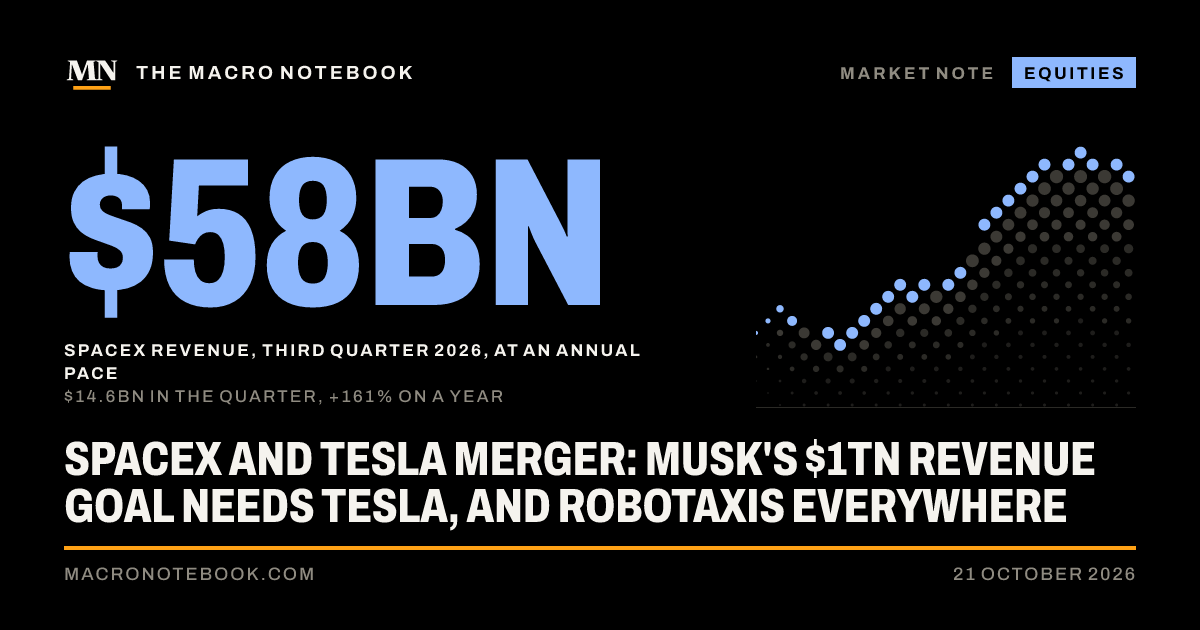
SpaceX’s revenue was $14.6bn in the third quarter, up 161% on a year, its results filed with the SEC show. That is about $58bn at an annual pace. To take in $1tn in 2028, it would need to average $250bn a quarter, 17 times what it made in the third quarter.
The target has moved fast. In June, two days after the listing, Musk wrote that he “would be surprised if revenue were not greater than $1-trillion in 2031”, Reuters reported. In four months the date has come forward three years. The finance chief kept the nearer goal, a $100bn run rate by December, and guided to first-quarter 2027 revenue of $33bn to $37bn, according to the 24/7 Wall St. account.
A run rate is not a year’s revenue. It takes one month or quarter and multiplies it, so a company growing this fast shows a run rate well above what it books in the calendar year. The 2027 range is a run rate; the 2028 post is about revenue.
What the AI business would have to earn
Most of the growth now comes from computing power. The Super Intelligence segment, which rents computing capacity and sells Grok, made $7.6bn in the quarter, on capacity of 1.7 gigawatts at the end of September. That works out at about $18bn of yearly revenue per gigawatt, on our numbers. It is a rough measure, as the capacity was added through the quarter.
Musk said he was “fairly confident” of adding 10 gigawatts in 2027, according to the call report. At today’s revenue per gigawatt, 10 more gigawatts would add about $180bn a year. To reach $1tn from computing alone at that rate would take more than 50 gigawatts. Every gigawatt also costs money first: SpaceX spent $19.6bn on capital projects in the third quarter alone, as we reported yesterday. And each needs power, which is already stopping some AI data centres.
Why Tesla is the missing piece
Tesla adds revenue at once, but not growth. Its revenue was $28.0bn in the third quarter, roughly flat on a year, its quarterly update shows. Deliveries fell 2%.
Revenue at an annual pace, third quarter 2026, $bn
Revenue at an annual pace, third quarter 2026, $bn. Source: SpaceX and Tesla third-quarter 2026 results (Form 8-K exhibits): quarterly revenue multiplied by four. The $1tn line is Musk's 2028 goal.
SpaceX
58
Tesla
112
Combined
170
Musk's 2028 goal
1000
Source: SpaceX and Tesla third-quarter 2026 results (Form 8-K exhibits): quarterly revenue multiplied by four. The $1tn line is Musk's 2028 goal.The Macro Notebook
Put together, the two companies take in about $170bn a year at their current pace. A combined company would still need about six times its revenue to reach $1tn. No plausible path in rockets, satellites or car sales closes that gap in two years. The only business big enough is the one Tesla has promised for years: cars that drive themselves, sold as rides.
That business is still small. Tesla’s robotaxis had driven nearly 2 million unsupervised miles in total by the end of September, eight times the total three months earlier, and Cybercab rides began in Austin on 3 September, the update says. Its paid self-driving software, which still needs a driver watching, had 1.74 million active subscriptions. On its call, Tesla gave the second quarter of 2027 for unsupervised driving in owners’ cars, first by adding them to its robotaxi fleet and only inside robotaxi zones, Electrek reported.
So the $1tn case needs three things at once: SpaceX’s computing business growing several times over, a merger that adds Tesla’s revenue, and robotaxis moving from a few cities to mass use within about a year. If any one is late, the target slips. A slower path, with SpaceX alone and self-driving spreading over years, still reaches $1tn, but more likely near the 2031 date Musk gave in June.
Who decides on a SpaceX and Tesla merger
Musk would sit on both sides of the deal, and the voting power is uneven. After the June listing he held about 82.4% of SpaceX’s votes, its prospectus shows, through Class B shares that carry ten votes each. At Tesla, where each share has one vote, he owns 19.8%, Tesla’s proxy statement says. Unless the terms prevent it, a combined company would likely give him more say over Tesla’s business than he has now.
The boards are close too. The same proxy shows that Tesla director Ira Ehrenpreis has sat on SpaceX’s board since February 2026, and that Kimbal Musk, Elon’s brother and a Tesla director, has also served on SpaceX’s board. Tesla already holds SpaceX shares: a $2bn investment in xAI in January became a SpaceX stake when SpaceX bought xAI in February. Musk said a deal would need the support of both sets of shareholders.
What to watch
The committees. Any terms, the share-swap ratio above all, and whether either committee hires its own advisers.
3 December. Tesla’s annual meeting, where shareholders can question the board. A merger is not on the agenda yet.
SpaceX’s December run rate. The $100bn goal is the first test of how fast the AI business really grows.
Robotaxi cities. Each new city without safety drivers is a step towards the volume the $1tn case needs.
Disclosure
This is analysis and opinion, not investment advice.
WeeklyThe Notebook by email
The week, in one email
Once a week: the stories we published, and the releases and decisions due in the week ahead. Free. One click stops it.
We email you a link to confirm. By signing up, you agree to the Terms and the Privacy policy.
Check your email. We sent a link to . Open it within 15 minutes to confirm.
You are signed in as . You can change this on your Saved page.
You get the weekly email. To stop it, use the link at the end of any of them, or your Saved page.
The lek has not bought so many euros since at least 1995, when Eurostat's records begin. In September 2026 a euro cost 91.85 lek on average, the lowest monthly figure in those records. In 2019 it cost 123.01. Put the other way round, the lek now buys 33.9% more euros than it did in 2019, and 37.7% more dollars.