Brazil’s election goes to a run-off on Sunday, and the race is a statistical tie. Senator Flávio Bolsonaro has 47% of voting intentions against 45% for President Luiz Inácio Lula da Silva, Datafolha’s latest poll shows. With a margin of error of two points either way, neither leads. Counting only valid votes, it is 51% to 49%.
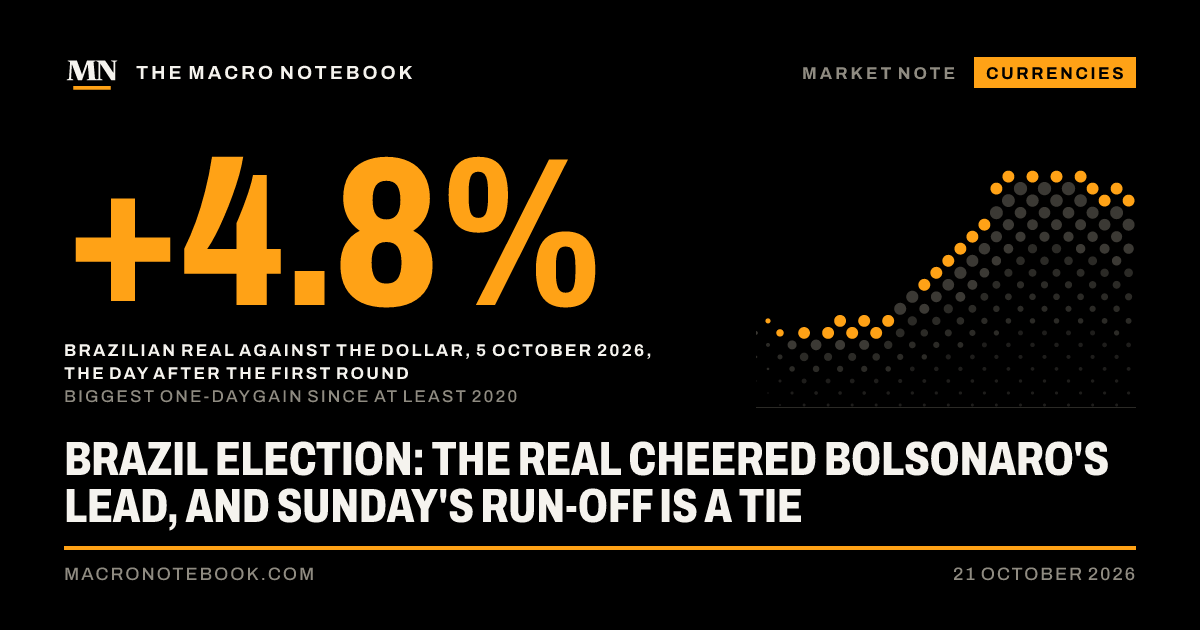
The currency has already voted once. When Mr Bolsonaro came first in the first round on 4 October, the real rose 4.8% against the dollar in a day. That was its biggest one-day gain in at least six years.
The senator’s lead has narrowed since. In Datafolha’s first run-off poll, taken on 6 and 7 October, he led by 49% to 45%, a four-point gap. A week later Lula held 45% and Mr Bolsonaro slipped to 47%. Another 6% would vote blank or spoil their ballot, and 2% are undecided.
Few voters are still moving. 93% say their choice is final. The voters who backed the smaller first-round candidates may decide it: of those, 46% now lean to Mr Bolsonaro and 27% to Lula, with the rest blank, spoiled or undecided.
The country is split along familiar lines. Lula leads by 61% to 32% in the Northeast and by 53% to 38% among voters on incomes of up to two minimum wages. Mr Bolsonaro leads by 62% to 29% among evangelical Christians and by 57% to 35% in the South.
How the real reacted to the first round
The real is the clearest market read on the race. On Friday 2 October, before the vote, a dollar cost R$5.2238 at the central bank’s PTAX rate, the Banco Central do Brasil’s data show. On Monday 5 October, after Mr Bolsonaro’s first place, it cost R$4.9859. The real gained 4.8% in one session.
Biggest one-day gains of the Brazilian real against the dollar since 2020, %
Biggest one-day gains of the Brazilian real against the dollar since 2020, %. Source: Banco Central do Brasil, PTAX selling rate (SGS series 1), daily, January 2020 to October 2026.
5 Oct 2026, after the first round
4.77
9 Nov 2020
4.72
3 Jun 2020
4.13
3 Oct 2022, after the first round
3.97
Source: Banco Central do Brasil, PTAX selling rate (SGS series 1), daily, January 2020 to October 2026.The Macro Notebook
The same thing happened four years ago. After the first round of 2022, which sent Jair Bolsonaro into a run-off against Lula, the real rose 4.0% in a day. Both times, the currency jumped the day after a first round that put a Bolsonaro in the run-off.
As Mr Bolsonaro’s poll lead narrowed, the real gave some of its gain back. It weakened to R$5.0826 per dollar on 16 October, the day the second Datafolha poll came out, and was R$5.0140 on 20 October. It is still 11% stronger than at the end of 2025, when a dollar cost R$5.5739.
Why investors care: debt and interest rates
The money at stake is the state’s. Brazil’s gross general government debt was 82.9% of GDP in August, central bank figures show. It was 71.7% in December 2022, the month before Lula’s third term began, and has risen in most months since.
That debt is expensive to carry. The central bank’s Selic target rate is 13.75%, its data show. The bank raised it to 15% in June 2025 and has cut it five times this year, by a quarter-point each time, most recently on 17 September. A government that borrows at those rates sees its debt grow fast unless it runs a surplus before interest.
So the run-off is, for markets, a question about the budget. Investors will look at whoever wins for signs of how the next government plans to stabilise the debt, and at the central bank for how far it keeps cutting.
What the Brazil election means beyond Brazil
Brazil is not alone in this. France’s bond yields rose after the riots of 17 October, as investors priced the political cost of closing a deficit. In both countries, politics now moves the price of the currency or the debt.
What to watch
Sunday 25 October. The run-off. The electoral court publishes the count as it comes in.
Monday 26 October. The real’s first session after the vote. A move on the scale of 5 October would show how far the result was already priced.
The final polls. Datafolha’s last survey before the vote, and whether Lula closes the two-point gap.
Disclosure
This is analysis and opinion, not investment advice.
WeeklyThe Notebook by email
The week, in one email
Once a week: the stories we published, and the releases and decisions due in the week ahead. Free. One click stops it.
We email you a link to confirm. By signing up, you agree to the Terms and the Privacy policy.
Check your email. We sent a link to . Open it within 15 minutes to confirm.
You are signed in as . You can change this on your Saved page.
You get the weekly email. To stop it, use the link at the end of any of them, or your Saved page.
The lek has not bought so many euros since at least 1995, when Eurostat's records begin. In September 2026 a euro cost 91.85 lek on average, the lowest monthly figure in those records. In 2019 it cost 123.01. Put the other way round, the lek now buys 33.9% more euros than it did in 2019, and 37.7% more dollars.