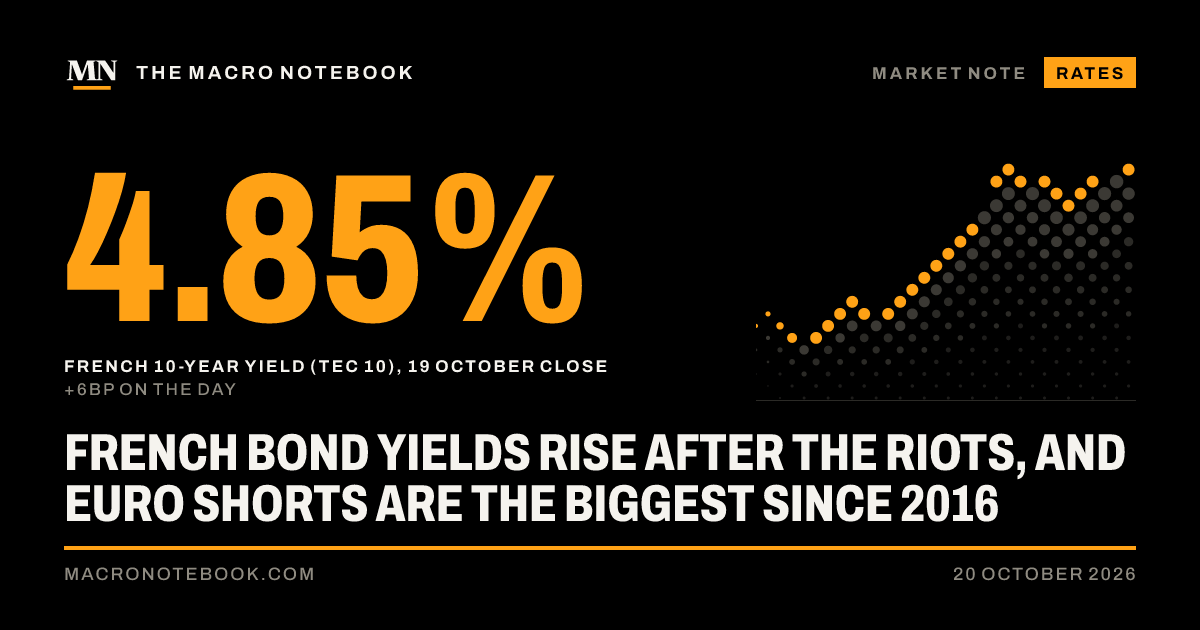
French bond yields rise afterthe riots, and euro shortsare the biggest since 2016
French bond yields rose to 4.85% after riots burned Limoges town hall. The gap over Germany is 139bp, and speculators hold their biggest euro bet since 2016.
French bond yields rose again on Monday, the first trading day after a weekend of riots in which protesters burned down the town hall of Limoges. The 10-year yield closed at 4.853%, up 6bp from Friday, the Banque de France’s daily benchmark shows. That is close to this autumn’s high of 4.903%, set on 1 October, and 74bp above the end of August.
The move on the day was modest. The worry behind it is not. France is a heavily indebted country heading into a presidential election, and its streets are now in the news as well as its budget.
What happened in Limoges
The fire came at the end of a march on Saturday 17 October, one of many across France against the cost of living, alongside marches by school students. The 19th-century town hall was set alight, its roof partly fell in and two-thirds of its front was lost, franceinfo reported. “It is a monument that is burning, but it is not the Republic,” said the mayor, Guillaume Guérin. There was violence on the edge of marches in several cities, and the prime minister, Sébastien Lecornu, called for partial, local curfews.
As we reported on 18 October, cost of living protests have spread across Europe. They are not only French: Italy and Portugal have had them too.
Why French bond yields are rising
Investors ask more to lend to France than to Germany, and that extra has grown quickly. Germany’s 10-year yield was 3.46% on Monday, the Bundesbank says. France paid 139bp more, against 82bp on 7 September and 134bp last Friday. The widest this autumn was 144bp, on 2 October. The two central banks measure their yields in slightly different ways, so the gap is a guide rather than an exact price.
Two things drive it. The first is debt. France’s public debt was 119.0% of GDP at the end of June, Insee says. The second is politics. A government that must cut spending faces voters who protest against higher prices. A government that does not cut faces lenders who charge more, which makes the deficit harder to close. Riots make that trap more visible, because they raise the political cost of cutting.
Monday’s move was small next to that. The yield is still below its 1 October high, and the gap to Germany below its 2 October peak. The market took the riots as one more reason for caution, not as a shock.
Bets against the euro are the biggest since 2016
The clearer signal is in currencies. Speculators in euro futures on the Chicago Mercantile Exchange held a net short position of 137,573 contracts on 13 October, the Commodity Futures Trading Commission reported. Each contract is worth €125,000, so the bet that the euro will fall is worth about €17bn. It grew by more than a third in a single week, and it was the largest since 12 January 2016, the commission’s historical data show. Those figures predate the riots.
Speculators' net short position in euro futures, thousand contracts
Speculators' net short position in euro futures, thousand contracts. Source: Commodity Futures Trading Commission, Commitments of Traders, legacy futures only, Euro FX (CME), non-commercial longs minus shorts, Tuesdays.
1 Sep
24.9
8 Sep
42.6
15 Sep
27.0
22 Sep
52.3
29 Sep
63.3
6 Oct
99.3
13 Oct
137.6
12 Jan 2016
146.5 (for comparison)
Source: Commodity Futures Trading Commission, Commitments of Traders, legacy futures only, Euro FX (CME), non-commercial longs minus shorts, Tuesdays.The Macro Notebook
The euro has already fallen. The European Central Bank’s reference rate was $1.1225 on Monday, its data show, down from $1.1590 on 1 September, a fall of 3.1%. The low so far was $1.1177 on 7 October. We explained on 6 October how French debt and Spain’s snap election drove the first leg of that fall.
What French bond yields mean beyond France
France’s problem is a common one in a sharper form. Many rich countries run large deficits and pay more interest as yields rise. What sets France apart is that the political cost of closing the gap is now on the streets, months before an election. That is why investors watch it: if the trap holds there, they will price it elsewhere.
What to watch
The streets. Further protests, and whether the curfews hold.
The budget. Any retreat on savings in the 2027 budget would show up in the gap to Germany.
The next positioning data. The CFTC publishes figures for 20 October on Friday 23 October, the first to cover the days after the riots.
The 1 October high. A close above 4.903% would take French yields to a new high for this autumn.
Disclosure
This is analysis and opinion, not investment advice.
WeeklyThe Notebook by email
The week, in one email
Once a week: the stories we published, and the releases and decisions due in the week ahead. Free. One click stops it.
We email you a link to confirm. By signing up, you agree to the Terms and the Privacy policy.
Check your email. We sent a link to . Open it within 15 minutes to confirm.
You are signed in as . You can change this on your Saved page.
You get the weekly email. To stop it, use the link at the end of any of them, or your Saved page.
The lek has not bought so many euros since at least 1995, when Eurostat's records begin. In September 2026 a euro cost 91.85 lek on average, the lowest monthly figure in those records. In 2019 it cost 123.01. Put the other way round, the lek now buys 33.9% more euros than it did in 2019, and 37.7% more dollars.