Are UK house prices falling? Asking pricesare flat on a year as mortgage rates bite
Are UK house prices falling? Asking prices are 0.1% below a year ago, Rightmove says, and are falling in cheaper regions as two-year fixes reach 5.55%.
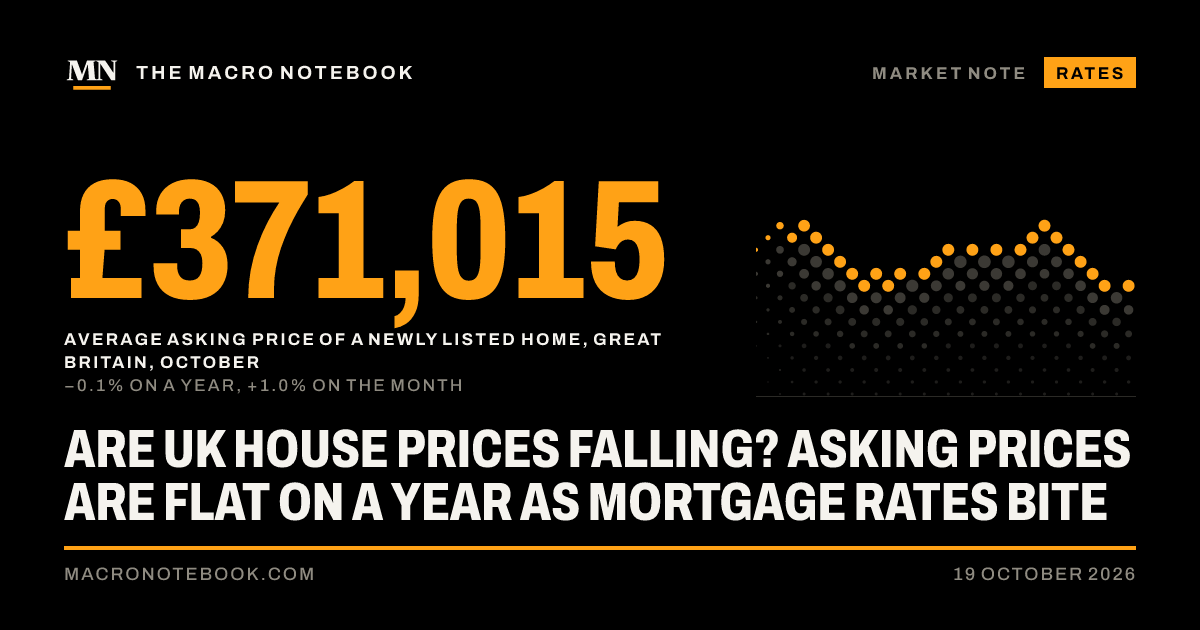
Are UK house prices falling? Not yet across the country, but they have stopped rising. The average asking price of a home put up for sale rose 1.0% this month, or £3,575, to £371,015. That leaves it 0.1% below a year ago, Rightmove said on Monday. In September prices were 0.8% lower than a year earlier.
The reason is the cost of a mortgage. Rightmove’s own tracker puts the average two-year fixed rate at 5.55%, up from 5.29% a month ago and 4.25% in February, before the war in Iran began. It says that adds about £250 a month to a typical new mortgage.
Where UK house prices are falling
The national rise hides falls in the cheaper parts of the country. New sellers in four of the five lowest-priced regions cut their asking prices this month: by 2.0% in the North East, 1.9% in Scotland, 0.6% in the North West and 0.3% in Wales. Yorkshire and the Humber was the exception, up 0.3%. Rightmove calls this an early sign that higher mortgage costs now hurt buyers even where homes are cheapest. These regions had held up well earlier in the year.
London went the other way. Asking prices in the capital rose 2.5%, the most in Great Britain, and 3.9% in inner London. But that follows a 6% fall in July and August, and London prices are still 1.7% below a year ago, the weakest of any region. Autumn usually brings more expensive homes to market in London, which lifts the average. Other London figures are weak: 38% of homes on sale have had their price cut, and a home takes 78 days on average to find a buyer.
First-time buyer homes, those with two bedrooms or fewer, were almost flat: up 0.2% on the month to £225,627, and down 0.5% on a year.
What buyers pay for a mortgage
The Bank of England’s own figures show the same jump. The average quoted rate on a two-year fixed mortgage with a 25% deposit was 5.13% in September, against 3.97% in February, Bank of England data show. The five-year fix rose from 4.00% to 4.98%. Buyers with a 10% deposit paid 5.37% for two years, from 4.34%.
UK two-year fixed mortgage rate, 75% LTV, %
UK two-year fixed mortgage rate, 75% LTV, %. Source: Bank of England, quoted household interest rates (IUMBV34), monthly average, not seasonally adjusted.
Jan 2026
3.93
Feb
3.97
Mar
4.45
Apr
5.14
May
4.91
Jun
4.80
Jul
4.79
Aug
4.92
Sep
5.13
Source: Bank of England, quoted household interest rates (IUMBV34), monthly average, not seasonally adjusted.The Macro Notebook
The rate first jumped in March and April, after the war in Iran began. It eased over the summer and has climbed again since August. We reported on 6 October that the average five-year fix on the market had reached 6%, a three-year high.
Markets expect more. Bank Rate is 3.75%, and traders put the chance of a rise at the Bank of England’s meeting on 5 November at 93%, according to Central Bank Watch, on prices at Friday’s close.
Asking prices and sold prices
Rightmove measures what sellers ask, not what buyers pay. Its figures come from 104,164 homes put on sale between 13 September and 10 October. Sold prices come later and show a market that is still rising, if slowly. The average UK house price was £273,000 in the 12 months to July, up 1.4%, the Office for National Statistics said. The annual rate was 1.5% in June. Sold prices lag: a sale is counted when it completes, often months after the price was agreed.
Demand is weaker, but sales have not collapsed. The number of sales agreed is 8% lower than a year ago, about the same gap as for the year so far. New buyers contacting agents are down 9%, while new listings are up 3%. There are more homes for sale than at this time of year in any year since 2014, Rightmove says. That gives buyers choice and keeps sellers from raising prices.
What to watch
The Budget on 28 October is next. The IFS has warned that the Chancellor must choose between tax rises and cuts, and markets will judge what the Budget means for borrowing and interest rates. Some first-time buyers are also waiting for details of the government’s Your First Home scheme for new-build homes. The Bank of England decides on rates on 5 November. Until rates come down, the cheaper regions are where price cuts are most likely to show first.
Disclosure
This is analysis and opinion, not investment advice.
WeeklyThe Notebook by email
The week, in one email
Once a week: the stories we published, and the releases and decisions due in the week ahead. Free. One click stops it.
We email you a link to confirm. By signing up, you agree to the Terms and the Privacy policy.
Check your email. We sent a link to . Open it within 15 minutes to confirm.
You are signed in as . You can change this on your Saved page.
You get the weekly email. To stop it, use the link at the end of any of them, or your Saved page.
The lek has not bought so many euros since at least 1995, when Eurostat's records begin. In September 2026 a euro cost 91.85 lek on average, the lowest monthly figure in those records. In 2019 it cost 123.01. Put the other way round, the lek now buys 33.9% more euros than it did in 2019, and 37.7% more dollars.