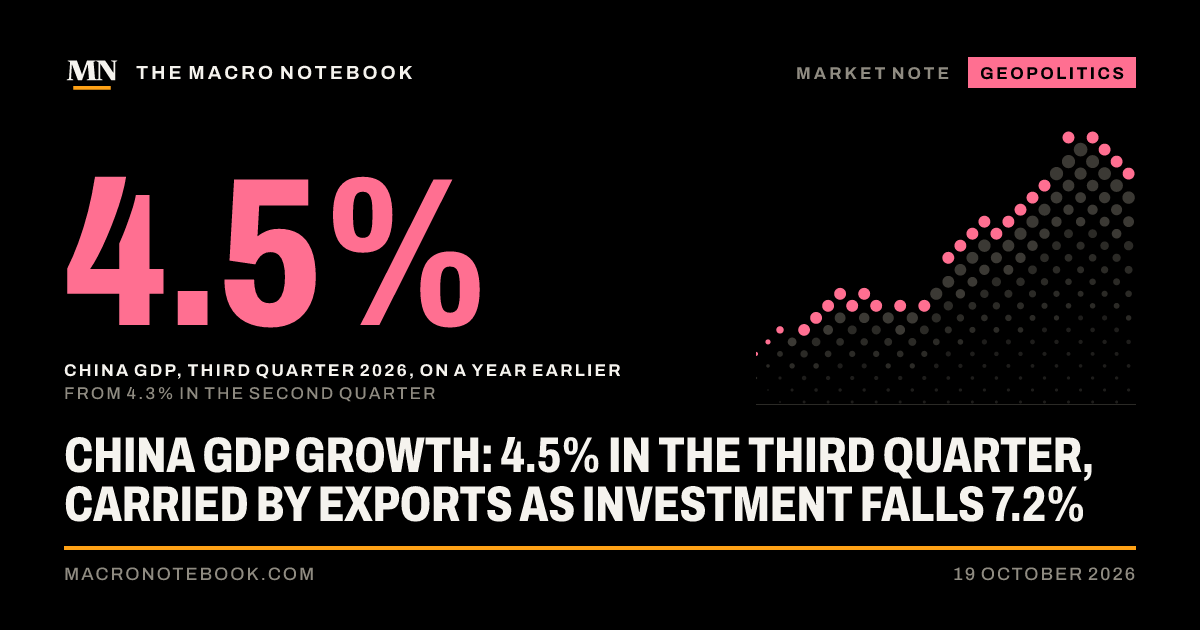
China’s GDP growth picked up to 4.5% in the third quarter from a year earlier, the National Bureau of Statistics said on Monday, from 4.3% in the second quarter. Against the second quarter, the economy grew 1.2%. Over the first nine months it grew 4.6%, to 107.1tn yuan of output.
The headline hides two economies. One sells to the world and is booming: exports of goods rose 16.4% in the first nine months, and 29.6% in September alone. The other builds and spends at home, and is shrinking: investment in fixed assets fell 7.2%, and retail sales of consumer goods rose just 1.1%.
What drove China’s GDP growth
Factories and exports did the work. Output of industrial firms above a set size rose 5.3% in the nine months. High-tech manufacturing grew 14.3% and equipment makers 10.2%. Machinery and electronics made up 64.3% of all exports, and their sales abroad rose 23.7%. Production of industrial robots rose 29.1% and of lithium-ion batteries 39.5%.
Services grew 5.2%. The fastest parts were business services, up 12.3%, and information technology and software, up 10.4%.
Trade grew on both sides. Imports rose 22.3%, faster than exports, so the gain in total trade, 18.8%, was larger than the rise in exports alone. The NBS figures are in yuan and are not adjusted for prices.
China, January to September 2026, change on a year earlier
China, January to September 2026, change on a year earlier. Source: National Bureau of Statistics of China, 19 October 2026. Industry: firms above designated size. Exports and retail sales in current yuan.
Exports of goods
+16.4%
High-tech manufacturing
+14.3%
Industry
+5.3%
Services
+5.2%
Retail sales
+1.1%
Fixed investment
−7.2%
Property investment
−20.6%
GDP
+4.6%
Source: National Bureau of Statistics of China, 19 October 2026. Industry: firms above designated size. Exports and retail sales in current yuan.The Macro Notebook
Property and private investment keep falling
Investment is where the weakness sits. Spending on property development fell 20.6% in the nine months, and sales of new homes fell 13.9% by value. Investment by private firms fell 10.4%. Infrastructure investment fell 4.2% and manufacturing investment 2.1%. Only a few areas grew: investment in intellectual property rose 9.3%, and in information services 20.2%.
Households are spending little. Retail sales of goods grew 1.1% over the nine months, and 1.1% again in September on its own. Sales of services did better, up 5.0%. Urban unemployment was 5.2% in September, 0.1 points lower than in August.
Prices are rising again
China spent much of the past few years with factory prices falling. That has turned. Producer prices rose 5.0% in September from a year earlier, up from 3.8% in August, and the prices that industry pays for its inputs rose 6.9%. Consumer prices are still tame: up 0.9% on a year in September, and 1.1% excluding food and energy.
That matters beyond China. If its factory prices keep rising, the goods it sells abroad will cost more too.
The question is how long exports can carry the load. Trading partners are pushing back. China agreed this month to cap its exports of hybrid cars to the EU, as we reported on 13 October, at less than half of this year’s level. A target that rests on sales abroad leaves China exposed to such limits.
What to watch
The official purchasing managers’ indices for October will give the first look at the fourth quarter. The key test is investment: a fall of 7.2% over nine months is large, and so far exports have made up the difference. Any new support for property or for household spending would show the government thinks that cannot last.
Disclosure
This is analysis and opinion, not investment advice.
WeeklyThe Notebook by email
The week, in one email
Once a week: the stories we published, and the releases and decisions due in the week ahead. Free. One click stops it.
We email you a link to confirm. By signing up, you agree to the Terms and the Privacy policy.
Check your email. We sent a link to . Open it within 15 minutes to confirm.
You are signed in as . You can change this on your Saved page.
You get the weekly email. To stop it, use the link at the end of any of them, or your Saved page.
The lek has not bought so many euros since at least 1995, when Eurostat's records begin. In September 2026 a euro cost 91.85 lek on average, the lowest monthly figure in those records. In 2019 it cost 123.01. Put the other way round, the lek now buys 33.9% more euros than it did in 2019, and 37.7% more dollars.