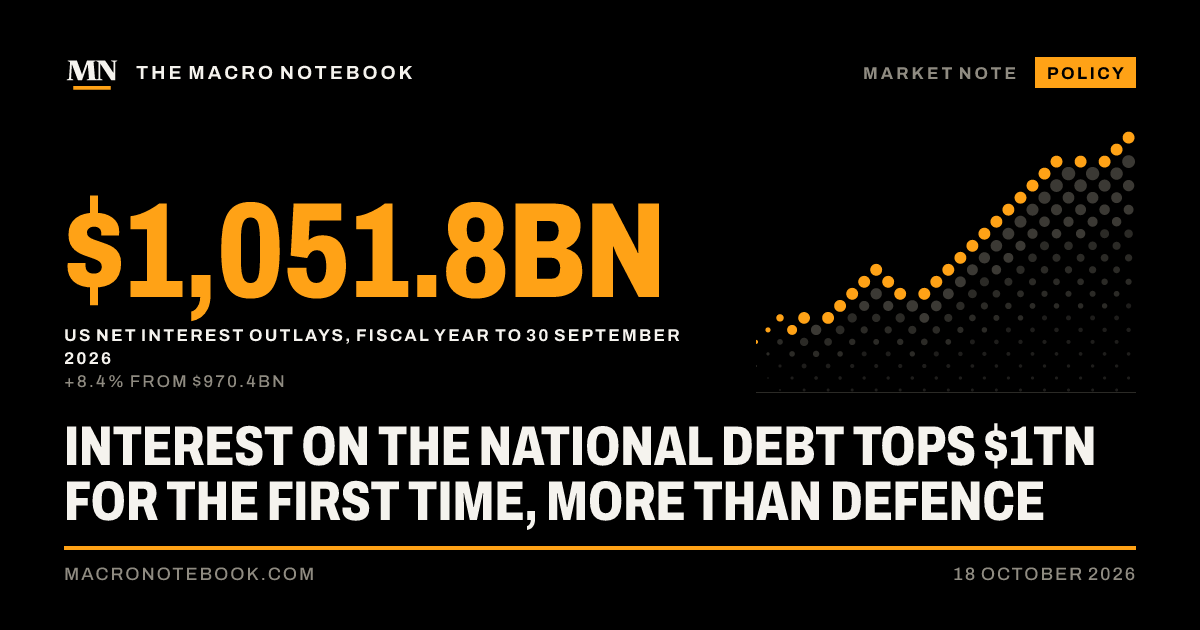
Interest on the nationaldebt tops $1tn for the firsttime, more than defence
US net interest on the national debt hit $1,051.8bn in fiscal 2026, up 8.4%, Treasury figures show. It now costs more than defence and a fifth of revenue.
Interest on the national debt passed $1tn for the first time in the year to September. The US government’s net interest outlays reached $1,051.8bn in fiscal 2026, up 8.4% from $970.4bn the year before, the Treasury’s final monthly statement for the year shows. That is about $2.9bn a day.
The same statement puts the budget deficit for the year at $1,992.5bn, up from $1,775.4bn. Receipts rose 3.2% to $5,403.3bn. Outlays rose 5.5% to $7,395.8bn. Interest grew faster than both.
A record, and more than defence
It is a record. Net interest stood at $352.3bn as recently as fiscal 2021, so it has roughly tripled in five years. Before this year, the highest figure on record was fiscal 2025’s, in the government’s own series that runs back to 1940.
US net interest on the national debt, by fiscal year, $bn
US net interest on the national debt, by fiscal year, $bn. Source: US Treasury, Monthly Treasury Statement, September of each year (fiscal years end 30 September).
2019
375.6
2020
344.7
2021
352.3
2022
475.1
2023
659.2
2024
881.7
2025
970.4
2026
1051.8
Source: US Treasury, Monthly Treasury Statement, September of each year (fiscal years end 30 September).The Macro Notebook
Interest now costs more than national defence, which took $965.2bn in fiscal 2026. It also passed health spending, at $1,025.6bn. Only two lines of the budget are larger: Social Security, at $1,667.1bn, and Medicare, at $1,072.6bn. Medicare is now just $20.8bn ahead.
Measured against revenue, interest took 19.5% of every dollar the government collected, up from 18.5% in fiscal 2025 and 8.7% in fiscal 2021. Measured against the economy, net interest was already 3.15% of GDP in fiscal 2025, a whisker below the 1991 peak of 3.16%. The 2026 share will be known once the official figures for the fiscal year’s GDP are in.
Net interest and gross interest
There are two figures for interest on the national debt, and both are in the news. Gross interest on Treasury securities was $1,360.0bn in fiscal 2026, up from $1,215.6bn. That includes $291.5bn paid to the government’s own trust funds, such as Social Security’s, which hold special Treasury securities. Those payments move money from one part of the government to another.
Net interest leaves out such internal payments and subtracts interest the government earns. It is the better measure of what the debt costs taxpayers. Interest paid on securities held by the public, by investors at home and abroad and by the Fed, came to $1,068.5bn, the statement shows.
Why the bill keeps rising
Two things drive the bill: how much the government owes and the rate it pays. Both rose. Debt held by the public reached $32.43tn on 30 September, up $2.15tn in a year, Treasury’s Debt to the Penny data show. Total public debt passed $40tn, at $40.17tn.
The average interest rate on marketable Treasury debt was 3.518% in September, according to Treasury’s average rates data, up from 3.406% a year earlier and 1.470% in September 2021. The Treasury borrowed cheaply when rates were near zero. As that debt matures, it is refinanced at today’s rates.
Today’s rates are higher still. The 10-year Treasury yield was 5.09% on 16 October, and the 3-month bill yield 4.26%, the Treasury’s daily yield curve shows. Both are well above the 3.518% average. So each bond that matures and is rolled over adds to the bill, even if the debt stopped growing.
What to watch next
The Federal Reserve meets on 28 October. Markets put the chance of a rate rise at that meeting at about 16%, and of a higher rate by December at about 88%, according to Central Bank Watch, at the close on 16 October. Any rise feeds through quickly to Treasury bills, which are refinanced every few weeks.
The Treasury will publish its statement for October, the first month of fiscal 2027, on 12 November. Watch the interest line, and whether rising costs push the Treasury to sell more bills and fewer long bonds at its next quarterly refunding.
Disclosure
This is analysis and opinion, not investment advice.
WeeklyThe Notebook by email
The week, in one email
Once a week: the stories we published, and the releases and decisions due in the week ahead. Free. One click stops it.
We email you a link to confirm. By signing up, you agree to the Terms and the Privacy policy.
Check your email. We sent a link to . Open it within 15 minutes to confirm.
You are signed in as . You can change this on your Saved page.
You get the weekly email. To stop it, use the link at the end of any of them, or your Saved page.
The lek has not bought so many euros since at least 1995, when Eurostat's records begin. In September 2026 a euro cost 91.85 lek on average, the lowest monthly figure in those records. In 2019 it cost 123.01. Put the other way round, the lek now buys 33.9% more euros than it did in 2019, and 37.7% more dollars.