A daily read on economics, equities and geopolitics.
Markets now
UST 2Y 4.65% ▼16bp
UST 10Y 4.96% ▼17bp
UST 30Y 5.29% ▼13bp
BUND 10Y 3.42% ▼2bp
EURUSD 1.1205 ▼0.3%
USDJPY 157.05 ▼0.5%
GBPUSD 1.3376 ▼0.2%
EURALL 90.64 ▼0.10
GOLD 4,023.66 ▼2.5%
SILVER 54.56 ▼5.1%
BTC 81,328 ▼3.3%
ETH 2,386 ▼3.5%
CommoditiesMarket noteFriday 23 October 2026, 09:20
Why is diesel more expensive than gas?The gap is close to a record $2 a gallon
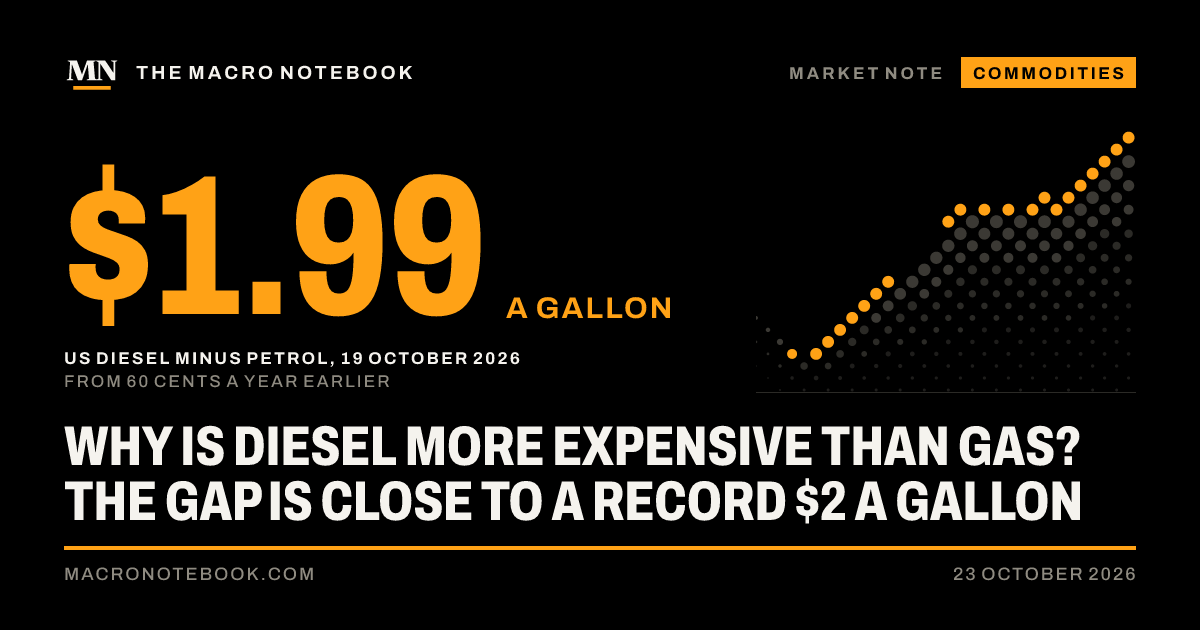
Why is diesel more expensive than gas? In the US it costs $1.99 a gallon more, near the record gap. Refining and distribution cause it, not crude oil or tax.
In the US, where petrol is called gas, diesel is more expensive because the world is short of it, and the refining and selling of each gallon take a bigger share of the price. Crude oil and taxes play a small part. On 19 October 2026 diesel cost $6.276 a gallon against $4.284 for regular petrol, the Energy Information Administration’s weekly survey shows. The gap of $1.99 is close to the record of $2.05 set on 21 September 2026.
That record is the widest since the EIA’s weekly diesel series began in March 1994, by our calculation from the weekly diesel and weekly petrol prices. The previous record was $1.61 on 28 November 2022, when Russia’s invasion of Ukraine had upended the diesel trade. A year ago, on 20 October 2025, the gap was 60 cents.
How much more does diesel cost than gas?
For most of the 1990s the two fuels cost about the same. On average over 2000, diesel cost less than a cent a gallon more than petrol. Since then diesel’s premium has grown in steps: 13 cents on average in 2005, 21 cents in 2010, 28 cents in 2015 and 45 cents in 2019. Diesel was last cheaper than petrol in the week of 24 August 2015.
The jumps come in years of shortage. In 2022 the premium averaged $1.04 a gallon. It eased to 56 cents in 2025. In the first 42 weeks of 2026 it has averaged $1.24, the most of any year in the series. Before the war in the Middle East began at the end of February, on 23 February 2026, it was 87 cents.
Diesel minus petrol, US retail, yearly average, $ a gallon
Diesel minus petrol, US retail, yearly average, $ a gallon. Source: US Energy Information Administration, weekly retail prices of No 2 diesel and regular petrol; our calculation. 2026 to 19 October.
2000
0.01
2005
0.13
2010
0.21
2015
0.28
2019
0.45
2022
1.04
2025
0.56
2026, so far
1.24
Source: US Energy Information Administration, weekly retail prices of No 2 diesel and regular petrol; our calculation. 2026 to 19 October.The Macro Notebook
Is crude oil the reason diesel costs more?
No. Both fuels come from the same barrel, so the crude in a gallon of either costs much the same. The EIA splits the pump price into four parts each month. In May 2026, the latest month it shows, a gallon of regular petrol averaged $4.48: 52% crude oil, 22% refining, 15% distribution and marketing and 12% taxes. A gallon of diesel averaged $5.60: 42% crude, 25% refining, 23% distribution and marketing and 11% taxes.
In cents, the crude oil in each gallon was almost identical, about $2.33 for petrol and $2.35 for diesel, by our calculation from those shares. Refining added about 41 cents more to diesel, and distribution and marketing about 62 cents more. Those two parts make up nearly all of the $1.12 gap in May. In the EIA’s split, both include profits as well as costs, and that is where a shortage shows up.
Why diesel cost $1.12 more than petrol in May 2026, cents a gallon
Why diesel cost $1.12 more than petrol in May 2026, cents a gallon. Source: US Energy Information Administration, Gasoline and Diesel Fuel Update; our calculation from the EIA's rounded shares, so the parts add to one cent more than the total.
Crude oil
+2¢
Refining
+41¢
Distribution and marketing
+62¢
Taxes
+8¢
Diesel minus petrol
+112¢
Source: US Energy Information Administration, Gasoline and Diesel Fuel Update; our calculation from the EIA's rounded shares, so the parts add to one cent more than the total.The Macro Notebook
Do taxes make diesel more expensive?
Only a little. The federal excise tax is 24.3 cents a gallon on diesel and 18.3 cents on petrol, and state taxes average 35.50 cents on diesel and 33.27 cents on petrol, according to the EIA’s figures for January 2026. Together that is about 8 cents a gallon. Taxes explain about 4% of today’s $1.99 gap. They explain why diesel costs a few cents more in a normal year, not why it costs $2 more now.
Why are diesel prices so high in 2026?
Diesel belongs to a family of fuels called distillates, with heating oil and jet fuel. They are traded around the world, and “international demand for distillate fuel affects U.S. diesel fuel prices”, the EIA notes. Demand also rises each autumn and winter, when heating oil competes for the same supply. Refiners cannot simply make more diesel and less petrol. In 2023 a 42-gallon barrel of crude gave US refineries 19.57 gallons of petrol and 12.47 gallons of distillate fuel, EIA data show.
The war cut supply from the world’s biggest exporting region. In March the International Energy Agency said exports of crude and refined products through the Strait of Hormuz were below 10% of their level before the conflict, as it announced the largest stock release in its history. On 11 October it pointed to “tightening global diesel markets” after new attacks on energy sites in Saudi Arabia, and asked members to release diesel faster. As we reported on 13 October, the IEA wants stocks released faster and the Russian diesel deal is small.
US stocks are thin. Stocks of distillate fuel stood at 104.3m barrels in the week to 16 October 2026, EIA data show, down from 115.6m a year earlier. That is the lowest for mid-October since the EIA’s weekly records began in 1982, by our count, below the 106.2m of October 2022.
Will the gap between diesel and gas close soon?
Not on wholesale prices. Ultra-low-sulphur diesel in New York Harbor, a main trading hub, cost $5.265 a gallon on 20 October 2026, against $2.897 for regular petrol. That wholesale gap of $2.37 is the widest since the diesel series began in June 2006, and wider than the gap at the pump. Pump prices move later than wholesale prices, so the retail gap has room to widen again.
Three things would narrow it. The first is stock releases: the G7 agreed on 2 October to release up to 100m barrels of oil and diesel over four months, as we reported. The second is a mild winter, which would leave more distillate for trucks and less for heating; oil-heated homes already face higher bills. The third is a return of normal traffic through the Strait of Hormuz.
What to watch
The EIA publishes its weekly pump prices every Monday and its stock figures every Wednesday. If distillate stocks keep falling into November, the record gap of September may not hold for long.
Disclosure
This is analysis and opinion, not investment advice.
WeeklyThe Notebook by email
The week, in one email
Once a week: the stories we published, and the releases and decisions due in the week ahead. Free. One click stops it.
We email you a link to confirm. By signing up, you agree to the Terms and the Privacy policy.
Check your email. We sent a link to . Open it within 15 minutes to confirm.
You are signed in as . You can change this on your Saved page.
You get the weekly email. To stop it, use the link at the end of any of them, or your Saved page.
The lek has not bought so many euros since at least 1995, when Eurostat's records begin. In September 2026 a euro cost 91.85 lek on average, the lowest monthly figure in those records. In 2019 it cost 123.01. Put the other way round, the lek now buys 33.9% more euros than it did in 2019, and 37.7% more dollars.