A daily read on economics, equities and geopolitics.
Markets now
UST 2Y 4.79% ▲2bp
UST 10Y 5.12% ▼3bp
UST 30Y 5.42% ▼6bp
BUND 10Y 3.45% ▼1bp
EURUSD 1.1215 ▼0.1%
USDJPY 158.13 ▼0.1%
GBPUSD 1.3347 ▲0.1%
EURALL 90.77 ▼0.33
GOLD 4,114.04 ▼0.4%
SILVER 57.79 ▲1.6%
BTC 82,944 ▲1.3%
ETH 2,446 ▲1.7%
CommoditiesMarket noteWednesday 21 October 2026, 23:30
Ghana's raw mineralexport ban: as Africa keepsits ore, watch metal prices
Ghana's raw mineral export ban by 2030 joins Congo, Gabon and Zimbabwe. Africa mines 73% of the world's cobalt and manganese, so metal prices are the test.
Ghana will ban the export of raw mineral ores by 2030, President John Mahama said on Monday. “I’ve set a clear goal that by 2030, raw mineral ores should no longer leave our shores,” he told the Mining in Motion conference, Citi Newsroom reported. He named bauxite, manganese, iron and lithium, and said the government would pursue “a phased prohibition on exports of unprocessed ores, supported by the necessary legal measures”.
The ban is a goal, not yet a law: no list of dates by mineral has been published. Ghana already bans exports of iron scrap and non-ferrous metals, Mahama said.
Ghana is the latest in a line of African governments that want ore refined at home, so that more of the value stays in the country. Buyers are courting producers at the same time: we wrote on Tuesday that the US is chasing critical minerals in Central Asia, where China already trades far more. The question for markets is what happens to metal prices if the line keeps growing. The answer depends on how much of the world’s supply the countries hold, and on whether the refineries get built in time.
Ghana raw mineral export ban: how much metal Africa mines
For some metals, Africa is most of the market.
Share of world mine output, 2025, %
Share of world mine output, 2025, %. Source: US Geological Survey, Mineral Commodity Summaries 2026: cobalt (Congo's share as estimated by the USGS), manganese (manganese content) and bauxite. Estimates for 2025.
Cobalt: Congo
73
Manganese: South Africa, Gabon, Ghana
73
Bauxite: Guinea
34
Manganese: Ghana alone
10
Source: US Geological Survey, Mineral Commodity Summaries 2026: cobalt (Congo's share as estimated by the USGS), manganese (manganese content) and bauxite. Estimates for 2025.The Macro Notebook
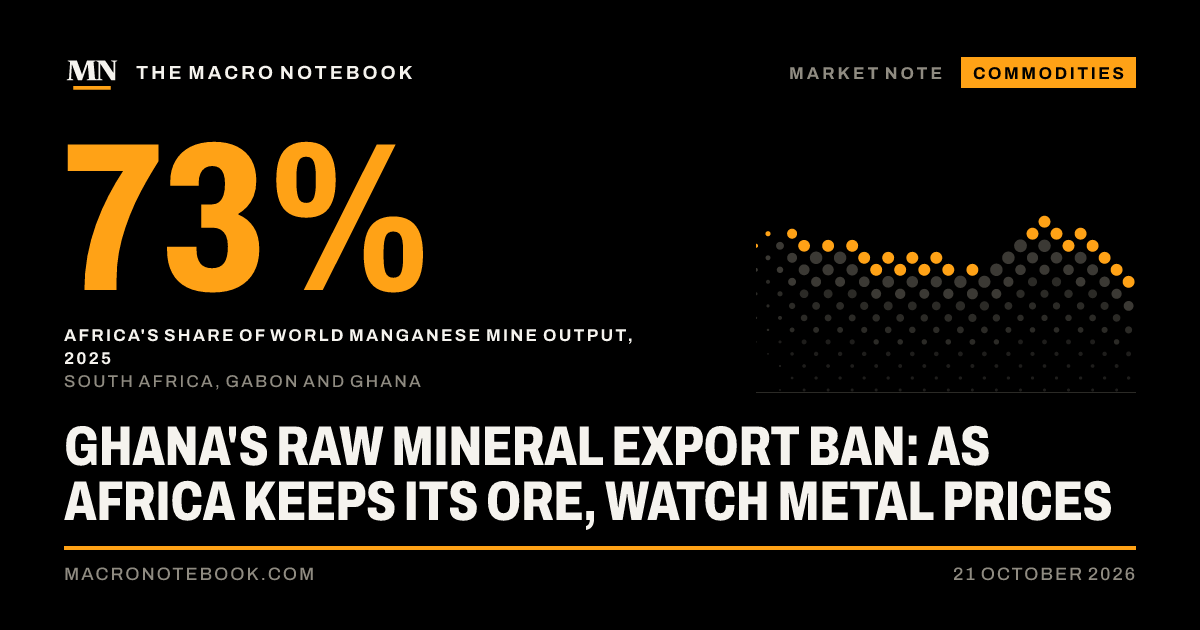
Ghana mined an estimated 2.0m tonnes of manganese, by manganese content, in 2025: about 10% of the world’s output, behind only South Africa and Gabon, the US Geological Survey estimates. The three countries together mined 73%. Manganese goes mostly into steel. Ghana on its own cannot move the price much. Ghana together with its neighbours can.
Guinea mined about a third of the world’s bauxite, the ore of aluminium: 150m of 440m tonnes, on the USGS’s figures. In August 2025 its government revoked the bauxite licences of a subsidiary of a UAE-based aluminium producer after a dispute over building a refinery, and handed them to a state-backed company.
What Congo’s cobalt ban did to the price
Congo shows what happens when the biggest supplier stops shipping. It mines about 73% of the world’s cobalt, a metal used in batteries. In February 2025 it banned cobalt exports to deal with oversupply and low prices, and in October replaced the ban with quotas of up to 96,600 tonnes a year in 2026 and 2027, according to the USGS.
The price rose. The US spot price of cobalt cathode averaged an estimated $21 a pound in 2025, up 25% from $16.77 in 2024, and the London Metal Exchange cash price rose from $11.84 to about $15. The ban worked because Congo holds most of the supply and buyers had few other sources.
Other governments are moving the same way. Gabon, the second-largest manganese miner, will ban exports of raw manganese ore from 1 January 2029, said the French group Eramet. Zimbabwe suspended exports of all raw minerals and lithium concentrate in February, ahead of a lithium concentrate ban that had been due in January 2027, Al Jazeera reported.
Why prices can fall later
A ban does not always mean scarcity for long. Indonesia, the best-known precedent, banned exports of raw nickel ore to push miners to build smelters at home. In 2019 it mined about 30% of the world’s nickel; by 2025 its share had risen to an estimated 67%, USGS figures forboth years show.
The nickel price followed a curve. The LME cash price averaged about $14,000 a tonne in 2019, rose to $25,815 in 2022, then fell back to an estimated $15,000 in 2025, as new Indonesian plants raised supply. The ban moved the processing to Indonesia; it did not make nickel scarce.
That is the two-step pattern to watch in Africa. First, prices tend to rise, as buyers lose raw supply before new refineries are ready. Then, if the plants are built and run, output returns as refined metal and prices can fall. If the plants are not built, the countries lose export income and the market stays tight. Power is a weak point: refining needs large amounts of cheap, reliable electricity. Africa is already building oil refineries to keep more of its fuel trade at home, as we reported in September; metals need the same kind of investment.
What to watch
Ghana’s law. The list of minerals, the dates and any quotas will show how fast the ban bites.
More countries. If South Africa or Guinea joins with firm dates, most of the world’s manganese, or a third of its bauxite, would come under export limits.
Prices. Manganese ore, alumina and cobalt. A sustained rise while refineries are still being built would show the bans are tightening supply.
Gabon, 1 January 2029. The first big test for manganese.
Disclosure
This is analysis and opinion, not investment advice.
WeeklyThe Notebook by email
The week, in one email
Once a week: the stories we published, and the releases and decisions due in the week ahead. Free. One click stops it.
We email you a link to confirm. By signing up, you agree to the Terms and the Privacy policy.
Check your email. We sent a link to . Open it within 15 minutes to confirm.
You are signed in as . You can change this on your Saved page.
You get the weekly email. To stop it, use the link at the end of any of them, or your Saved page.
The lek has not bought so many euros since at least 1995, when Eurostat's records begin. In September 2026 a euro cost 91.85 lek on average, the lowest monthly figure in those records. In 2019 it cost 123.01. Put the other way round, the lek now buys 33.9% more euros than it did in 2019, and 37.7% more dollars.