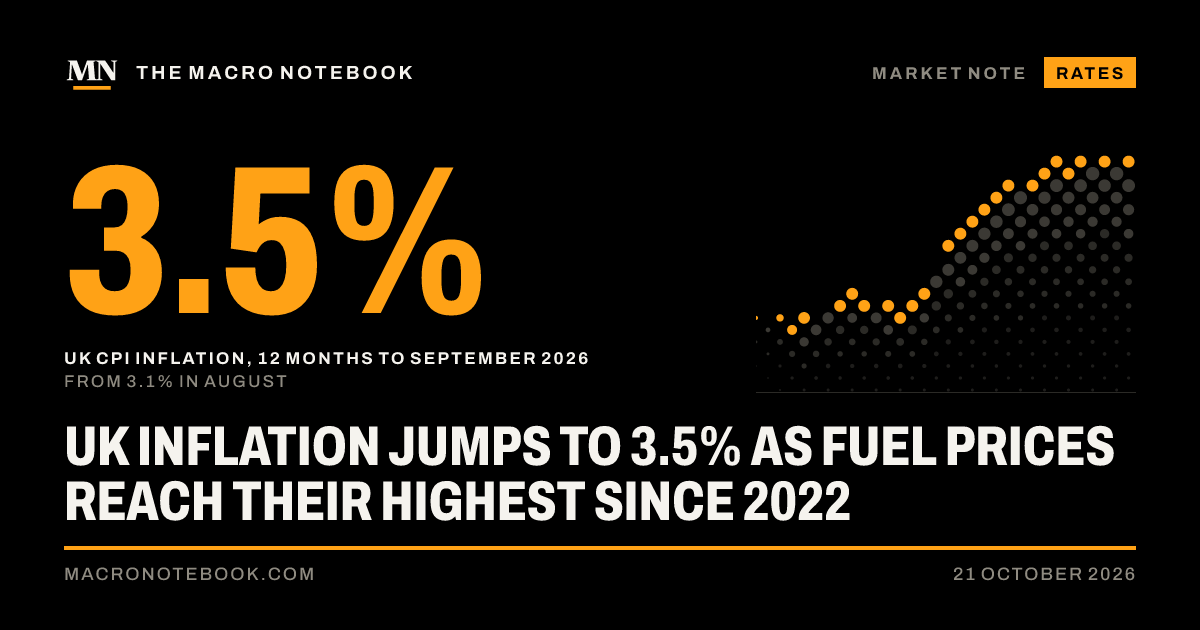
UK inflation jumps to 3.5% as fuelprices reach their highest since 2022
UK inflation rose to 3.5% in September from 3.1%, the ONS says, as petrol reached 169.5p a litre. Markets put a Bank of England rate rise on 5 November at 95%.
UK inflation jumped to 3.5% in September, from 3.1% in August, as the price of petrol and diesel rose again. Consumer prices were 3.5% higher than a year earlier, the Office for National Statistics said on Wednesday. Prices rose 0.4% in the month alone, against almost no change in September 2025.
It is the highest rate since October 2025 and the biggest one-month rise in the annual rate since April 2025, when it went from 2.6% to 3.5%, the ONS series shows. These are the last inflation figures before the Budget on 28 October and the Bank of England’s decision on 5 November.
UK CPI inflation, 12-month rate, %
UK CPI inflation, 12-month rate, %. Source: Office for National Statistics, CPI annual rate, all items (D7G7).
Sep 2025
3.8
Dec 2025
3.4
Mar 2026
3.3
Jun 2026
2.6
Jul 2026
2.9
Aug 2026
3.1
Sep 2026
3.5
Source: Office for National Statistics, CPI annual rate, all items (D7G7).The Macro Notebook
Why UK inflation rose in September
Fuel did most of the work. Motor fuel prices were 29.8% higher than a year earlier, up from 23.0% in August. Petrol rose 8.2p a litre in the month to an average of 169.5p, the highest since August 2022. Diesel rose 10.7p to 192.5p, the highest since July 2022. A year ago, both were falling. The same fuel shock is lifting prices across Europe, as we reported on 18 October.
The rise is spreading beyond the pump. Kerosene, used as heating oil, rose 22.7% in the month. Air fares fell 19.5% after the summer, less than the 28.8% fall a year earlier.
Other prices pushed up as well. Recreation and culture rose 0.7% in the month, led by live music and computer game downloads. Housing costs for owner-occupiers rose 4.0% on a year. The main thing holding the rate down was restaurants and hotels, where hotel prices rose less than a year earlier.
Food and the core rate
Food is the exception. Food and soft drink prices rose just 1.3% on a year on the ONS’s wider CPIH measure, the lowest since September 2021. The ONS notes that food makers expect their higher costs to reach shelves later and last longer, so this may not hold.
The core rate, which leaves out energy, food, alcohol and tobacco, is the one the Bank of England watches for lasting pressure. Core CPI rose to 2.8% from 2.6%. Goods inflation rose to 3.2% from 2.7%, the highest on the CPIH measure since September 2023. Services inflation, the part most tied to wages, rose to 3.7% from 3.4%.
That matters because it suggests the rise is not only about fuel.
What it means for wages
Pay has only just kept up. Regular pay, without bonuses, grew 3.7% on a year in the three months to August, the ONS said on Tuesday. But that average hides a split. Private sector pay grew 3.0%, below September’s inflation rate, while public sector pay grew 6.3%, lifted by the timing of pay awards. For most private sector workers, prices are now rising faster than pay.
The jobs market is no longer tight. The number of payrolled employees fell by 111,000 in the year to August, and vacancies fell the most since the start of the year, the ONS says.
What UK inflation means for interest rates
The Bank of England’s target is 2%. Inflation has been above it every month since October 2024, and is now moving away from it, not towards it.
The Bank cut Bank Rate to 3.75% last December and has held it since, its website shows. Markets now expect it to reverse course. Before Wednesday’s figures, futures prices put the chance of a rise on 5 November at 95%, Central Bank Watch calculates, with the rate seen at about 3.99% after the meeting, close to a full 0.25-point rise.
Gilt yields have moved ahead of the Bank. The two-year gilt yield, which tracks expected Bank Rate, was 4.91% on 16 October, the Bank’s data show, against 3.97% on 2 January. That rise feeds into fixed-rate mortgages, and as we reported on 19 October, house asking prices are now flat on the year.
The case against a rise is the economy’s weakness: falling payrolls and private pay that trails prices. The Bank’s dilemma is that higher fuel costs both raise inflation and squeeze spending. The core and services figures released on Wednesday make it harder to argue the rise will fade by itself.
Inflation and the Budget
The Treasury feels inflation too. Higher prices raise the cost of benefits and of index-linked gilts, whose interest rises with the Retail Prices Index. Also on Wednesday, the ONS said that debt interest was 16.6% higher in September than a year earlier, and that public sector net debt passed £3 trillion for the first time. The Chancellor, John Healey, presents his Budget on 28 October.
What to watch
The Budget, 28 October. Any change to fuel duty or energy bills would feed directly into the inflation rate.
The Bank of England, 5 November. The first rate rise since 2023 would mark the turn in UK rates.
October inflation, next month. Whether fuel keeps pushing the rate up, and whether food prices start to follow.
Disclosure
This is analysis and opinion, not investment advice.
WeeklyThe Notebook by email
The week, in one email
Once a week: the stories we published, and the releases and decisions due in the week ahead. Free. One click stops it.
We email you a link to confirm. By signing up, you agree to the Terms and the Privacy policy.
Check your email. We sent a link to . Open it within 15 minutes to confirm.
You are signed in as . You can change this on your Saved page.
You get the weekly email. To stop it, use the link at the end of any of them, or your Saved page.
The lek has not bought so many euros since at least 1995, when Eurostat's records begin. In September 2026 a euro cost 91.85 lek on average, the lowest monthly figure in those records. In 2019 it cost 123.01. Put the other way round, the lek now buys 33.9% more euros than it did in 2019, and 37.7% more dollars.