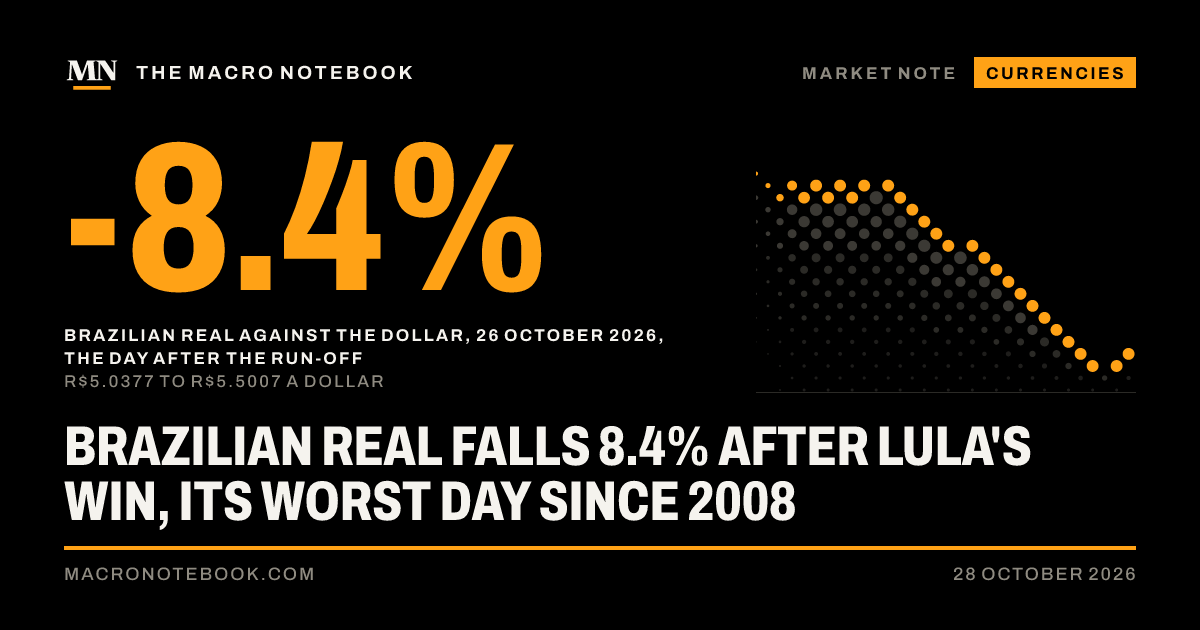
The Brazilian real had its worst day since the 2008 financial crisis on Monday, the first trading day after President Luiz Inácio Lula da Silva won a fourth term. A dollar cost R$5.5007 on 26 October, up from R$5.0377 on Friday: the real lost 8.4% in a day, the central bank’s reference rate shows. In São Paulo, the Ibovespa share index fell 13.9%, B3’s figures show, and trading stopped for half an hour soon after the open.
The real won back 3.1% on Tuesday, to R$5.3346, while shares slipped another 0.5%. Investors had bet on the other candidate, Flávio Bolsonaro, and had to unwind those bets at once. The question now is what a fourth Lula term means for Brazil’s budget, which is what bond markets price.
How bad was the Brazilian real’s fall?
By the central bank’s daily PTAX rate, 26 October was the third-largest one-day fall in the real since 1995. Only two days were worse: 15 January 1999, when Brazil gave up its fixed exchange rate and let the real float, and 8 October 2008, in the weeks after Lehman Brothers failed.
The Brazilian real's largest one-day falls against the dollar since 1995, %
The Brazilian real's largest one-day falls against the dollar since 1995, %. Source: Banco Central do Brasil, PTAX selling rate (SGS series 1); our calculation of the change in the real's value from the previous business day.
15 January 1999, the float
10.0
8 October 2008, after Lehman
8.5
26 October 2026, after the run-off
8.4
13 January 1999
8.2
18 May 2017
8.1
Source: Banco Central do Brasil, PTAX selling rate (SGS series 1); our calculation of the change in the real's value from the previous business day.The Macro Notebook
The size of the move matters as much as its direction. One day wiped out the real’s gain for the whole year: a dollar cost R$5.5024 on 31 December 2025, almost exactly Monday’s rate. After Tuesday’s rebound the real is 3.1% up on the year, but weaker than on 2 October, before the first round, when a dollar cost R$5.2238. It is still well short of its weakest reference rate, R$6.2086 on 2 January 2025.
Why did the real fall after Lula’s win?
Because the market had priced the opposite result. Mr Bolsonaro led the first round on 4 October, and the real jumped 4.8% the next day, as we reported on 21 October. The Ibovespa rose 7.7% that day, from 192,115 to 206,912. Lula then won the run-off, as we covered on Monday, and those gains went into reverse.
Behind the bet is the state of the public finances. Brazil’s gross government debt was 82.9% of GDP in August 2026, central bank figures show, up from 71.7% in December 2022, the month before Lula’s third term began. Investors who sold on Monday were betting that a fourth term will not bring the spending restraint needed to stop that ratio rising. A budget deficit that keeps the debt growing faster than the economy is what bond buyers fear most.
Brazilian bonds: the biggest one-day jump in yields on record
The bond market moved even more than the currency. The yield on the fixed-rate Treasury bond due in 2032 rose from 12.90% to 15.78% on Monday morning, a jump of 288 basis points, the Tesouro Direto price file shows. The bond due in 2029 rose 263 basis points and the one due in 2031, 293.
In the Tesouro Direto records, which start at the end of 2004, no fixed-rate bond had ever risen by so much in a day. The previous largest jumps came on 12 March 2020, in the pandemic crash, at about 200 basis points, and on 18 May 2017. The inflation-linked bond due in 2035 rose 126 basis points, to a real yield of 8.02%.
Those rates matter for the budget itself. The central bank’s Selic rate is 13.75%, its data show, and the government would now pay nearly 16% to borrow until 2032. The higher the rate, the faster the debt grows.
São Paulo stocks: the circuit breaker
B3, the São Paulo exchange, halted trading at 10:05 Brasília time on Monday, after prices signalled a 10% fall from Friday’s close, InfoMoney reported. Trading resumed at 10:38. The Ibovespa closed at 176,608, down 13.9%. In B3’s daily data since 1998, only three days were worse: 10 September 1998, and 12 and 16 March 2020. The index had not lost more than 10% in a day since 18 March 2020.
For a foreign investor the loss was larger. Measured in dollars, the Ibovespa lost 21.1% on Monday, our calculation from the B3 and central bank figures shows. On Tuesday it closed at 175,710, still 9.1% above its level at the end of 2025.
What to watch
The central bank’s next rate decision, on 4 November (its Copom calendar). The bank has cut the Selic five times this year, from 15%, by a quarter-point each time.
Lula’s economic team and his first budget statements for the new term, which begins in January.
The Treasury’s bond auctions, and whether demand returns at yields near 16%.
The Fed’s decision tonight, 28 October, which moves the dollar against every emerging-market currency.
Disclosure
This is analysis and opinion, not investment advice.
ContactWrite to the Notebook
Something to add?
Spotted an error, or a source this piece should cite? Want your own research linked or featured? Tell us. We read every message.
The lek has not bought so many euros since at least 1995, when Eurostat's records begin. In September 2026 a euro cost 91.85 lek on average, the lowest monthly figure in those records. In 2019 it cost 123.01. Put the other way round, the lek now buys 33.9% more euros than it did in 2019, and 37.7% more dollars.