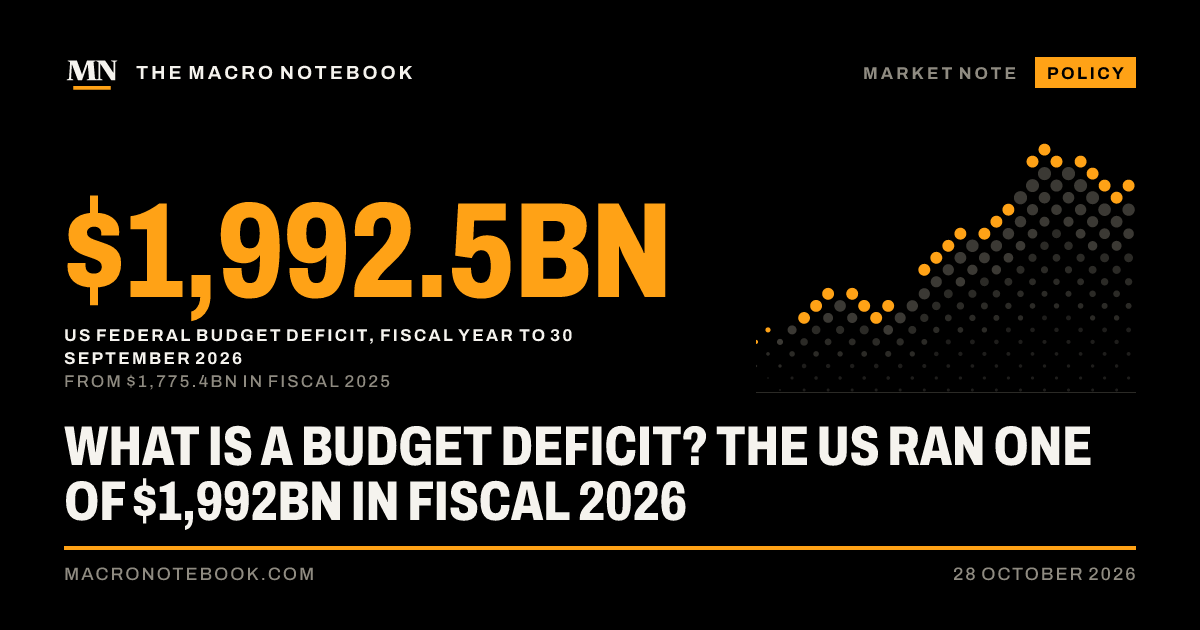
A budget deficit is the gap that opens when a government spends more in a year than it collects in taxes and other revenue. It borrows to cover the gap, by selling bonds. In the fiscal year to 30 September 2026 the US federal government spent $7,395.8bn and collected $5,403.3bn, a deficit of $1,992.5bn, the Treasury’s final monthly statement for the year shows.
That is about $5.5bn a day, and it is up from $1,775.4bn the year before. Britain’s government borrowed £134.2bn in the year to March 2026, and the chancellor, John Healey, presents his Budget today, 28 October 2026. Here is what a deficit is, how it differs from the debt, and how big the American and British ones are.
What is a budget deficit, in plain words?
Take a year of a government’s accounts. On one side are its receipts: income tax, payroll taxes, corporate tax, VAT or sales taxes, customs duties and fees. On the other are its outlays: pensions, health care, defence, welfare, salaries and the interest on what it already owes.
If outlays are larger, the year ends in a deficit.
If receipts are larger, it ends in a surplus.
If they match, the budget is balanced.
A deficit is a flow: it measures one year. Each year’s deficit is added to the stock of debt, which is everything the government owes from all past years. A government can cut its deficit and still see its debt rise, as long as the deficit stays above zero.
Economists also watch the primary deficit, which leaves out interest payments. It shows whether a government’s day-to-day spending is covered by its taxes before the bill for past borrowing.
Budget deficit vs national debt: what is the difference?
The deficit is the year’s shortfall; the debt is the pile it adds to. The US Treasury’s statement for September 2026 shows how one feeds the other. Net interest on the debt reached $1,051.8bn in fiscal 2026, more than half of that year’s deficit, as we reported on 18 October. The larger the debt, the larger the interest bill, and the harder it is to close the deficit.
Both are usually compared with the size of the economy, because a richer country can carry a larger debt and a larger deficit.
How big is the US budget deficit?
Large by its own history. The federal deficit was 5.8% of GDP in fiscal 2025, figures from the Office of Management and Budget show. Outside wars and recessions, that is high: it was 2.4% in 2015 and 4.6% in 2019, before the pandemic.
US federal budget deficit, % of GDP, selected fiscal years
US federal budget deficit, % of GDP, selected fiscal years. Source: Office of Management and Budget via FRED (FYFSGDA188S), deficit shown as a positive number. The last surplus was in fiscal 2001.
1943, Second World War
26.9
2009, financial crisis
9.8
2015
2.4
2019
4.6
2020, pandemic
14.5
2021
11.7
2024
6.2
2025
5.8
Source: Office of Management and Budget via FRED (FYFSGDA188S), deficit shown as a positive number. The last surplus was in fiscal 2001.The Macro Notebook
The record is the Second World War: 26.9% of GDP in 1943. The pandemic year of 2020 came next in modern times, at 14.5%, and the financial crisis pushed it to 9.8% in 2009. The US last ran a surplus in 2001, at 1.2% of GDP, the end of a four-year run of surpluses that began in 1998.
In fiscal 2026, receipts rose 3.2% and outlays 5.5%, the Treasury’s statement shows, so the gap widened by $217.1bn.
What causes a budget deficit?
Three things, usually at once.
The economy. In a recession, tax receipts fall as profits and wages drop, and spending on unemployment benefits rises. Economists call these the automatic stabilisers. The deficit widens without anyone voting for it, and narrows again in the recovery.
Policy. Tax cuts and new spending widen the deficit by choice. Wars have produced the largest deficits in American history.
Interest. When rates rise, the cost of rolling over old debt rises too. That is the part of the US deficit that grew fastest in 2026.
The part left over when the economy is running normally is the structural deficit. It is the one that worries bond investors, because growth alone will not close it.
Is a budget deficit bad?
Not always. Most governments run deficits in most years, and borrowing to cushion a recession, or to pay for roads and schools that serve for decades, is widely accepted. The question is whether the debt it builds grows faster than the economy, year after year.
When investors doubt that it will stop, they demand a higher yield to lend, and the interest bill rises further. Brazil showed how fast that can happen this week. Its gross government debt was 82.9% of GDP in August 2026, the central bank’s figures show, and doubts about the budget were at the heart of the market’s reaction to the election, as we wrote on 21 October.
How big is the UK budget deficit?
Britain measures its deficit as public sector net borrowing, over a financial year that runs from April to March. It was £134.2bn in the year to March 2026, our sum of the monthly figures from the Office for National Statistics shows. In the first six months of the current year, April to September 2026, the government borrowed £97.8bn, against £102.3bn in the same months a year earlier.
The ONS revises these figures often, so they may change in later releases. Today’s Budget sets out how the chancellor plans to bring borrowing down, and the Office for Budget Responsibility publishes its own forecast beside it. Before the Budget, the Institute for Fiscal Studies said the choice could take £35bn of tax rises or benefit cuts, as we reported on 12 October.
What to watch
The UK Budget and the OBR forecast, 28 October 2026: the plan for borrowing over the next five years.
The US Treasury’s monthly statement for October, due in November, the first month of fiscal 2027.
The ONS public sector finances for October, due on 20 November 2026.
Disclosure
This is analysis and opinion, not investment advice.
ContactWrite to the Notebook
Something to add?
Spotted an error, or a source this piece should cite? Want your own research linked or featured? Tell us. We read every message.
The lek has not bought so many euros since at least 1995, when Eurostat's records begin. In September 2026 a euro cost 91.85 lek on average, the lowest monthly figure in those records. In 2019 it cost 123.01. Put the other way round, the lek now buys 33.9% more euros than it did in 2019, and 37.7% more dollars.