A daily read on economics, equities and geopolitics.
Markets now
UST 2Y 4.69% ▲4bp
UST 10Y 5.00% ▲4bp
UST 30Y 5.33% ▲4bp
BUND 10Y 3.36% ▼6bp
EURUSD 1.1193 ▼0.1%
USDJPY 156.80 ▼0.2%
GBPUSD 1.3368 ▼0.1%
EURALL 90.74 ▲0.10
GOLD 3,995.84 ▼0.7%
SILVER 53.90 ▼1.2%
BTC 81,102 ▼0.3%
ETH 2,385 ▼0.1%
GeopoliticsMarket noteMonday 26 October 2026, 07:35
Serbia election results: Vučićloses, Lula wins in Brazil,and markets missed both
Serbia election results: the Student List has 52.6% to 39.3% for Vučić. Lula won Brazil with 51.8%. Betting markets had both wrong; the US votes on 3 November.
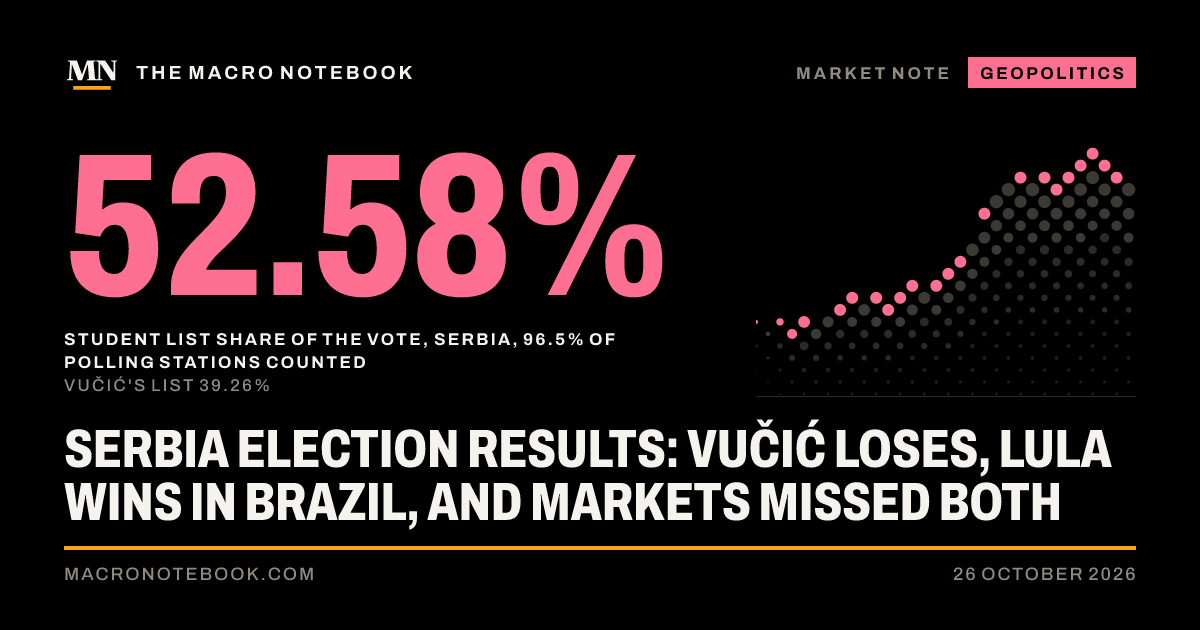
Two governments lost on Sunday, and in both places the money was on the other side. Serbia’s election results give the student-led Student List 52.58% of the vote against 39.26% for Aleksandar Vučić’s list, with 96.5% of polling stations counted, the Republic Electoral Commission’s count shows. Vučić conceded on election night. In Brazil, President Luiz Inácio Lula da Silva won the run-off with 51.79% of the valid vote against 48.21% for Flávio Bolsonaro, who had led the first round.
On the morning of the vote, betting markets gave Vučić’s list a 72% chance of winning and Lula 21%. Both were wrong. The third vote of the season, the US midterms on 3 November, is the one where the markets have priced a change of control.
Serbia election results: the count so far
The Electoral Commission had processed 8,102 of 8,392 polling stations by 08:25 on Monday. The Student List had 2,227,266 votes and “Aleksandar Vučić – United Serbia” 1,662,823. The Socialist Party of Ivica Dačić, Vučić’s partner in government for most of the past 14 years, had 2.17%, below the 3% threshold for seats. No other list passed it, though lists of national minorities face a lower bar.
“It is clear that we have lost these elections,” Vučić said before the final count, Al Jazeera reported. On his own sample he put the Student List at 135 to 140 of the 250 seats and his list at about 105. A government needs 126.
Vučić resigned as president in September to lead his list and run for prime minister, as we reported on 30 September. His party has governed since 2012. The new parliament will choose the government, and its speaker will call the presidential election that his resignation set off.
What it means for the dinar and EU money
The dinar did not move, and it was not expected to. The National Bank of Serbia manages it closely against the euro: its official rate was 117.50 dinars per euro on Monday, the bank’s figures show, against 117.48 on Friday. The market test in Serbia is not the currency but what a new government does with the budget and with Brussels.
The clearest sum at stake is European. Serbia has been allocated €1.58bn from the EU’s Reform and Growth Facility for 2024 to 2027, the Serbian government says. The money is paid in tranches only when agreed reforms are done, many of them on the rule of law. The students’ protests began over those questions, so a government formed by them will be judged in Brussels on the same list.
The betting market had read the race the other way. On Sunday morning, Polymarket traders priced Vučić’s list at 71.5% to win, its election market shows. By Sunday evening the price had collapsed.
Brazil: Lula’s fourth term, and a sell-off abroad
Lula won 64,256,232 votes and Mr Bolsonaro 59,826,041, a margin of 4.4 million, the Superior Electoral Court’s final count shows. Turnout was 80.78%. Lula came second in the first round on 4 October, and he is the first candidate to win a run-off from there. Mr Bolsonaro said he did not recognise the result and would seek to have the vote annulled, France 24 reported.
Investors had bet the other way, and that is why prices are falling. Polymarket gave Lula a 20.5% chance on the morning of the vote, its market shows. The real had risen after Mr Bolsonaro’s first-round lead: a dollar cost R$5.2238 on 2 October and R$5.0377 on Friday 23 October, a 3.7% gain for the real, central bank data show. We covered how the real cheered the first round on 21 October.
That gain is now at risk. A Tokyo-listed fund that tracks Brazil’s stock market fell nearly 15% on Monday, investingLive reported, citing Reuters. São Paulo opens at 14:00 Tirane time, after this note was written.
Market odds on the morning of the vote, and the result, %
Market odds on the morning of the vote, and the result, %. Source: Polymarket price histories, 25 October 2026, 06:00 UTC; Republic Electoral Commission of Serbia (96.5% of polling stations); Tribunal Superior Eleitoral.
Vučić list: odds of winning
71.5
Vučić list: vote share
39.3
Lula: odds of winning
20.5
Lula: valid vote share
51.8
Source: Polymarket price histories, 25 October 2026, 06:00 UTC; Republic Electoral Commission of Serbia (96.5% of polling stations); Tribunal Superior Eleitoral.The Macro Notebook
The worry is the budget. Brazil’s gross government debt was 82.9% of GDP in August, the central bank’s figures show, and investors doubt a fourth Lula term will cut spending enough to stabilise it.
US midterms: the vote the markets have priced
The US votes on 3 November for the whole House of Representatives and a third of the Senate. Here the markets expect change. Polymarket traders give the Democrats a 91.5% chance of winning the House and 64.5% for the Senate, its House market and its Senate market show.
A Democratic House would end one-party control in Washington for the last two years of the president’s term. For bond investors that matters through the budget: spending bills and any rise in the debt ceiling would then need both parties. The 10-year Treasury yield closed at 5.00% on 23 October, Treasury data show. We looked at what the 2018 midterms did to stocks on 23 October.
Serbia and Brazil are a warning on how far to trust such prices. Markets put a 72% chance on one outcome and a 21% chance on another, and both went the other way on the same day.
What to watch
Serbia: the commission’s final results, then the first sitting of parliament and the Student List’s choice of prime minister. The presidential election date follows.
Brazil: the real and the Ibovespa in São Paulo today; then the central bank’s next rate decision. Lula’s fourth term starts in January.
United States: the midterms on 3 November, after the Fed’s decision on 28 October and the first estimate of third-quarter GDP on 29 October.
Disclosure
This is analysis and opinion, not investment advice.
WeeklyThe Notebook by email
The week, in one email
Once a week: the stories we published, and the releases and decisions due in the week ahead. Free. One click stops it.
We email you a link to confirm. By signing up, you agree to the Terms and the Privacy policy.
Check your email. We sent a link to . Open it within 15 minutes to confirm.
You are signed in as . You can change this on your Saved page.
You get the weekly email. To stop it, use the link at the end of any of them, or your Saved page.
The lek has not bought so many euros since at least 1995, when Eurostat's records begin. In September 2026 a euro cost 91.85 lek on average, the lowest monthly figure in those records. In 2019 it cost 123.01. Put the other way round, the lek now buys 33.9% more euros than it did in 2019, and 37.7% more dollars.