A daily read on economics, equities and geopolitics.
Markets now
UST 2Y 4.70% ▲2bp
UST 10Y 4.99% ▼1bp
UST 30Y 5.30% ▼1bp
BUND 10Y 3.39% ▼1bp
EURUSD 1.1150 ▼0.3%
USDJPY 157.82 ▲0.2%
GBPUSD 1.3328 ▼0.1%
EURALL 90.77 ▼0.03
GOLD 4,062.73 ▲1.4%
SILVER 54.47 ▲1.1%
BTC 80,801 ▲1.0%
ETH 2,347 ▲1.1%
GeopoliticsMarket noteWednesday 28 October 2026, 09:19
Israel election results: no blochas a majority, and the shekeland Tel Aviv shares fall
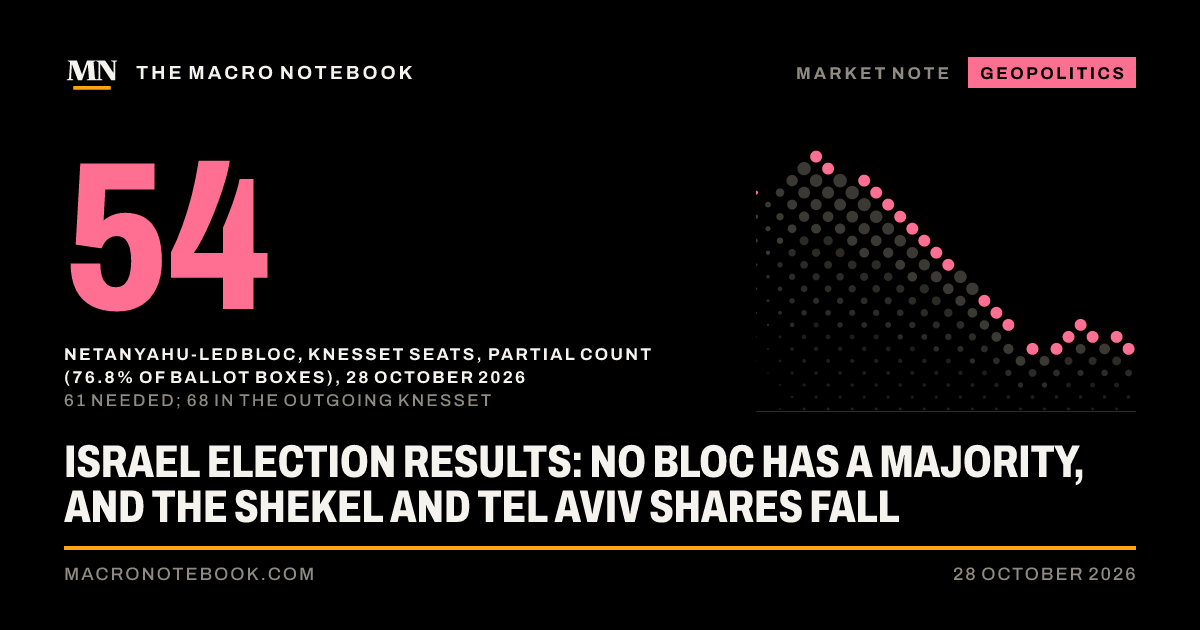
Israel election results with 76.8% counted: Netanyahu's bloc has 54 seats, Eisenkot's 47 and the Arab parties 19. The shekel fell 1%, Tel Aviv shares 1.7%.
Israel’s election has left no bloc with a majority. With 76.8% of ballot boxes counted, the bloc led by Prime Minister Benjamin Netanyahu has 54 of the Knesset’s 120 seats, the bloc led by the former army chief Gadi Eisenkot has 47, and the two Arab-led parties have 19, according to the Central Elections Committee’s partial results reported by The Times of Israel at 10:58 Israel time on Wednesday. A government needs 61.
Markets took the deadlock badly. The shekel weakened 1% to about NIS 3.08 a dollar, and the TA-125 share index fell 1.7% in Tel Aviv on Wednesday morning, the same report shows. The count will change: votes in double envelopes, including soldiers’, are counted last, and the final result will take several days.
Israel election results so far
Mr Netanyahu’s Likud is still the largest party, with 27 seats in the partial count. His bloc of Likud and four religious and nationalist parties had 68 seats in the outgoing Knesset, CNN reports. On this count it loses 14.
Israel election results: Knesset seats by party, partial count
Israel election results: Knesset seats by party, partial count. Source: Central Elections Committee partial results, 76.8% of ballot boxes counted, 10:58 Israel time on 28 October 2026, as reported by The Times of Israel. 61 of 120 seats are needed for a majority.
Likud (Netanyahu)
27
Yashar (Eisenkot)
20
Joint List
13
B'Yachad (Bennett, Lapid)
11
The Democrats
8
Yisrael Beytenu
8
Otzma Yehudit
7
Shas
7
United Torah Judaism
7
Ra'am
6
Religious Zionism
6
Source: Central Elections Committee partial results, 76.8% of ballot boxes counted, 10:58 Israel time on 28 October 2026, as reported by The Times of Israel. 61 of 120 seats are needed for a majority.The Macro Notebook
Mr Eisenkot’s Yashar has 20 seats. With B’Yachad, the Democrats and Yisrael Beytenu, his bloc reaches 47. The Arab-led Joint List and Ra’am have 19 seats between them, the most Arab parties have ever won, CNN reports. Three small parties are below the 3.25% threshold, the Reservists at 2.64% among them.
Turnout was 77.7%, up from 70.6% in 2022 and the highest since 1999, the committee’s figures show, CNN reports. Almost 5.7 million of about 7.3 million eligible voters cast a ballot.
Both leaders claim the result. Mr Netanyahu said his bloc still had the support of a “decisive majority among the Zionist and Jewish public”, and ruled out working with the Arab parties. Mr Eisenkot said that “the public has voted for change”. The parties opposed to Mr Netanyahu hold 66 seats on this count, but they span right, centre, left and the Arab parties. Mr Eisenkot has set conditions that most Arab lawmakers are unlikely to accept, and two of his allies, Avigdor Lieberman and Naftali Bennett, have ruled out a government with them.
How markets reacted to the Israel election
Investors had hoped for a clear result. Elections have wrong-footed markets this week: on Monday Brazil’s currency had its worst day since 2008 after a result traders had not expected. The shekel hit a three-week high on Tuesday, polling day, The Times of Israel reports. On Wednesday morning it gave that back.
Shares: besides the TA-125, the TA-35 of the largest companies fell 1.5% and the TA-90 of mid-sized companies 3%. Insurers fell 4.1%.
Bonds: the yield on the 10-year government bond rose 6 basis points to 4.1%, Calcalist reports, and banks and builders led the fall in shares.
The shekel: NIS 3.0843 a dollar, 1% weaker than on Tuesday.
“Investors will be looking for a stable coalition which will be able to drive fiscal policy,” Ronen Menahem, chief markets economist at Mizrahi Tefahot Bank, told The Times of Israel.
The shekel’s three-year rally
Wednesday’s fall comes after a long rise. A dollar cost NIS 4.081 on 27 October 2023, three weeks after the 7 October attacks, and NIS 2.811 on 29 May 2026, the Bank of Israel’s representative rates show: a gain of 45% for the shekel. On Monday, the last rate before the vote, it was NIS 3.078. Before this year, the dollar had last been that cheap in November 2021.
A strong shekel lowers import prices but hurts exporters, above all the technology companies that earn in dollars. A long, open coalition fight could undo part of that rally, which is why traders watch the count so closely. The war with Iran, which Mr Netanyahu mentioned in his speech, is the other risk: oil rose 4% in a day on 9 October after President Trump ruled out a new strike before the midterms. Qatari mediators have put a new draft deal to Tehran, the same Times of Israel report says.
What happens next
The final count, in the coming days, including the double-envelope votes.
Consultations with the president. Each party recommends a candidate, and the president asks the one with the best chance to form a government. That person has four to six weeks, CNN reports. If both Mr Eisenkot and Mr Netanyahu fail, Israel could vote again.
The shekel and the 10-year yield as the coalition talks go on, and the Federal Reserve’s decision tonight, 28 October, which moves the dollar against every currency.
Disclosure
This is analysis and opinion, not investment advice.
ContactWrite to the Notebook
Something to add?
Spotted an error, or a source this piece should cite? Want your own research linked or featured? Tell us. We read every message.
The lek has not bought so many euros since at least 1995, when Eurostat's records begin. In September 2026 a euro cost 91.85 lek on average, the lowest monthly figure in those records. In 2019 it cost 123.01. Put the other way round, the lek now buys 33.9% more euros than it did in 2019, and 37.7% more dollars.