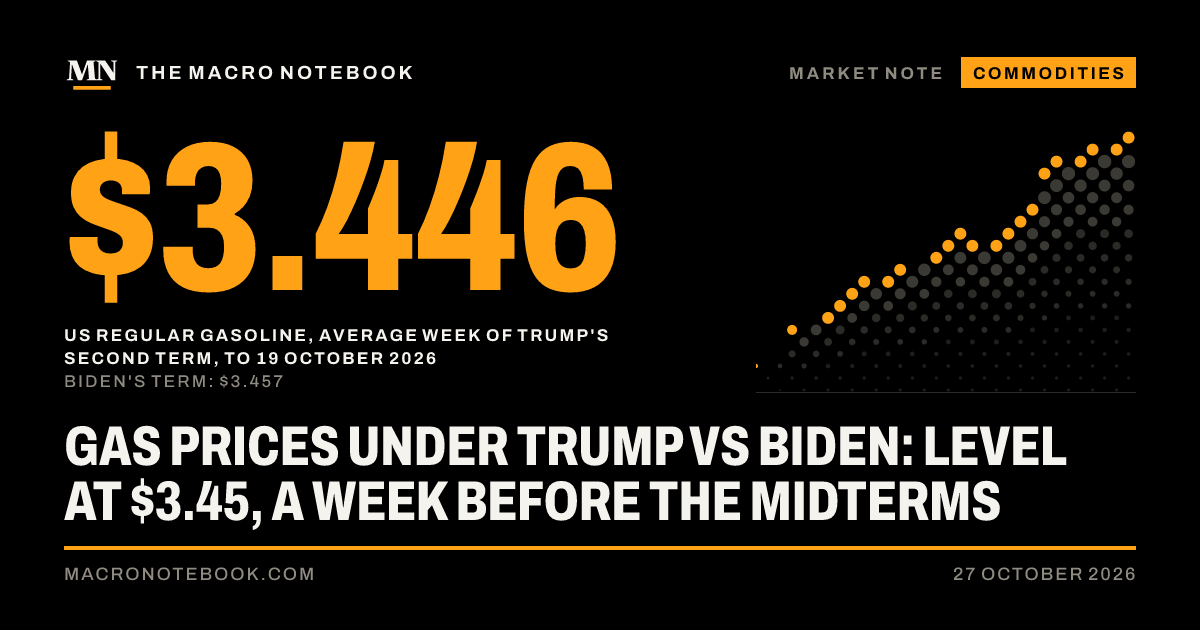
Gas prices under Trump and Biden are now all but level. Across the 92 weeks of Donald Trump’s second term to 19 October 2026, a gallon of regular gasoline has cost $3.446 on average, weekly Energy Information Administration data show. Across Joe Biden’s four years it cost $3.457: a gap of about one cent. With the pump price at $4.28 and the midterm elections on 3 November, the comparison has become a campaign line.
Our calculation from the same data shows how fast the gap is closing. If prices stay near $4.28, Mr Trump’s average passes Mr Biden’s with the EIA’s survey for the week of 2 November, the day before the vote. To stop it, the price would have to average less than about $3.98 over those two weeks.
Gas prices under Trump vs Biden: the averages
The comparison depends on which Trump term is meant, and on whether prices are adjusted for inflation.
US regular gasoline, average weekly price by term, $ a gallon
US regular gasoline, average weekly price by term, $ a gallon. Source: US Energy Information Administration via FRED (GASREGW), weeks from each inauguration; our calculation. In brackets, in September 2026 dollars, adjusted by the BLS consumer price index (CPIAUCSL).
Trump, 2017–21
2.48 ($3.30 in 2026 dollars)
Biden, 2021–25
3.46 ($3.93 in 2026 dollars)
Trump, 2025–
3.45 ($3.53 in 2026 dollars)
Source: US Energy Information Administration via FRED (GASREGW), weeks from each inauguration; our calculation. In brackets, in September 2026 dollars, adjusted by the BLS consumer price index (CPIAUCSL).The Macro Notebook
In Mr Trump’s first term, gasoline averaged $2.48 a gallon, a dollar less than under Mr Biden. Prices fell as low as $1.77 in April 2020, when the pandemic emptied the roads. Under Mr Biden they peaked at $5.01 in June 2022, after Russia’s invasion of Ukraine, and he left office with them at $3.04.
Adjusted for inflation with the consumer price index, the picture changes. In September 2026 dollars, Mr Biden’s term still averages $3.93, against $3.53 for Mr Trump’s second term so far. Prices in general rose by about a fifth during the Biden years, so a dollar at the pump then was worth more than a dollar now.
Why gas prices have risen in 2026
The second term began cheaply. In its first week, in January 2025, a gallon cost $3.11, and it fell to $2.78 in January 2026, the lowest of the term.
Then oil jumped. Brent crude rose from $61.98 a barrel on 2 January 2026 to $138.21 on 7 April, EIA figures show, as war in the Gulf cut supply. It was $115.22 on 20 October. Crude made up 52% of the pump price in May 2026, the EIA estimates, and gasoline followed it to a peak of $4.50 in the week of 11 May.
The price has eased in October, from $4.35 on 5 October to $4.28 on 19 October. It is still $1.27 a gallon higher than a year earlier, the EIA’s weekly Gasoline and Diesel Fuel Update shows. The West Coast pays most, at $5.56 a gallon, and California $6.03; the Gulf Coast pays least, at $3.78.
How high is $4.28 a gallon by Biden’s standard?
Higher than almost all of it. Of Mr Biden’s 208 full weeks in office, only 13 had a higher price than the latest week’s $4.28, all in the spring and summer of 2022. The first was the week of 14 March 2022, at $4.32, and the last the week of 25 July, at $4.33.
Presidents have little direct control over the price of gasoline, which is set by world crude markets, refinery margins and taxes. Voters still judge them by it. We wrote on 9 October that the White House had ruled out a new strike on Iran before the midterms, and oil rose 4% in a day. Diesel has risen even more than petrol, as we explained last week.
What to watch
The EIA’s next weekly survey, due on 27 October, and the one for the week of 2 November, the day before the vote. Those two readings decide whether the second-term average passes Mr Biden’s by polling day.
Brent crude, the main driver of the pump price.
The Federal Reserve’s rate decision on 28 October.
Disclosure
This is analysis and opinion, not investment advice.
ContactWrite to the Notebook
Something to add?
Spotted an error, or a source this piece should cite? Want your own research linked or featured? Tell us. We read every message.
The lek has not bought so many euros since at least 1995, when Eurostat's records begin. In September 2026 a euro cost 91.85 lek on average, the lowest monthly figure in those records. In 2019 it cost 123.01. Put the other way round, the lek now buys 33.9% more euros than it did in 2019, and 37.7% more dollars.