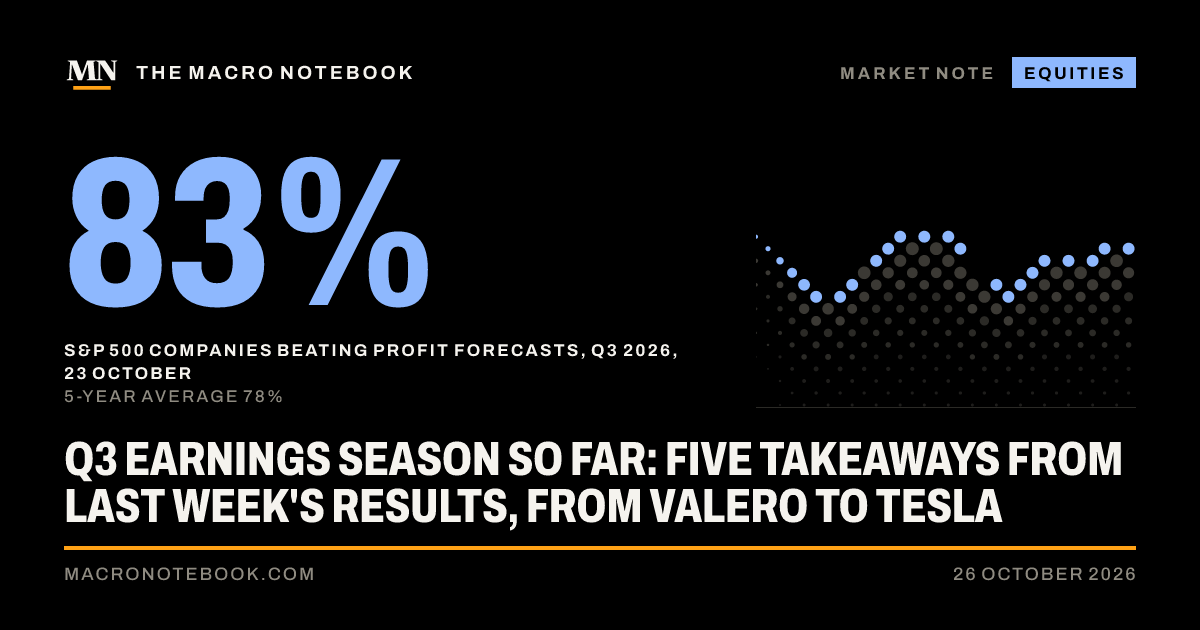
A quarter of the S&P 500 has now reported in the Q3 earnings season, and the results say more about oil and AI than about the economy as a whole. 83% of the S&P 500 companies that have reported beat analysts’ profit forecasts, above the five-year average of 78%, FactSet’s count of 23 October shows. Profits for the index are on course to rise 29.5% on a year. Last week alone brought results from Meta, Tesla, Netflix, GM, Procter & Gamble, United Airlines, Valero and American Express. Five things stand out.
1. Most companies beat, but by less than usual
Beating a forecast is the norm; the size of the beat is the news. Companies that have reported earned 2.1% more than analysts expected, against a five-year average of 7.5% and a ten-year average of 8.0%. Revenue came in 1.2% above forecasts, also below the averages, and only 66% of companies beat on sales, against 70% over five years.
The reason is that the bar was already high. At the end of September, analysts already expected third-quarter profits to grow 29.2% on a year, close to the 29.5% FactSet now counts with a quarter of results in. Forecasts that rise before the season leave less room for surprise. Ten of the eleven sectors are growing their profits; health care is the only one shrinking.
2. The oil shock moved profit from fuel buyers to refiners
The clearest pattern of the week was fuel. Valero, one of the biggest US refiners, earned $6.83bn in the third quarter, against $1.10bn a year earlier, its results show. Its refining margin was $39.24 a barrel, three times the $13.14 of a year before. The margin on diesel over Brent crude on the US Gulf Coast was $72.27 a barrel, from $21.05. Energy is now one of the sectors leading the index’s profit growth.
Refining margin per barrel, Valero, $
Refining margin per barrel, Valero, $. Source: Valero Energy, third quarter 2026 results, 22 October 2026.
Q3 2025
13.14
Q3 2026
39.24
Source: Valero Energy, third quarter 2026 results, 22 October 2026.The Macro Notebook
The other side of that margin is a bill. United Airlines paid $3.90 a gallon for jet fuel, up 60% from $2.43, its results show, and its fuel costs rose 62% to $4.84bn. Revenue grew a strong 17.4%, to $17.9bn, but adjusted earnings per share fell 8.6%, to $2.54. Procter & Gamble’s sales rose 4%, yet its core earnings rose only 1%: higher commodity costs alone cut 1.4 points from its gross margin. The oil shock is not stopping companies from selling; it is taking a slice of what they earn. We explained why diesel costs so much more than petrol on 23 October.
3. AI spending is now larger than some companies’ cash
Meta’s revenue rose 26% to $64.60bn. But it spent $34.91bn on capital projects in the quarter, more than the $32.79bn its operations produced, its results show, so its free cash flow was negative $2.12bn. We wrote about what that did to the Nasdaq on 23 October.
Tesla shows the same strain on a smaller scale. Its revenue was flat at $28.05bn and its car revenue fell 3%, but capital spending more than doubled to $4.73bn and research spending rose 69%, which Tesla puts partly down to its AI work, its quarterly update shows. Its operating margin fell to 2.6% from 5.8%, and free cash flow fell 62% to $1.53bn.
4. Growth is slowing where investors pay most for it
Netflix is profitable and growing, but more slowly. Revenue rose 11.8% on a year, down from 17.6% at the end of 2025, its letter to shareholders shows, and its operating margin widened to 34.6%. For a stock priced on growth, that was not enough: the shares fell after the results, as we reported on 22 October. Communication services, Netflix’s and Meta’s sector, is the one sector whose negative surprise FactSet singled out.
5. The consumer is still spending
The economy behind the results looks steady. American Express card members spent $454.0bn in the quarter, 8% more than a year earlier, and the share of loans written off fell to 1.8% from 1.9%, its results show. P&G sold 2% more by volume, and United’s revenue jumped.
General Motors’ revenue rose 2.9% to $50.0bn, and its adjusted earnings per share rose 32% to $3.70, its results show. It raised its forecast of automotive free cash flow for 2026 to $11.5bn to $12.5bn and approved $20bn of share buybacks. Its share of the US car market slipped, to 16.1% from 16.8%.
What the Q3 earnings season means for stocks
Strong profits have not made shares expensive. The S&P 500 trades at 18.7 times its expected earnings for the next 12 months, below its five-year average of 19.8, FactSet says. But that price has to compete with bonds. On our calculation, it gives an earnings yield of about 5.3%, against 5.00% on the 10-year Treasury on 23 October, Treasury data show. Shares offer investors only a little more than a government bond, so a profit miss or a rate rise is hard to absorb.
This week is the busiest of the season: 179 S&P 500 companies report, Alphabet and Microsoft among them on Wednesday 28 October and Amazon on Thursday 29 October, around the Fed’s decision on 28 October.
Disclosure
This is analysis and opinion, not investment advice.
WeeklyThe Notebook by email
The week, in one email
Once a week: the stories we published, and the releases and decisions due in the week ahead. Free. One click stops it.
We email you a link to confirm. By signing up, you agree to the Terms and the Privacy policy.
Check your email. We sent a link to . Open it within 15 minutes to confirm.
You are signed in as . You can change this on your Saved page.
You get the weekly email. To stop it, use the link at the end of any of them, or your Saved page.
The lek has not bought so many euros since at least 1995, when Eurostat's records begin. In September 2026 a euro cost 91.85 lek on average, the lowest monthly figure in those records. In 2019 it cost 123.01. Put the other way round, the lek now buys 33.9% more euros than it did in 2019, and 37.7% more dollars.