Is the AI bubble bursting?The Nasdaq falls 2.6% as Meta'sspending outruns its cash
Is the AI bubble bursting? Meta now spends more than its cash flow, and protests stall an Australian data centre. The Nasdaq fell 2.6% and bonds rallied.
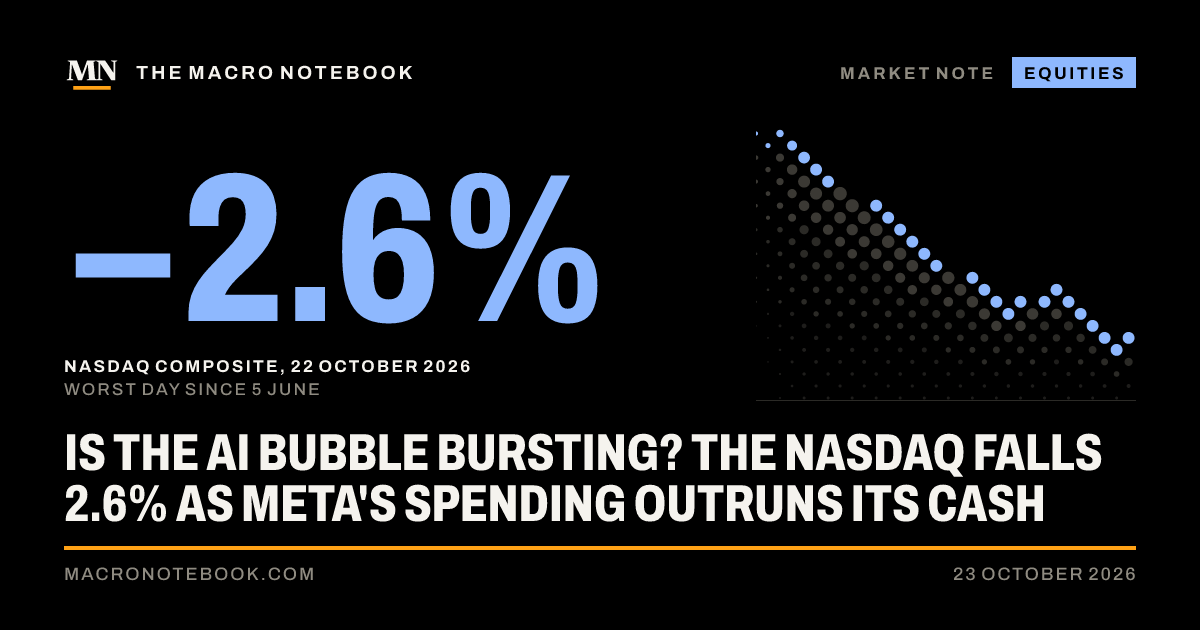
Is the AI bubble bursting? Investors asked again on Thursday, when the Nasdaq Composite fell 2.6% to 26,008.86, its worst day since 5 June, Nasdaq data show. Bonds rallied as stocks fell: the 10-year Treasury yield dropped 17 basis points to 4.96%. Two pieces of news this week fed the worry. Meta’s spending on AI now exceeds the cash its business brings in, and in Australia, local protests have held up the power line a data centre needs. Neither proves a bust. Together they show the two limits on the boom: money and power.
What happened to AI stocks on 22 October
The companies closest to the AI build-out fell hardest. Meta lost 7.0% to $648.85, according to Nasdaq. AMD fell 8.1%, Micron 6.3% and Nvidia 4.4%. CoreWeave, which rents out AI computing power, fell 10.1%. The Nasdaq 100, the index of the largest non-financial stocks on the exchange, lost 2.9%. The Nasdaq Composite is now 5.8% below its 2026 high of 6 October.
Share price fall on 22 October 2026, %
Share price fall on 22 October 2026, %. Source: Nasdaq, closing prices on 21 and 22 October 2026; our calculation.
CoreWeave
10.1
AMD
8.1
Meta
7.0
Micron
6.3
Nvidia
4.4
Nasdaq 100
2.9
Nasdaq Composite
2.6
Source: Nasdaq, closing prices on 21 and 22 October 2026; our calculation.The Macro Notebook
Meta now spends more than it earns in cash
Meta reported its third-quarter results on 21 October. Revenue rose 26% to $64.60bn, the company said. But capital expenditures, including finance leases, reached $34.91bn in the quarter, more than the $32.79bn of cash its operations produced. Free cash flow was negative $2.12bn.
Meta did not slow down. It now expects to spend $135bn to $145bn this year, narrowed from $130bn to $145bn, which raises the bottom of the range. It said it is still working on its budget for next year. For shareholders, the question is no longer whether Meta can afford the build-out from its profits. This quarter it could not, and it kept building anyway.
The second blow came from Melbourne. NEXTDC, an Australian data centre operator, said on 21 October that Jemena, the local electricity distributor, had suspended work on the power line its M3 data centre needs, citing community and stakeholder opposition, and the local council had not given consent while consultation goes on. The next increase in power now comes in the financial year that starts in July 2027.
NEXTDC took about A$140m of revenue and earnings from those contracts out of its forecast. It cut its forecast of underlying earnings before interest, tax, depreciation and amortisation for the year to June 2027 to A$245m–265m, from A$385m–410m, and cut planned spending to A$4.5bn–5.0bn from A$5.25bn–5.75bn. It has “paused projects not backed by customer contracts”, its chief executive, Craig Scroggie, said. The shares closed 41.7% lower, their worst day since the company listed in 2010, Reuters reported.
The same resistance is growing in the US. At least 75 projects worth about $130bn were blocked or delayed by local opposition in the first quarter of 2026, Data Center Watch found, and at least 45 worth nearly $68bn in the second, its next report says. Power is the bottleneck in Britain too: Microsoft walked away from Nscale’s Essex AI site last week over grid supply.
Is the AI bubble bursting, or is the build-out hitting limits?
A bubble bursts when buyers stop paying, and the clearest sign would be the biggest spenders cutting their plans. That has not happened. Meta raised the bottom of its spending range this week. NEXTDC cut its forecasts because it cannot get power, not because customers walked away: the capacity “remains under contract”, Scroggie said, and construction of the data halls is continuing.
What changed is the risk. Investors are learning that spending can run ahead of cash, and that power lines and planning rules can delay revenue by a year or more. On one measure, valuations are less stretched than the word bubble suggests. As we wrote on Tuesday, technology stocks trade at a lower price-earnings ratio than consumer staples, because profit forecasts for chipmakers have soared. Those forecasts are what a slowdown would hit first.
Bonds took the other side
Money moved into Treasuries. The 10-year yield fell to 4.96% from 5.13%, and the 2-year to 4.65% from 4.81%, Treasury data show. It was the 10-year’s biggest one-day fall since 2 August 2024, by our calculation from the Fed’s daily series, and its first close below 5% since 22 September.
Markets also see little chance of a rise in US interest rates next week. At the close on 22 October, futures put the chance of a Fed rate rise on 28 October at 8%, according to Central Bank Watch. Cheaper borrowing helps the data centre builders, many of which borrow heavily. But as we write separately today, stocks now barely pay more than bonds, which leaves little room for disappointment.
What to watch
The Fed decides on 28 October. The other cloud giants report their spending plans in the coming days, and a cut by any of them would be the clearest sign yet of a turn. In Australia, NEXTDC will announce the result of its spending review by its annual meeting on 20 November. The Victorian government is not expected to rule on its next M3 expansion until after the state election on 28 November.
Disclosure
This is analysis and opinion, not investment advice.
WeeklyThe Notebook by email
The week, in one email
Once a week: the stories we published, and the releases and decisions due in the week ahead. Free. One click stops it.
We email you a link to confirm. By signing up, you agree to the Terms and the Privacy policy.
Check your email. We sent a link to . Open it within 15 minutes to confirm.
You are signed in as . You can change this on your Saved page.
You get the weekly email. To stop it, use the link at the end of any of them, or your Saved page.
The lek has not bought so many euros since at least 1995, when Eurostat's records begin. In September 2026 a euro cost 91.85 lek on average, the lowest monthly figure in those records. In 2019 it cost 123.01. Put the other way round, the lek now buys 33.9% more euros than it did in 2019, and 37.7% more dollars.