Marco Rubio’s visit to Uzbekistan this week is Washington’s latest bid for a region that Russia once ran and China now trades with most. The secretary of state met Uzbekistan’s foreign minister, Bakhtiyor Saidov, in Samarkand on Monday, and the two agreed to deepen cooperation on critical minerals, the State Department said. Uzbekistan also signed the Artemis Accords on space exploration, the 77th country to do so, and showed interest in American civil nuclear technology.
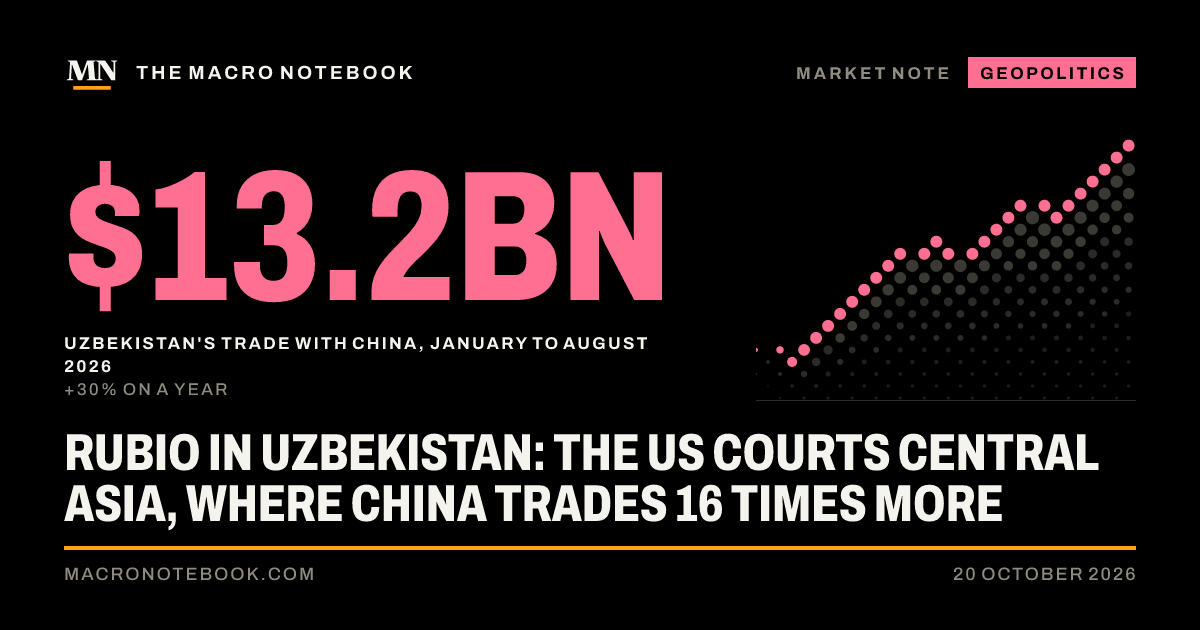
The trade figures show how far the US has to go. In the first eight months of this year Uzbekistan traded $13.2bn of goods and services with China, and $810m with the United States, its statistics committee says. China’s trade is 16 times America’s.
What Rubio wants from Uzbekistan and its neighbours
The meeting took place on the edge of the C5+1, a forum of the five Central Asian republics and the US, whose foreign ministers met in Samarkand on the same day. The six governments backed investment in the Trans-Caspian route, which runs from Central Asia to Europe across the Caspian Sea, the South Caucasus and Turkey, and so avoids Russia. They named mineral processing, energy and cybersecurity as priorities. But the joint statement put no figure on new funding, Euronews reported.
Rubio said the US was not asking the region to pick a side. “This is not about coming here to say, stop talking to somebody else,” he told Euronews.
The prize is in the ground. Kazakhstan, Uzbekistan’s northern neighbour, produced 25,839 tonnes of uranium in 2025, about 40% of the world’s mine output, the World Nuclear Association says. Uzbekistan wants partners to find and process its own minerals: Saidov proposed cooperation on exploration, processing and local industry. Washington wants more sources of the minerals used in energy technology and advanced manufacturing.
Uzbekistan’s trade: China first, Russia second
Uzbekistan’s trade grew 7.6% in the year to August, to $57.4bn. Its links with China grew fastest. Trade with China rose 30%, from $10.1bn in the same months of 2025, and China’s share reached 23.0%. Trade with Russia rose 9.7% to $9.2bn, or 16.0% of the total. Kazakhstan came third with $3.7bn.
Uzbekistan's trade in goods and services by partner, January to August 2026, $bn
Uzbekistan's trade in goods and services by partner, January to August 2026, $bn. Source: National Statistics Committee of Uzbekistan, preliminary data, 30 September 2026.
China
13.2
Russia
9.2
Kazakhstan
3.7
South Korea
1.3
Germany
0.8
United States
0.8
Source: National Statistics Committee of Uzbekistan, preliminary data, 30 September 2026.The Macro Notebook
The US is growing from a low base. Trade with it rose 33%, from $608m, but it is still 1.4% of the total, behind South Korea and level with Germany.
The flows run in different directions. Russia is the biggest buyer of Uzbek exports, at $3.2bn this year, ahead of China at $2.0bn, the committee said on Tuesday. The US is not among the top ten. China’s weight comes from what it sells: Uzbekistan imported $34.5bn of goods and services in the eight months, 16.3% more than a year earlier, and China is its biggest trading partner.
Kazakhstan sells more to America
Kazakhstan is a different case. It sold $4.07bn of goods to the US in 2025, against $986m that it bought, American customs figures show. That was the most in the series, and 73% more than the $2.35bn of 2024. Uzbekistan’s goods trade with the US is far smaller: $474m of American exports and $575m of imports last year, on the same figures.
The pattern matches what we see elsewhere. China’s exports have kept rising this year even as its home economy slowed, as we reported on Monday, and its trading partners are starting to push back, as the EU did over hybrid cars. Central Asia is one of the places where that trade grows fastest.
What to watch
The test of the visit is money. A minerals deal needs mines, processing plants and a route to market that does not run through Russia or China, and none of that has a price on it yet. Rubio told Kazakhstan he would like to visit after the G20 summit in Miami in December. Uzbekistan’s statistics committee published its August figures on 30 September; the September figures, due about a month later, will show whether China’s lead is still growing.
Disclosure
This is analysis and opinion, not investment advice.
WeeklyThe Notebook by email
The week, in one email
Once a week: the stories we published, and the releases and decisions due in the week ahead. Free. One click stops it.
We email you a link to confirm. By signing up, you agree to the Terms and the Privacy policy.
Check your email. We sent a link to . Open it within 15 minutes to confirm.
You are signed in as . You can change this on your Saved page.
You get the weekly email. To stop it, use the link at the end of any of them, or your Saved page.
The lek has not bought so many euros since at least 1995, when Eurostat's records begin. In September 2026 a euro cost 91.85 lek on average, the lowest monthly figure in those records. In 2019 it cost 123.01. Put the other way round, the lek now buys 33.9% more euros than it did in 2019, and 37.7% more dollars.