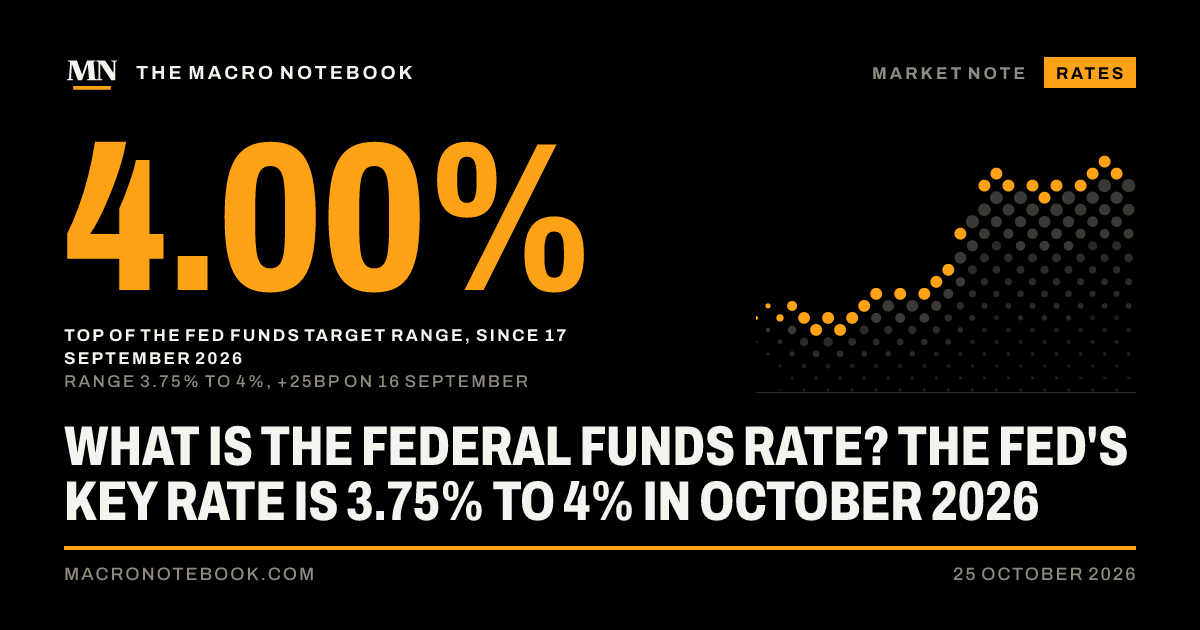
What is the federal fundsrate? The Fed's key rateis 3.75% to 4% in October 2026
What is the federal funds rate? The rate banks charge each other overnight, which the Fed steers. Raised to 3.75% to 4% in September; next decision 28 October.
The federal funds rate is the interest rate that US banks charge each other to borrow overnight. The Federal Reserve sets a target range for it, and moving that range is its main way to make borrowing dearer or cheaper across the economy. Since 17 September 2026 the range has been 3.75% to 4%, after the Fed raised it by a quarter point, its first increase since July 2023. The next decision is due on Wednesday 28 October.
What is the federal funds rate today?
There are two numbers. The target range is the Fed’s decision: 3.75% to 4% since September. The effective federal funds rate is what banks actually pay, a median of the day’s overnight loans, published each morning by the New York Fed. It was 3.88% on 22 October 2026, up from 3.63% before the increase.
“Federal funds” are the money banks hold in their accounts at the Fed, called reserves. A bank that ends the day with more than it needs lends the extra to one that is short, usually for one night. The rate on those loans feeds into what banks charge for everything else.
Who sets the federal funds rate?
The Federal Open Market Committee (FOMC) does. It has twelve voting members: the seven governors of the Federal Reserve Board, the president of the New York Fed, and four of the other eleven regional Fed presidents, who take turns on one-year terms. It holds eight scheduled meetings a year. In 2026 the last two are on 27 and 28 October and on 8 and 9 December.
The Fed has two goals set by Congress: maximum employment and stable prices, which it defines as 2% inflation. When inflation runs above the goal it raises the rate, to slow spending; when unemployment rises it cuts. In September it said “Inflation remains elevated”, and the vote to raise was 12 to 0.
How does the Fed control the federal funds rate?
It does not set the rate by decree. It sets other rates that hold the market rate inside the range. Under the implementation note of 16 September, from 17 September:
the Fed pays 3.90% on the reserves banks hold with it, so no bank has reason to lend overnight for much less;
it borrows from money funds and others at 3.75%, the bottom of the range, through its overnight reverse repo facility, which sets a floor for those lenders;
it lends to banks at 4%, the top of the range, through its discount window.
With those three rates in place, the effective rate has stayed at 3.88% since September, a little below the middle of the range.
How does the federal funds rate affect you?
Short-term borrowing moves with it almost one for one. Banks’ prime rate, the base for many credit cards and small-business loans, sits three points above the top of the range: it went to 7% in September. Rates on savings accounts and money-market funds follow it too, with a lag.
Long-term rates such as mortgages move with bond yields, which depend on where investors expect the federal funds rate to go over many years, not only on today’s level. That is why mortgage rates can rise when the Fed is cutting, or fall when it is raising. As we reported on 9 October, US mortgage rates reached 7.40%, the highest since 2023.
Why did the Fed raise the rate in 2026?
Because inflation went the wrong way. Consumer prices were 2.4% higher than a year earlier in February 2026, before energy prices jumped. The annual rate reached 4.2% in May and was 3.7% in September, by our calculation from the Bureau of Labor Statistics index. The Fed’s preferred gauge, the core PCE price index, leaves out food and energy, so it shows whether higher prices are spreading. It rose 3.0% in the year to August 2026, against 2.7% in the year to November 2025.
A central bank can often look through a jump in oil prices, which lifts prices once and then fades. When core inflation stays at 3% or more for most of a year, it is harder to ignore. A higher federal funds rate is meant to cool demand enough to bring inflation back to 2%.
How high has the federal funds rate been?
The monthly series begins in July 1954. Its peak was 19.10% in June 1981, when the Fed under Paul Volcker fought double-digit inflation. Twice it has held the range at zero to 0.25%: from December 2008 to December 2015, after the financial crisis, and from March 2020 to March 2022, in the pandemic, according to the Fed’s target series.
Effective federal funds rate, yearly average, %
Effective federal funds rate, yearly average, %. Source: Federal Reserve Board via FRED (FEDFUNDS), our calculation. 2026 is January to September.
1974
10.50
1981
16.38
1989
9.22
2000
6.24
2007
5.02
2015
0.13
2019
2.16
2021
0.08
2024
5.14
2026, so far
3.65
Source: Federal Reserve Board via FRED (FEDFUNDS), our calculation. 2026 is January to September.The Macro Notebook
The last cycle shows how fast it can move. From March 2022 to July 2023 the Fed raised the top of the range from 0.25% to 5.50%, in eleven steps. It cut six times from September 2024 to December 2025, to 3.75%, held it through the summer of 2026, and then raised it again in September, with inflation well above its goal.
Will the Fed raise rates in October 2026?
Markets think not. On the close of 23 October, futures-based odds compiled by Central Bank Watch gave a 10% chance of a rise on 28 October and 90% of no change. In its September projections the median official put the rate at 4.1% at the end of 2026, a quarter point above the middle of the current range: one more rise this year. If it does not come in October, the December meeting is the last chance. As we wrote at the time, the Fed raised rates and pencilled in one more, and the minutes of that meeting showed most officials expected another rise by the end of the year.
Disclosure
This is analysis and opinion, not investment advice.
WeeklyThe Notebook by email
The week, in one email
Once a week: the stories we published, and the releases and decisions due in the week ahead. Free. One click stops it.
We email you a link to confirm. By signing up, you agree to the Terms and the Privacy policy.
Check your email. We sent a link to . Open it within 15 minutes to confirm.
You are signed in as . You can change this on your Saved page.
You get the weekly email. To stop it, use the link at the end of any of them, or your Saved page.
The lek has not bought so many euros since at least 1995, when Eurostat's records begin. In September 2026 a euro cost 91.85 lek on average, the lowest monthly figure in those records. In 2019 it cost 123.01. Put the other way round, the lek now buys 33.9% more euros than it did in 2019, and 37.7% more dollars.