What is a recession? The definition,the record, and where the US stands in 2026
What is a recession? A broad fall in output, jobs and income that lasts months. Two quarters of falling GDP is a rule of thumb; the US uses a committee.
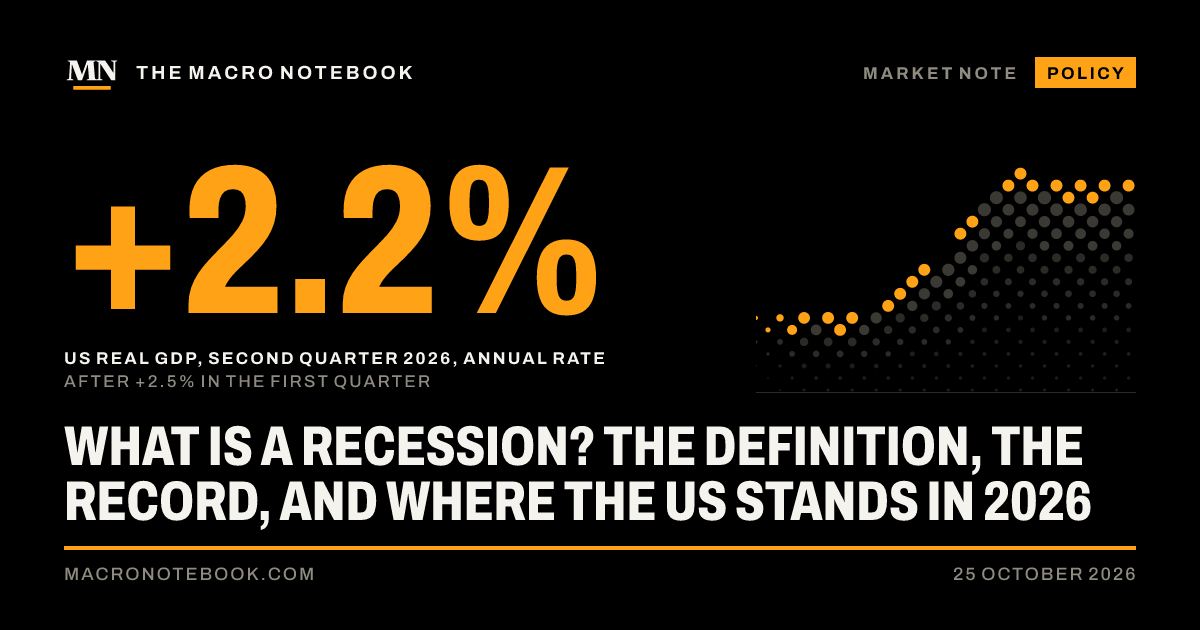
A recession is a broad fall in economic activity: output, jobs, incomes and spending shrink together across much of the economy, for more than a few months. Two quarters in a row of falling GDP is the common rule of thumb, but in the US the official call comes from a committee of economists, and it uses more than GDP. By its record, the US has had 13 recessions since 1945, and the last ended in April 2020. In the second quarter of 2026 the US economy grew at an annual rate of 2.2%.
What is the definition of a recession?
In the US, recessions are dated by the Business Cycle Dating Committee of the National Bureau of Economic Research (NBER), a private research group. Its definition, as it puts it, “emphasizes that a recession involves a significant decline in economic activity that is spread across the economy and lasts more than a few months”. It calls those three tests depth, diffusion and duration, and it treats them as “somewhat interchangeable”: a very sharp fall can count even if it is short.
The committee looks at a range of monthly figures. It says it has put the most weight on two of them, real personal income less government transfers, and the number of jobs on payrolls. It also looks at spending, sales, industrial production and GDP. There is no formula.
The committee is slow by design. It waits until it is confident that a recession has occurred, so it “tends to wait to identify a peak until a number of months after it has actually occurred”. A recession is often well under way, or even over, before it is official.
Is a recession two quarters of negative GDP?
Not in the US, though it is the rule most people know, and many other countries use it for a “technical recession”. GDP, the value of everything an economy produces, is measured each quarter, so the rule is simple to check. It can mislead both ways.
2022 is the best example. The Bureau of Economic Analysis’s first estimate, published on 28 July 2022, said real GDP fell at an annual rate of 0.9% in the second quarter, after a fall of 1.6% in the first. That met the rule. The NBER called no recession: the unemployment rate was 3.6% in June 2022, close to a 50-year low, and employers kept adding jobs. The GDP figures were later revised, and the current estimates show a fall of 1.0% in the first quarter and growth of 0.6% in the second.
The rule can also miss a recession. The NBER dates one from March to November 2001, yet in today’s figures GDP never fell for two quarters in a row that year: it shrank at an annual rate of 1.3% in the first quarter, grew 2.5% in the second and shrank 1.6% in the third.
How long do recessions last?
Not long, on average, against the good years. The NBER’s record lists 13 recessions from 1945 to 2020. They lasted 10.3 months on average, from peak to trough, and the expansions between them 64.2 months. The longest was the Great Recession, 18 months from December 2007 to June 2009. The shortest was the two months of 2020.
US recessions since 1969, months from peak to trough
US recessions since 1969, months from peak to trough. Source: National Bureau of Economic Research, US Business Cycle Expansions and Contractions.
1969–70
11
1973–75
16
1980
6
1981–82
16
1990–91
8
2001
8
2007–09
18
2020
2
Source: National Bureau of Economic Research, US Business Cycle Expansions and Contractions.The Macro Notebook
The expansion that began after April 2020 has not been ended by any NBER call. By the end of October 2026 it will be 78 months old, longer than the post-war average but shorter than the record of 128 months that ended in February 2020.
What causes a recession?
Each one has its own mix, but most start with a shock or a squeeze. The 1973–75 and 1980 recessions followed jumps in the price of oil. The deep one of 1981–82 came after the Federal Reserve pushed interest rates very high to bring down inflation. The 2001 recession followed the end of the dot-com boom, the 2007–09 recession a housing and banking crash, and the 2020 one the pandemic.
Interest rates matter because a recession usually needs spending to fall. When borrowing gets dearer, homes, cars and new factories are put off, firms hire fewer people, and those people spend less. That is why rate rises and a high oil price, both features of 2026, raise the question.
Is the US in a recession in 2026?
Not on the figures so far. Real GDP grew at an annual rate of 2.5% in the first quarter of 2026 and 2.2% in the second, by our calculation from the BEA’s figures. It grew by just 0.2% in the fourth quarter of 2025, but it did not fall.
The jobs market has cooled but not cracked. The unemployment rate was 4.2% in September 2026, against 4.1% in July and August. A widely used warning sign is the Sahm rule, devised by the economist Claudia Sahm: it signals a recession when the three-month average unemployment rate rises half a point or more above its low of the past year. In September 2026 the real-time Sahm reading was 0.00, far from the 0.50 trigger.
The bond market sends a mild warning. The New York Fed runs a model that turns the gap between 10-year and 3-month Treasury yields into the chance of a recession a year later; an inverted curve, with short rates above long ones, has come before past recessions. With the gap at 0.96 points in September 2026, the model puts the chance of a recession in September 2027 at 12.8%, down from 27.4% for September 2026.
What to watch next
The first estimate of GDP for the third quarter of 2026 is due on Thursday 29 October at 8:30 ET, on the BEA’s schedule, with personal income and spending for September. Payrolls and the unemployment rate for October follow. A fall in GDP on its own would not make a recession. A fall in GDP together with lost jobs and falling real incomes, across many industries, would be the pattern the NBER looks for.
Some of the debate is about the stock market too. As we wrote on 23 October, the Nasdaq’s fall on AI fears sent bond yields down, and in 2018 shares fell almost 20% around the midterms, yet the next recession began only in 2020, with the pandemic. Markets can fall a long way in a growing economy.
Disclosure
This is analysis and opinion, not investment advice.
WeeklyThe Notebook by email
The week, in one email
Once a week: the stories we published, and the releases and decisions due in the week ahead. Free. One click stops it.
We email you a link to confirm. By signing up, you agree to the Terms and the Privacy policy.
Check your email. We sent a link to . Open it within 15 minutes to confirm.
You are signed in as . You can change this on your Saved page.
You get the weekly email. To stop it, use the link at the end of any of them, or your Saved page.
The lek has not bought so many euros since at least 1995, when Eurostat's records begin. In September 2026 a euro cost 91.85 lek on average, the lowest monthly figure in those records. In 2019 it cost 123.01. Put the other way round, the lek now buys 33.9% more euros than it did in 2019, and 37.7% more dollars.