A daily read on economics, equities and geopolitics.
Markets now
UST 2Y 4.56% ▼5bp
UST 10Y 4.94% ▼4bp
UST 30Y 5.31% ▼1bp
BUND 10Y 3.38% ▼1bp
EURUSD 1.1172 ▲0.4%
USDJPY 157.25 ▼0.5%
GBPUSD 1.3399 ▲0.6%
EURALL 90.90 ▲0.07
GOLD 3,875.52 ▼3.3%
SILVER 49.12 ▼5.4%
BTC 77,223 ▼0.8%
ETH 2,242 ▼0.3%
CommoditiesMarket noteMonday 2 November 2026, 07:52
What is a crack spread?The refiners' margin seta record of $81.86 in 2026
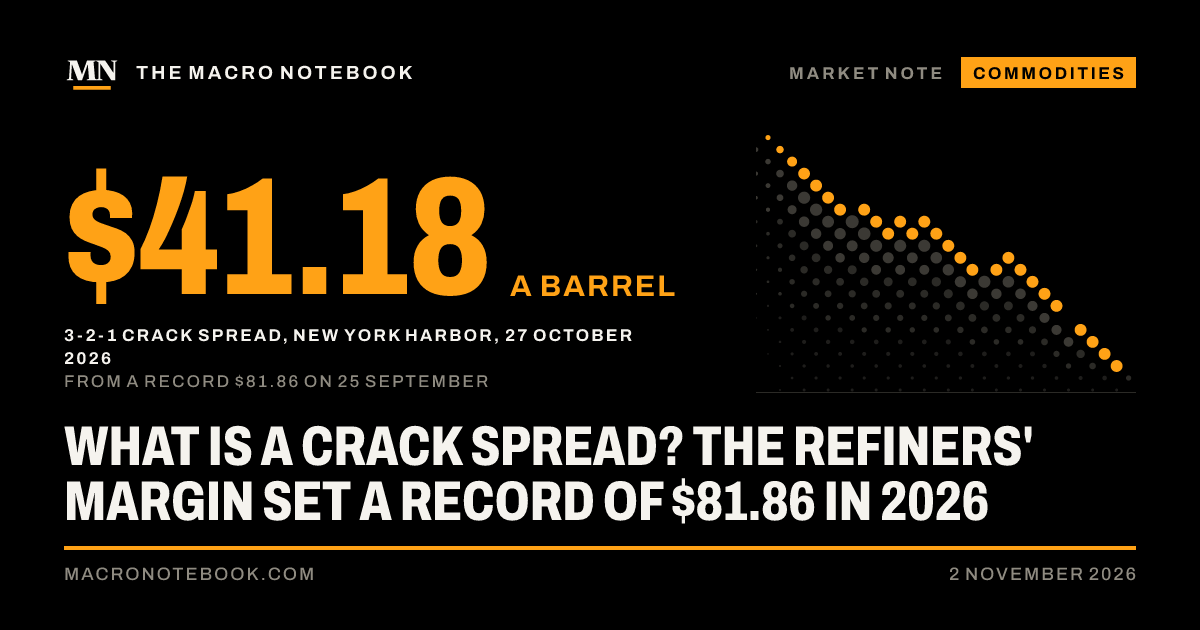
A crack spread is what refiners earn between crude oil and fuel. The 3-2-1 version hit a record $81.86 a barrel in September 2026; by 27 October it had halved.
A crack spread is the gap between the price of crude oil and the price of the fuels a refinery “cracks” out of it, in dollars a barrel. It is the market’s rough measure of what refiners earn before their costs. The most quoted version, the 3-2-1, assumes three barrels of crude make two of petrol and one of diesel. Worked out from New York Harbor spot prices against US crude, it stood at $41.18 a barrel on 27 October 2026, about half the record of $81.86 set on 25 September 2026.
Crude is priced by the barrel and fuels by the gallon, and a barrel holds 42 gallons. So the fuel prices are first turned into barrels. Take 25 September 2026, the day of the record, from the EIA’s spot price tables:
Petrol cost $3.493 a gallon, or $146.71 a barrel. Two barrels: $293.41.
Diesel cost $4.949 a gallon, or $207.86 a barrel.
Together the three barrels of fuel were worth $501.27.
Three barrels of crude at $85.23 cost $255.69.
The difference, $245.58, divided by three barrels, gives $81.86 a barrel.
The same sum works for one fuel at a time. The diesel crack spread is a barrel of diesel less a barrel of crude; the petrol crack spread, also called the gasoline crack, is the same for petrol. Traders also quote crack spreads from futures prices and for other places, such as the US Gulf Coast or Chicago, and other ratios, such as 5-3-2. The levels differ, but they move together. We use the EIA’s spot prices because anyone can check them and they go back two decades.
What is the crack spread today?
The 3-2-1 averaged $53.78 a barrel in October 2026 to the 27th, down from $68.22 in September, the highest monthly average in our series. July, August and September 2026 are the three highest months on record. Before this year, the top month was May 2022, at $62.68, when Russia’s invasion of Ukraine had upended the fuel trade.
The fall in October came from petrol, not diesel. The petrol crack dropped to $15.03 a barrel on 27 October, from $63.56 on 28 August. Petrol margins tend to ease after the summer driving season: from 2010 to 2025 the petrol crack averaged $22.74 in May and $19.45 in October. This year the drop was far larger than usual.
Diesel crack spread: a record in October 2026
Diesel went the other way. The diesel crack spread reached $124.55 a barrel on 8 October 2026, the highest in the series and above the $118.74 of 11 May 2022. It was still $93.48 on 27 October. Its October average, $107.82, was second only to September’s $110.82.
At the pump this shows up as the gap between the two fuels. As we explained on 23 October, diesel costs about $2 a gallon more than petrol in the US, close to the widest on record, and the extra is almost all refining and distribution, not crude.
Crack spread chart: twenty years of the 3-2-1
For most of the 2010s the 3-2-1 sat close to $20 a barrel: its average from 2010 to 2019 was $19.83. It fell to $11.27 in 2020, when lockdowns emptied roads and skies, and jumped to $43.27 in 2022. In 2026 to 27 October it has averaged $50.86, the highest of any year.
3-2-1 crack spread, New York Harbor fuels against WTI, yearly average, $ a barrel
3-2-1 crack spread, New York Harbor fuels against WTI, yearly average, $ a barrel. Source: US Energy Information Administration, daily spot prices of WTI crude, New York Harbor conventional petrol and ultra-low sulphur diesel; our calculation. 2026 to 27 October.
2007
15.66
2009
8.46
2012
31.78
2015
19.83
2019
19.19
2020
11.27
2022
43.27
2024
22.66
2025
23.46
2026, so far
50.86
Source: US Energy Information Administration, daily spot prices of WTI crude, New York Harbor conventional petrol and ultra-low sulphur diesel; our calculation. 2026 to 27 October.The Macro Notebook
Why are crack spreads so high in 2026?
The war in the Middle East cut supply from the world’s biggest exporting region. In March the International Energy Agency said exports of crude and refined products through the Strait of Hormuz were below 10% of their level before the conflict, as it announced the largest stock release in its history. The 3-2-1 averaged $28.78 in February 2026 and $46.65 in March, the first full month of the war.
What does the crack spread mean for refiners and drivers?
For refiners, a wide crack spread usually means fat profits. Shell said in its third-quarter update note of 7 October that its indicative refining margin was $42 a barrel in the third quarter of 2026, up from $24 in the second. Shell’s measure uses its own mix of crudes and products, so it is lower than the New York 3-2-1, but it moved the same way.
A crack spread is not a profit figure, though. It leaves out what a refinery spends on energy, staff, upkeep and transport, and refineries make more than petrol and diesel: jet fuel, heating oil, asphalt and chemicals. It measures the market, not one plant.
For drivers, the crack spread is the part of the pump price that is neither crude nor tax. The EIA splits the price of each gallon every month in its Gasoline and Diesel Fuel Update. In May 2026, refining made up 22% of the price of regular petrol and 25% of the price of diesel. When crack spreads are wide, that share grows, and pump prices can stay high even when crude oil falls.
What to watch
The crack spread moves with the war, the seasons and refinery outages. Three things will set it this winter:
Heating demand. Diesel and heating oil come from the same part of the barrel, so a cold winter keeps the diesel crack high.
Flows through Hormuz. Any lasting reopening would bring Gulf fuel back to the market.
Refinery maintenance. Plants close for repairs in the spring and autumn, which tightens supply for a few weeks.
The EIA publishes its spot prices every weekday, a few days after the trading day.
Disclosure
This is analysis and opinion, not investment advice.
ContactWrite to the Notebook
Something to add?
Spotted an error, or a source this piece should cite? Want your own research linked or featured? Tell us. We read every message.
The lek has not bought so many euros since at least 1995, when Eurostat's records begin. In September 2026 a euro cost 91.85 lek on average, the lowest monthly figure in those records. In 2019 it cost 123.01. Put the other way round, the lek now buys 33.9% more euros than it did in 2019, and 37.7% more dollars.