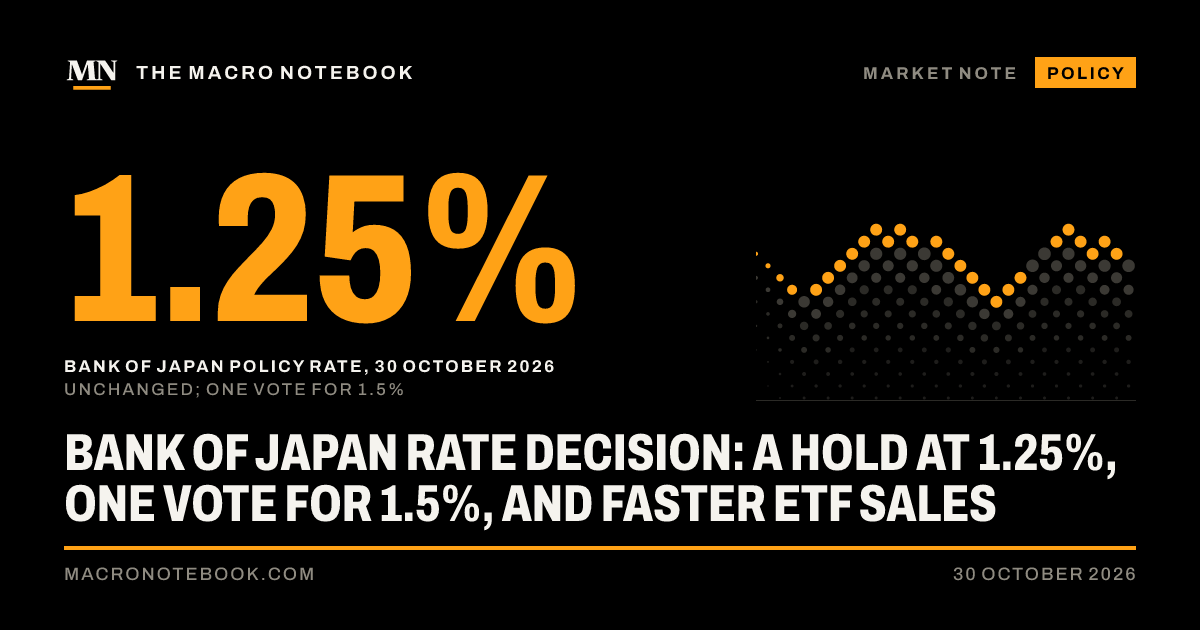
The Bank of Japan left its policy rate at 1.25% on Friday, 30 October 2026, in an 8–1 vote. One board member, Hajime Takata, wanted a rise to 1.5%. The bigger change in the Bank of Japan rate decision was elsewhere: from January 2027 the bank will sell ¥860bn of its exchange-traded funds a year, up from ¥330bn, its statement says.
The hold was expected. The bank raised its rate to 1.25% only on 18 September, from 1.00%.
What the Bank of Japan decided
The board will keep the overnight call rate, the rate at which banks lend to each other for a day, at around 1.25% until its next meeting, which ends on 17 December.
Takata’s dissent sets out the case for moving faster. In the statement’s words, he judged that underlying inflation had reached the 2% target and that the bank “needs to step up the pace” of bringing its rate closer to the neutral rate, the level that neither speeds up nor slows down the economy. He proposed 1.5%, and the other eight members voted him down.
The rest of the board is not far from his view of prices. In its new outlook, the bank says underlying inflation is “generally consistent” with its 2% target and is expected to stay around that level, the Bank’s View for October shows. It also says the risks to its price forecasts are skewed to the upside.
What the bank expects for growth and prices
The forecasts changed little from July. The median board member expects:
- Real GDP growth of 0.7% in fiscal 2026, the year to March 2027, 0.7% in fiscal 2027 and 0.8% in fiscal 2028.
- Core inflation (consumer prices less fresh food) of 2.5% in fiscal 2026, 2.6% in fiscal 2027 and 2.0% in fiscal 2028.
The 2.6% for fiscal 2027 is up from 2.4% in July, which the bank puts down to the rise in crude oil prices since the summer. Its forecasts assume Dubai crude falls from around $105 a barrel to around $70 by the end of the period.
The forecasts leave out one large factor. A temporary cut in the consumption tax on food and drink is before the Diet, Japan’s parliament. If it covers every item in the government’s plan, it would take about 1.3 percentage points off core inflation in fiscal 2027, the bank estimates. That would bring measured inflation well below 2% for a year, even if the underlying trend does not change.
Why the ETF sales matter
The Bank of Japan is one of the largest owners of Japanese shares. It bought exchange-traded funds for more than a decade to support the stock market, and it began selling them in January 2026, slowly, at about ¥330bn a year at book value, the price it paid.
Trading on the Tokyo market has grown since, the bank says, and the sales have gone smoothly. So it will now sell at about 0.1% of the market’s trading value, double the share it aimed for before. That is about ¥860bn a year at book value, or about ¥2,460bn at market value, the bank estimates, since the shares are worth far more than it paid. The new pace starts in January 2027, and the bank can slow or stop the sales if markets turn rough.
The yen and the December meeting
The yen was weak going into the meeting. The dollar bought 158.06 yen on 29 October, our calculation from the ECB’s reference rates shows, up 0.6% in a week. A weak yen raises the price of imported fuel and food, which is one reason the bank sees upside risks to inflation.
Markets still lean towards a rise in December. Before Friday’s decision, futures priced a 58.1% chance of a rise at the 17 December meeting, Central Bank Watch’s figures show, on data to 29 October. The Fed held its rate at 3.75% to 4% on 28 October, so the gap between US and Japanese policy rates is still at least 2.5 percentage points.
What to watch
- The full Outlook Report, Monday 2 November, with the board’s reasoning in detail.
- The Summary of Opinions, Tuesday 10 November, which shows how many members lean towards a rise.
- The Diet’s vote on the consumption tax cut on food, which would lower measured inflation in fiscal 2027.
- The next decision, 17 December, a week after the Fed’s. Futures price a 68.6% chance that the Fed raises its rate on 9 December, Central Bank Watch shows, the path we set out before its October meeting.