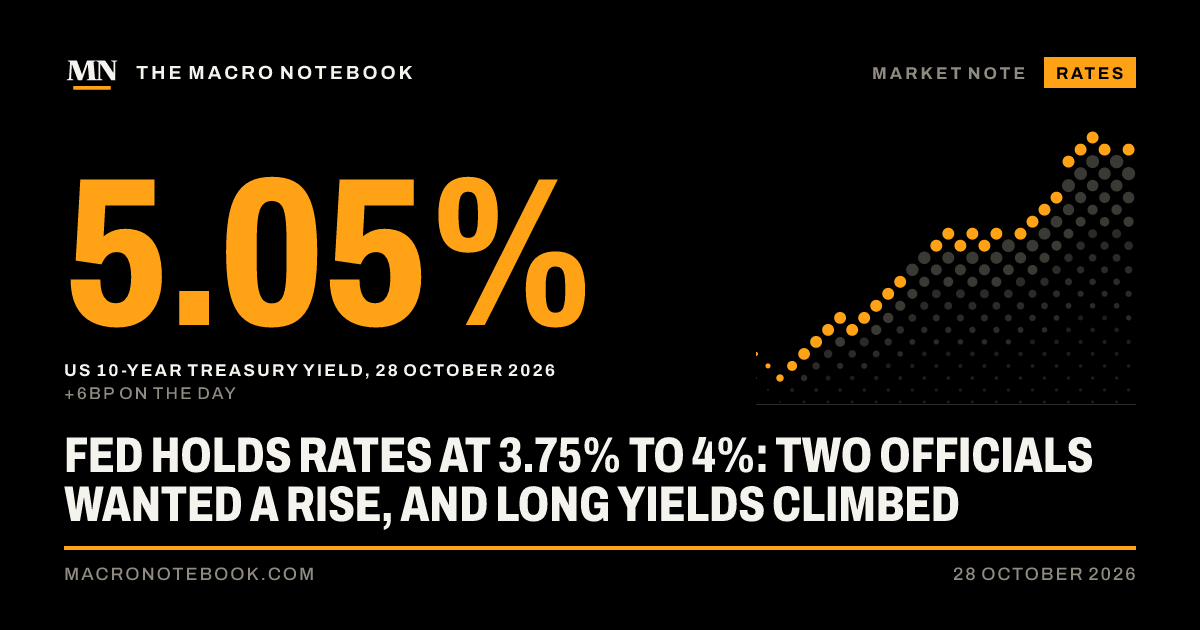
Fed holds rates at 3.75%to 4%: two officials wanteda rise, and long yields climbed
The Fed holds rates at 3.75% to 4% in a 10–2 vote, with two officials for a rise. Warsh gave no date for the next move. The 2-year yield fell; the 10-year rose.
The Fed holds rates, as markets expected, but the vote was split the other way. The Federal Reserve left its target range at 3.75% to 4% on Wednesday by 10 votes to 2, and both dissenters, Governor Lisa Cook and Cleveland Fed President Beth Hammack, wanted a quarter-point rise, the statement shows. In September the Fed raised rates by a unanimous 12 to 0.
Markets had priced a hold at 88%, as we reported this morning, so the decision itself surprised no one. The reaction came in the shape of the yield curve. The 2-year Treasury yield fell 3 basis points to 4.67%, while the 10-year rose 6 to 5.05% and the 30-year 7 to 5.37%, Treasury data show.
The Fed holds rates: what changed in the statement
Most of the text is word for word what the Fed wrote on 16 September. Three changes matter:
Growth was upgraded. Activity is now “expanding at a strong pace”, where in September it was “a solid pace”.
The promise of action went. September’s line, “Today’s policy action will support a timelier return” to 2% inflation, is replaced by “the accumulation of more information will help the Committee determine the policy stance”.
The vote split. It is Cook’s first dissent and Hammack’s second in favour of a rise since July, Yahoo Finance reports.
“Inflation remains elevated” and “The Committee will deliver price stability” both stay.
What Warsh said
Kevin Warsh, chair for five months, spent his opening statement on a strong economy and on prices. He said third-quarter growth was “likely running above 3 percent”, that business investment was rising “at about a double-digit pace”, and that capital spending was at “a historically high share of GDP”, led by high-tech investment. But inflation, he said, has run above the Fed’s goal “for close to 6 years”, and the committee’s discussion “focused mainly on the price stability side”.
On markets, he said financial conditions have tightened since September, but “I’m unwilling and unable to call them tight.” He also announced a change to the calendar: from 2027 one of the eight meetings will discuss strategy only, with no rate vote, and in 2028 two will.
In the questions, Yahoo Finance’s live coverage recorded him saying the “monetary medicine” was “starting to work some, but there’s no firm conclusions”. Six days before the midterm elections, he said: “Politics played no role in the decision.” Asked whether rates matter for the AI investment boom, he answered: “Interest rates get in the cracks.” He did not say when the next rise would come.
How markets read the Fed decision
The odds barely moved. Futures gave about an 85% chance of a quarter-point rise on 9 December, Yahoo Finance reported from CME data during the press conference, about where they stood on Tuesday. Stocks ended a little higher: the S&P 500 rose 0.28% to 7,744.38, gold rose 0.4% to $4,077.99 and the euro gained 0.3% to $1.1155, investingLive’s wrap shows.
The bond market moved more. The gap between the 10-year and 2-year yields widened from 29 basis points to 38. That 9-point steepening is the largest in one day since 29 July, by our calculation from Treasury data.
Change in US Treasury yields on 28 October 2026, basis points
Change in US Treasury yields on 28 October 2026, basis points. Source: US Treasury, daily par yield curve rates, 27 and 28 October 2026
3-month
−4bp
1-year
−3bp
2-year
−3bp
5-year
+3bp
10-year
+6bp
30-year
+7bp
Source: US Treasury, daily par yield curve rates, 27 and 28 October 2026The Macro Notebook
What the curve may be saying
Short yields follow the Fed’s next moves; long yields also carry what investors expect of inflation over a decade, and the extra return they demand for the risk. Our reading: the market took the hold, and the words “more information”, as a Fed in less of a hurry, and asked to be paid more to lend for longer. A falling 2-year and a rising 10-year is what you would expect if investors think a slower Fed leaves inflation higher for longer. It is one day’s move, and the 10-year was higher still, at 5.13%, on 21 October.
Warsh’s own words point to another pressure on long rates: heavy investment, much of it in AI, has to be paid for, and some of it with borrowed money. For how long yields work, see our guide to bond yields.
What to watch
Thursday 29 October: the first estimate of third-quarter GDP, where Warsh expects more than 3%, and September’s PCE prices. The ECB decides the same day.
The minutes of this meeting, in three weeks, will show how many officials leaned towards Cook and Hammack.
9 December: the last meeting of 2026, with new projections. A hot GDP or PCE figure would make a rise then more likely.
Disclosure
This is analysis and opinion, not investment advice.
ContactWrite to the Notebook
Something to add?
Spotted an error, or a source this piece should cite? Want your own research linked or featured? Tell us. We read every message.
The lek has not bought so many euros since at least 1995, when Eurostat's records begin. In September 2026 a euro cost 91.85 lek on average, the lowest monthly figure in those records. In 2019 it cost 123.01. Put the other way round, the lek now buys 33.9% more euros than it did in 2019, and 37.7% more dollars.