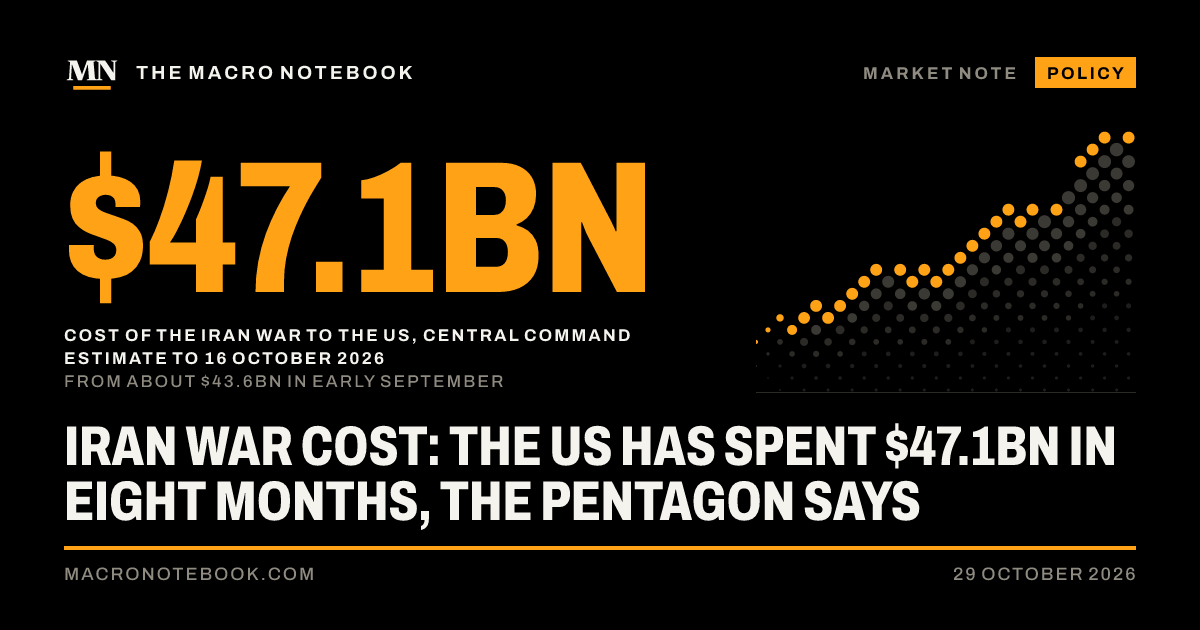
Iran war cost: the US has spent $47.1bnin eight months, the Pentagon says
Iran war cost to US taxpayers: $47.1bn by 16 October, most of it to replace missiles. It excludes damage to bases, and the White House wants $95bn more.
The Iran war cost American taxpayers $47.1bn up to 16 October, according to a new Pentagon estimate given to Congress. The figure, from US Central Command, is $3.5bn higher than in early September, when it stood at about $43.6bn, the Associated Press reported on Wednesday. The war, launched by the United States and Israel in late February, turned eight months old the same day.
The number lands six days before the midterm elections on 3 November, and as President Donald Trump keeps new strikes on Iran open as an option after the vote. Here is what the money paid for, what it leaves out, and how it compares with the rest of the budget.
What the Iran war cost buys
Most of it is ammunition. About $29bn of the $47.1bn is for replacing munitions, the Pentagon’s breakdown shows. The weapons in most demand are defensive interceptors fired by the Army’s Patriot and THAAD systems, and a single Patriot interceptor costs millions of dollars, AP reports.
Iran war cost to the US by type, Central Command estimate to 16 October 2026, $bn
Iran war cost to the US by type, Central Command estimate to 16 October 2026, $bn. Source: US Central Command estimate provided to Congress, reported by the Associated Press, 28 October 2026. The parts are rounded and do not add exactly to the $47.1bn total.
Replacing munitions
29.0
Operations
11.9
Equipment losses
6.0
Source: US Central Command estimate provided to Congress, reported by the Associated Press, 28 October 2026. The parts are rounded and do not add exactly to the $47.1bn total.The Macro Notebook
Operations, the cost of running ships, aircraft and troops in the region: about $11.9bn.
Equipment losses: about $6bn.
By service, the Air Force’s costs are $7.6bn and the Army’s more than $2bn. The Navy’s fell to $1.45bn from $2.2bn in early September; neither the Navy nor Central Command explained the drop.
What the $47.1bn leaves out
The estimate is not the full bill. It does not include damage to US bases in the Middle East. A Pentagon inspector general report released in September said Iranian missiles and drones had damaged or destroyed hundreds of buildings and other structures at bases in Kuwait, Bahrain, Qatar, the United Arab Emirates, Saudi Arabia, Iraq, Oman and Jordan, AP reports.
It also leaves out the human cost, which no budget line captures. The Pentagon’s tally lists 21 service members killed and 865 wounded; 18 of the deaths came from Iranian strikes, combat aircraft crashes or the disposal of Iranian drones.
And it leaves out the wider economy: the oil and fuel prices that every household and business pays. Oil has swung with each turn in Trump’s Iran policy, as we reported on 9 October.
How the Iran war cost compares with the budget
Against the federal budget, $47.1bn is not large. The US ran a deficit of $1,992.5bn in fiscal 2026, the year to 30 September, the Treasury’s final monthly statement shows; the war’s cost to mid-October is about 2.4% of that. We explained what a deficit is in our explainer yesterday.
The Defense Department’s military outlays were $916.8bn in fiscal 2026, against $868.4bn the year before, the same statement shows: a rise of $48.4bn, or 5.6%. The statement does not say how much of that was the war.
The pace of spending has slowed. The first $43.6bn came in a little over six months; the next $3.5bn took about six weeks.
What Congress is being asked for
The bigger numbers are still to come. The White House is asking Congress to approve a $95bn package that would help fund the Iran war and other priorities, AP reports, alongside a proposed military budget of $1.5tn. Democrats have tried to end the war through legislation, which has failed in the Republican-controlled Congress. Trump had first promised Americans a campaign of only a few weeks, and most voters say they want Congress to put ending the war first, according to a recent AP-NORC poll.
The cost could rise again if fighting resumes. A third aircraft carrier and thousands of additional troops are heading to the region, AP reports. Each new round of interceptors fired adds to the largest line of the bill.
Disclosure
This is analysis and opinion, not investment advice.
ContactWrite to the Notebook
Something to add?
Spotted an error, or a source this piece should cite? Want your own research linked or featured? Tell us. We read every message.
The lek has not bought so many euros since at least 1995, when Eurostat's records begin. In September 2026 a euro cost 91.85 lek on average, the lowest monthly figure in those records. In 2019 it cost 123.01. Put the other way round, the lek now buys 33.9% more euros than it did in 2019, and 37.7% more dollars.