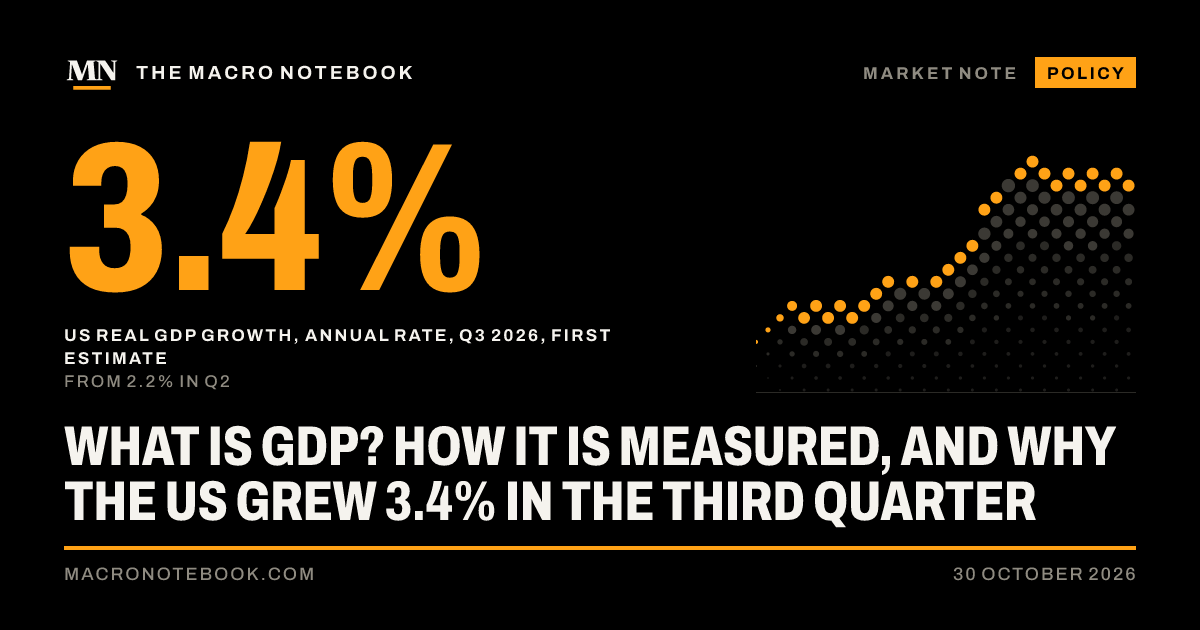
GDP, or gross domestic product, is the value of all the goods and services an economy produces in a given period. It is the broadest measure of how big an economy is and how fast it is growing. In the third quarter of 2026, US GDP grew at an annual rate of 3.4%, up from 2.2% in the second quarter, the Bureau of Economic Analysis said in its first estimate on 29 October 2026.
In money terms, the American economy was producing at a rate of $33.0tn a year in July to September 2026, the BEA’s figures show. Here is what GDP counts, how it is measured, and how to read a growth figure like 3.4%.
What is GDP, in plain words?
Add up the market value of everything produced inside a country’s borders in a year or a quarter: cars and haircuts, software and hospital care, new houses and restaurant meals. Count only final goods and services, the ones sold to their last user, so that nothing is counted twice. The steel in a car is part of the car’s price, so it is not added again.
Three words in the name carry the meaning:
Gross: no allowance is made for machines and buildings wearing out.
Domestic: it counts what is produced inside the country, whoever owns the factory. A Japanese carmaker’s plant in Kentucky adds to US GDP.
Product: it measures output, not wealth. GDP is a flow, like a salary, not a stock, like savings.
How is GDP calculated?
There are three ways to measure it, and in theory they give the same total: what is produced, what is spent on it, and the income it earns. The best known is the spending side:
GDP = consumer spending + investment + government spending + exports − imports
Imports are taken away because they were produced abroad. When an American buys a German car, the purchase shows up in consumer spending, and the import line removes it again.
The third quarter of 2026 shows each part at work. Investment added 3.27 percentage points to growth, consumer spending 2.52 and government 0.90, while net exports took away 3.32, the BEA’s contribution figures show (also for investment, net exports and government). Business spending on computers and other equipment rose, and much of that equipment was imported, so the same purchases raised investment and lowered net exports.
What made up US GDP growth, Q3 2026, percentage points
What made up US GDP growth, Q3 2026, percentage points. Source: US Bureau of Economic Analysis via FRED, first estimate of 29 October 2026. Contributions to real GDP growth at an annual rate; the parts sum to 3.37 before rounding.
Consumer spending
+2.52pt
Investment
+3.27pt
Government
+0.9pt
Net exports
−3.32pt
GDP growth
+3.4pt
Source: US Bureau of Economic Analysis via FRED, first estimate of 29 October 2026. Contributions to real GDP growth at an annual rate; the parts sum to 3.37 before rounding.The Macro Notebook
What is the difference between nominal and real GDP?
Nominal GDP counts output at today’s prices. Real GDP takes out the effect of rising prices, so it shows whether the economy produced more, not just charged more. The two can differ a lot when inflation is high.
In the third quarter of 2026, nominal GDP grew at an annual rate of 5.6% and real GDP at 3.4%, the BEA’s release shows. The gap between them is the rise in prices. Growth figures in the news are almost always real.
Real GDP is measured in the dollars of a base year. On that basis, the BEA puts US output at $24.6tn a year in the third quarter, in 2017 dollars, 2.1% more than a year earlier.
What does 3.4% GDP growth mean?
The US reports each quarter’s growth as an annual rate: the pace the economy would grow at over a full year if the quarter’s change were repeated four times. The rise from the second quarter to the third was 0.8%; at an annual rate that is 3.4%.
It is above the US average of recent decades. Real growth has averaged 3.2% a year at an annual rate since 1947, but only 2.4% in the 2010s, our calculation from the BEA’s quarterly series shows.
US real GDP growth, annual rate, %, the last eight quarters
US real GDP growth, annual rate, %, the last eight quarters. Source: US Bureau of Economic Analysis via FRED (A191RL1Q225SBEA). Q3 2026 is the first estimate of 29 October 2026; earlier quarters as revised.
Q4 2024
2.4
Q1 2025
0.1
Q2 2025
4.0
Q3 2025
3.9
Q4 2025
0.2
Q1 2026
2.5
Q2 2026
2.2
Q3 2026
3.4
Source: US Bureau of Economic Analysis via FRED (A191RL1Q225SBEA). Q3 2026 is the first estimate of 29 October 2026; earlier quarters as revised.The Macro Notebook
A single quarter can mislead. Swings in stockbuilding and trade move the headline from one quarter to the next: in the third quarter, the rise in investment came mainly from private inventories and equipment, the BEA says. Economists often look through those to final sales to private domestic buyers, which grew 4.9%.
The extremes show how far GDP can move. It fell at an annual rate of 28.0% in the second quarter of 2020, when the pandemic closed much of the economy, and rose at 34.9% in the next quarter as it reopened.
How often is GDP released, and does it change?
The BEA publishes three estimates for each quarter, about one, two and three months after it ends, and keeps revising them for years as fuller data arrive. The first estimate of the third quarter of 2026 rests partly on assumptions for September, so the 3.4% may change.
A fall in GDP over two quarters is often called a recession, but in the US the call is made by a committee that looks at jobs and income as well, as we explained on 25 October.
What GDP does not measure
GDP counts market activity. It leaves out unpaid work at home, does not show how income is shared, and counts spending on repairs after a disaster as output. A country’s GDP per person is a rough guide to living standards, not a measure of well-being. It remains the best single gauge of how much an economy produces, and the one that central banks, governments and markets watch most closely.
Disclosure
This is analysis and opinion, not investment advice.
ContactWrite to the Notebook
Something to add?
Spotted an error, or a source this piece should cite? Want your own research linked or featured? Tell us. We read every message.
The lek has not bought so many euros since at least 1995, when Eurostat's records begin. In September 2026 a euro cost 91.85 lek on average, the lowest monthly figure in those records. In 2019 it cost 123.01. Put the other way round, the lek now buys 33.9% more euros than it did in 2019, and 37.7% more dollars.