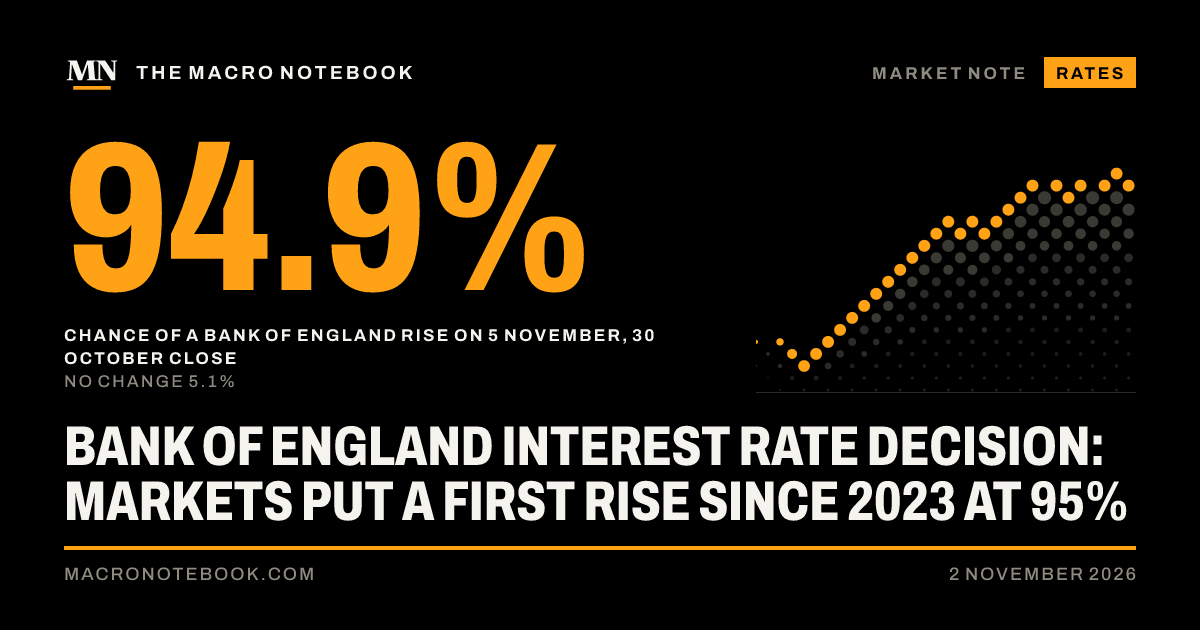
Bank of England interestrate decision: markets puta first rise since 2023 at 95%
Bank of England interest rate decision on Thursday: markets put a rise from 3.75% at 94.9%, the first since 2023, with UK inflation at 3.5% and climbing.
The Bank of England announces its next interest rate decision at noon on Thursday 5 November, and markets expect its first rise in more than three years. Futures prices put the chance of a rise at 94.9% at the close on 30 October, against 5.1% for no change and none for a cut, Central Bank Watch calculates. Bank Rate has stood at 3.75% since December 2025.
A rise would end a run of cuts that began in the summer of 2024. The Bank last raised rates on 3 August 2023, to 5.25%, and then cut six times, the last on 18 December 2025, its rate database shows. What changed is energy: the Bank’s own summaries point to the conflict in the Middle East and the rise in crude and fuel prices since it began.
Bank of England Bank Rate, %
Bank of England Bank Rate, %. Source: Bank of England, Official Bank Rate (IUDBEDR). Each bar is the rate after a change; 3.75% is the rate on 2 November 2026.
Aug 2023
5.25
Aug 2024
5.00
Nov 2024
4.75
Feb 2025
4.50
May 2025
4.25
Aug 2025
4.00
Dec 2025
3.75
Nov 2026, now
3.75
Source: Bank of England, Official Bank Rate (IUDBEDR). Each bar is the rate after a change; 3.75% is the rate on 2 November 2026.The Macro Notebook
Why the Bank of England may raise interest rates
The Bank was already split in September. Its Monetary Policy Committee voted 6–3 to hold at 3.75%, and three members, Megan Greene, Catherine Mann and Huw Pill, voted for a rise to 4%, the minutes show. The committee judged that the risks to inflation were “tilted to the upside”, more so than in July, and said it stood ready to act. Two more votes would make a majority for a rise.
Inflation has risen since. UK consumer prices were 3.5% higher in September than a year earlier, up from 3.1% in August, the Office for National Statistics said. Fuel did most of the work, but the rise is not only about fuel. The core rate, which leaves out energy, food, alcohol and tobacco, rose to 2.8% from 2.6%, and services inflation rose to 3.7% from 3.4%. As we reported on 21 October, petrol reached its highest price since 2022.
What the Budget forecasts changed
The Budget on 28 October came with a gloomier forecast for prices. The Office for Budget Responsibility now expects CPI inflation of 3½% in 2027, against 2% in its March forecast, with a quarterly peak of 3¾% in early 2027, its October outlook says. It expects inflation to return to 2% by 2028, if energy prices fall as markets expect.
The same outlook shows what markets expect of the Bank. The OBR’s forecast assumes Bank Rate reaching just over 4¼% by mid-2027, about three-quarters of a point higher than in March. It sees growth slowing from about 1¼% in 2026 to 1% in 2027.
What markets expect from the Bank of England
Bond markets moved first. The 2-year gilt yield was 4.98% on 28 October, more than a point above Bank Rate, Bank of England data show. On 2 January it was 3.97%. A 2-year yield that far above the policy rate means investors expect rates to rise, and it is why fixed mortgage deals got dearer before the Bank did anything: as we reported on 6 October, five-year fixes reached a three-year high.
The Bank of England is not alone. Central Bank Watch puts the chance of a rise by the Reserve Bank of Australia on 3 November at 75.0%, by the Federal Reserve on 9 December at 72.9%, and by the European Central Bank on 17 December at 76.5%. The Fed held its rate on 28 October, as we reported.
The case for waiting
The jobs market argues for caution. Private sector pay grew 3.0% on a year in the three months to August, below the rate of inflation, and the number of payrolled employees fell by 111,000 in the year to August, the ONS said in October. In September the Bank itself saw little evidence so far that higher energy prices were feeding into pay and other prices, and it expected soft labour market conditions to bring inflation down over time.
That is the question for Thursday. A rise now would aim at second-round effects before they show; a hold would bet that weak hiring does the job. The Bank’s minutes said the risk of such effects grows the longer energy prices stay high.
What to watch on Thursday
The decision, the vote and the minutes come out at 12:00 UK time (13:00 in Tirane), with the November Monetary Policy Report and its new forecasts. Three things will matter:
The vote. How many of the nine members back a rise, and whether any want to hold.
The forecasts. The Bank’s view on how long inflation stays above 3%.
The guidance. Whether it says one rise is enough, or keeps the door open for 17 December, the next meeting.
Disclosure
This is analysis and opinion, not investment advice.
ContactWrite to the Notebook
Something to add?
Spotted an error, or a source this piece should cite? Want your own research linked or featured? Tell us. We read every message.
The lek has not bought so many euros since at least 1995, when Eurostat's records begin. In September 2026 a euro cost 91.85 lek on average, the lowest monthly figure in those records. In 2019 it cost 123.01. Put the other way round, the lek now buys 33.9% more euros than it did in 2019, and 37.7% more dollars.