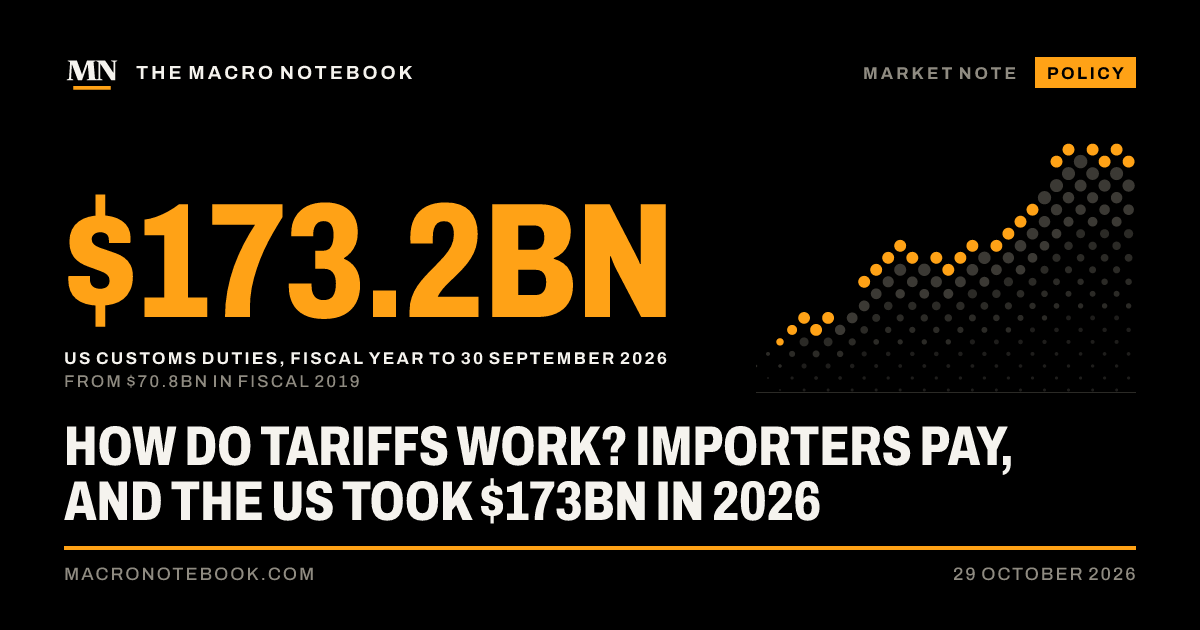
How do tariffs work? A tariff is a tax on imported goods, charged at the border, and the company that imports the goods pays it, not the foreign country that made them. In the fiscal year to September 2026 the US government collected $173.2bn in customs duties, after refunds, against $70.8bn in fiscal 2019, the Treasury’s monthly statements show.
The importer then decides how much of the tax to pass on to its customers, and most of it is passed on. Here is how the money moves, who ends up paying, and what happened when the courts ordered some of it repaid.
What are tariffs for?
Governments use tariffs for three reasons, often at once.
Revenue. Before income tax, customs duties paid for most of what the US federal government did.
Protection. A tariff makes imports dearer, so domestic producers can sell more, or charge more.
Leverage. A tariff, or the threat of one, can be used to win concessions from another country, on trade or on anything else.
The trade-off is the same in each case: the protected producer gains, and the buyers of the goods, companies and households, pay more.
How are tariffs collected?
When goods arrive at a US port, airport or border crossing, the importer of record files an entry with US Customs and Border Protection (CBP). The entry lists what the goods are, where they were made and what they are worth. Each product has a code in the Harmonized Tariff Schedule, and the code sets the rate.
Ad valorem tariffs are a percentage of the declared value: a 10% tariff on a $100 shipment costs the importer $10.
Specific tariffs are a fixed amount per unit, per kilo or per litre.
Extra tariffs, such as those imposed for trade or security reasons, are added on top of the normal rate through special chapters of the schedule.
The importer pays CBP, usually through a customs broker, and the money goes to the Treasury as “customs duties”. It is a tax revenue like any other, and it counts against the deficit like any other.
Who pays tariffs?
The importer pays the bill. The question is who bears the cost in the end, and there are three candidates: the foreign exporter, if it cuts its price to keep the sale; the importer, if it absorbs the tax in lower profits; or the customer, if the importer raises its price.
The evidence from the tariffs of 2025 points mostly at Americans. The tariffs were nearly 90% passed through to US import prices, economists at the Federal Reserve Bank of New York found in a study published on 6 October 2026: foreign exporters “lowered their prices very little”. Import prices rose almost one for one with the tariff in the first month.
From there, the cost reaches shops more slowly. The same study finds that each percentage point of average tariffs raises consumer goods prices by about a quarter of a percent after one year. About two-thirds of that comes from imported goods, and one-third from American-made goods whose makers raise prices when competition from imports gets dearer. A 10% tariff on all imports would, on those estimates, raise consumer goods prices by 2.6% after twelve months. We looked at what that meant for US inflation in our piece on tariffs and inflation.
How much do US tariffs raise?
For most of the past decade, tariffs were a small tax. In fiscal 2019, customs duties were $70.8bn, 2.8% of the $2,547bn of goods the US imported, we calculate from the Treasury’s figures and Census Bureau trade data. That share, an “effective tariff rate”, stayed between 2.4% and 3.1% from fiscal 2019 to fiscal 2024.
US customs duties by fiscal year (October to September), $bn
US customs duties by fiscal year (October to September), $bn. Source: US Treasury, Monthly Treasury Statement, Table 4, net customs receipts. Fiscal 2026 is net of refunds of duties collected under IEEPA.
2019
70.8
2020
68.6
2021
80.0
2022
99.9
2023
80.3
2024
77.0
2025
194.9
2026
173.2
Source: US Treasury, Monthly Treasury Statement, Table 4, net customs receipts. Fiscal 2026 is net of refunds of duties collected under IEEPA.The Macro Notebook
Then the tariffs of 2025 arrived. Monthly duties jumped from $8.2bn in March 2025 to $15.6bn in April and $29.5bn in August. In October 2025 they reached $31.4bn, 12.0% of that month’s goods imports, more than four times the 2019 rate. Fiscal 2025 closed with $194.9bn, almost twice any year from 2019 to 2024.
What happened when the Supreme Court struck tariffs down?
On 20 February 2026 the Supreme Court ruled, by six votes to three, that the International Emergency Economic Powers Act (IEEPA) does not authorise the president to impose tariffs. That law was the basis for the “reciprocal” tariffs on imports from every trading partner and for the drug-trafficking tariffs on Canada, Mexico and China.
Duties already paid under it had to be repaid. Importers claim them back, with interest, through a CBP system called CAPE, which handles refunds in batches rather than entry by entry. The refunds show up in the Treasury’s figures as negative receipts: net customs duties were about zero in May 2026, −$25.6bn in June and −$8.6bn in July. In August, net duties were back at $12.8bn, 3.8% of goods imports.
So fiscal 2026 ended with $173.2bn, still well above any year before 2025. Some companies booked the refunds as profit: Levi Strauss, for one, as we reported on 8 October.
Do refunds reach consumers?
Not directly. The refund goes to the importer of record, the company that paid the duty. A shopper who paid a higher price for a pair of jeans or a toaster gets nothing back unless the company chooses to cut its prices. That is the asymmetry of tariffs: the tax is passed on quickly, and the refund mostly stays with the business.
What to watch
The Treasury publishes customs receipts every month in its Monthly Treasury Statement. Net receipts tell you two things at once: how much new tariffs raise, and how much of the old ones is still being refunded. When refunds finish, the monthly figure will show what the tariffs still in force are worth.
Disclosure
This is analysis and opinion, not investment advice.
ContactWrite to the Notebook
Something to add?
Spotted an error, or a source this piece should cite? Want your own research linked or featured? Tell us. We read every message.
The lek has not bought so many euros since at least 1995, when Eurostat's records begin. In September 2026 a euro cost 91.85 lek on average, the lowest monthly figure in those records. In 2019 it cost 123.01. Put the other way round, the lek now buys 33.9% more euros than it did in 2019, and 37.7% more dollars.