Will the US strike Iran after the midterms? President Donald Trump will not say no. Asked late on Tuesday about strikes after the 3 November elections, Trump said: “I can’t tell you that… but anything’s possible,” Fox News reported. Officials told Fox that forces are being moved in the Middle East to give him options if he decides to resume strikes.
The remark fits a pattern. Three weeks ago Trump promised no attack before the vote. Now the vote is a week away, and what happens after it is open. For markets, that means oil prices that move with every word.
What Trump has said about Iran strikes and the midterms
- 7 October: Trump told reporters his administration was considering renewed strikes on Tehran before the election, CNBC reported. At a rally that night he said a deal with Iran was “not really something that I wanted to do”. Brent crude rose more than 4% the next day, to above $104 a barrel.
- 8 October: “We will not be attacking Iran at any time prior to the Midterm Elections,” he wrote on Truth Social, citing “productive discussions” with Tehran. The US naval blockade of Iran, he said, would stay.
- 27 October: “Anything’s possible,” on strikes after the vote.
The pledge covered only the time before the vote. Reuters reported in September that Trump’s aides wanted to keep the war contained through the midterms while leaving heavier strikes open for afterwards, CNBC noted.
What the military build-up shows
The forces are moving. The Wall Street Journal reported this week that “the U.S. has told several Gulf Arab countries to be prepared for a short, intense military campaign after the U.S. midterm elections”, Fox News reported, citing people familiar with the conversations. A third aircraft carrier and thousands of additional troops are heading to the region, the Associated Press reports.
On the other side, Iran says the US must lift its blockade of Iranian ports before peace talks can begin, while Washington wants concessions on Iran’s nuclear programme, according to Fox News’s summary of the mediation.
The war has already cost the US $47.1bn up to mid-October, on the Pentagon’s estimate; we look at what that money paid for in a separate piece today.
What it means for oil and petrol prices
The war is in the price of every barrel. US crude rose about 3% on Wednesday, then fell 92 cents, or 0.9%, to $101.86 early on Thursday in Asia, Fox News reported, citing Reuters, as traders weighed supply risks against wider market pressures. A day earlier, the Houthis had claimed a strike on Saudi Arabia’s biggest refinery, which Riyadh has not confirmed.
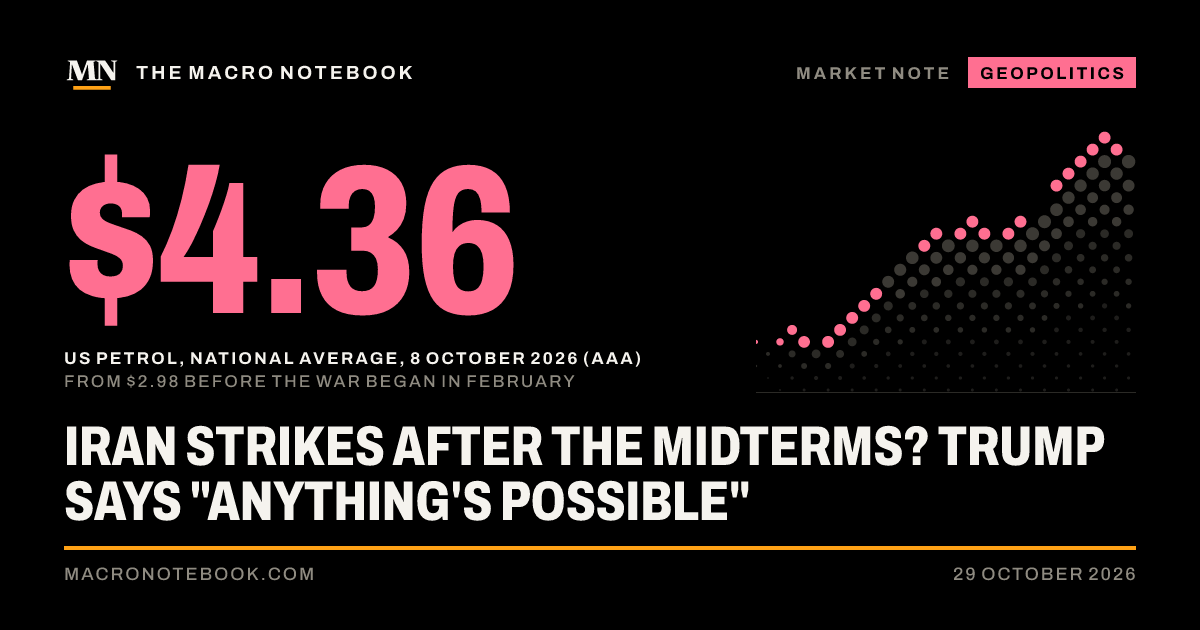
At the pump, American drivers paid $4.36 a gallon on 8 October, against $2.98 just before the war began in late February, CNBC reported, citing AAA. That is why the war’s timing matters so much to the election: the cost of living is among voters’ top concerns. We compared petrol prices under Trump and Biden on 27 October.
What to watch after the vote
- 3 November: the midterm elections decide which party controls Congress for Trump’s last two years in office.
- The carriers. The build-up could put three US carriers in the Middle East, CNBC reported on 8 October: the means for the “short, intense” campaign the Gulf states were told to expect.
- The talks. A deal on the blockade and on Iran’s nuclear programme would take strikes off the table; their failure would put them back.
Oil traders will read each of these the same way: as a change in the odds that Gulf supply is cut again.